

Coaches: Making a Difference
By
Rob Kaminski
MHSAA benchmarks editor
February 8, 2013
“A coach can never make a great player of a youngster who isn't potentially great.
But a coach can make a great competitor of any child.
And miraculously, coaches can make adults out of children.
For a coach, the final score doesn't read so many points for my team; so many points for theirs.
Instead it reads:
So many men and women out of so many boys and girls.
And this is a score that is never published.
And this is a score that coaches read to themselves, and in which they find real joy ...
When the last game is over.”
—Anonymous
The author of this poem prefers to be left anonymous, but there are those in the MHSAA office who know the person behind the words. And, they know the words were genuine, coming from a former long-time high school coach who believed in those values and lived them.
In today’s ever-changing world, one wonders if all coaches would be better off going about their tasks anonymously. In the fall issue of benchmarks, we shined a spotlight on a group whose highest compliment is to go about their business unnoticed: the contest officials.
This series celebrates those who don’t have that luxury. In communities across the country, large and small, rural and urban, everyone seems to know the names of their high school coaches. And, the cost of such infamy comes with heavy taxes these days, levied by societal shifts whereby an increasing number of parents and children perceive playing time, starting roles and connections to big-time colleges as natural-born rights.
Punch “high school coach firings” into Google, and you’ll get close to 13 million results. Upon inspecting a healthy sampling of these stories, some dismissals are due to misconduct – criminal or otherwise – but you’ll find far greater instances involving parental meddling and win-loss records.
More alarming is this: in related topics at the bottom of the first search page, “how to get a high school coach fired” appears. A click on that little gem returns more than 21 million results, including such sub-searches as “how can parents legally fire a high school basketball coach” and “how to get rid of a high school coach.” Might be enough to make a person want to officiate.
Unfairly, the public measure of coaches too often does not go beyond the scoreboard. Sadly, the fates of these educators hinge upon the performance of people not old enough to vote or, in many cases, drive.
And yet, coaching positions continue to be among those most coveted in many communities. What is it about the profession? What drives these individuals? Thankfully, our fields and gyms continue to be filled with leaders who don’t overemphasize wins and losses; who exude fairness and sportsmanship; who simply aim to teach lessons to students the way any math or science teacher would. People who care about your children.
By and large, the reason is because they had the right experiences with the right coaches when they were younger.
“My swim coach (Darin Millar, Royal Oak HS) was a major factor in why I entered education and coaching,” said David Zulkiewski, who is in his 13th year of paying it forward as coach of the boys and girls swim teams at Bloomfield Hills Andover. “I went to a private all boys school (Warren DeLaSalle) and the Christian Brothers provided a great role model for me that aided in my decision to become a teacher/coach. I saw the sacrifices they made and how hard they worked to help students and athletes.”
It’s in the makeup of coaches to dive head first into the profession, which is really a continuous cycle that begins when today’s crop of coaches were in their heyday as athletes.
“Participating in athletics created some of my best high school memories,” said Middleville Thornapple-Kellogg cross country coach Tamara Benjamin. “After college, when I had the chance to begin coaching, I jumped at it. I felt it was an honor and a privilege to coach a high school team, and 25 years later I still feel the same way.”
For still others, the exposure to coaching came even earlier, as they experienced the way of life on a daily basis.
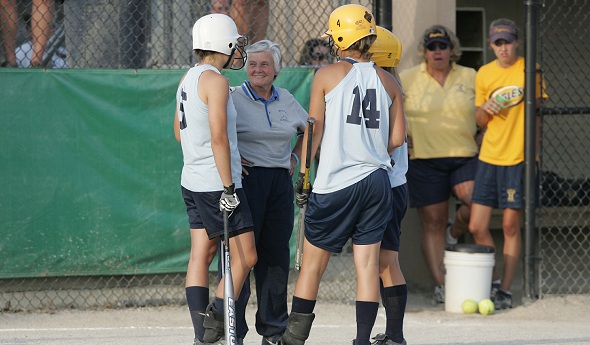
“My father was a high school coach of football and basketball. I was in the gym a lot growing up and it became a goal of mine to become a coach also,” said Diane Laffey, the winningest softball coach in MHSAA history, and No. 5 on the girls basketball list in her 50th year at Warren Regina. “I saw how he cared for his players off the court as well as on and it made me believe that perhaps I could make a difference in an athlete’s life.”
Pressures and challenges
There are, no doubt, many coaches who wish all parents would have been coaches, at least for one day. Perhaps then, there would be a greater understanding of what the job entails on a daily basis, and maybe even some empathy from a group which often causes far more headaches than even the most inexperienced playing roster.
A recent survey of more than 3,000 coaches nationwide identifies parents as the biggest challenge to the daily tasks of today’s athletic mentors (See the story on page 15 of this issue),
The study revealed that nearly 50 percent of the respondents identified over-involved parents as the No. 1 concern, while 80 percent of the subjects perceived that a child’s playing time was the parents’ No. 1 issue with today’s coaches.
“Parents, seem to be more and more demanding of your time and commitment, a street that does not travel both ways,” said Don Kimble, now in his 24th year as the swimming & diving coach at Holland High School.
“The biggest problem with our job is parents,” said Mike Roach, bowling coach at Battle Creek Pennfield. “With the proximity of spectators to athletes in bowling, its hard to get them to understand that as coaches it is our job to coach and their job to cheer. Some have taught their kids and now have a hard time letting the coach do his or her job.”
Part of the issue also stems from the parents’ perception of their kids’ best sports.
 “It seems like many sports are now becoming year-round activities instead of seasonal. I think it’s very important that children play a variety of sports instead of specializing when they are young. I think parents owe it to their child to have them try several sports or activities to find which one their child likes, not the one the parent likes,” said Rockford hockey coach Ed Van Portfliet.
The pressures to specialize can come from other sources, too, often times coming from within the walls of the school. Despite the bad rap parents can get, the majority do have their child’s best interests in mind. In many cases, they respect and listen to a coach’s advice. At times, in fact, coaches are their own worst enemies.
“In many schools I think pressure to specialize comes from the respective coaches. I try to keep a lid on it at Regina – but I know that some of our girls do specialize,” said Laffey, who also is the school’s athletic director. “I encourage them to play more than one sport; and a lot of our athletes do that. I emphasize to our coaches that these girls are high school students and they should be allowed to participate in as many extracurriculars as possible.
“I think the travel club teams and AAU in many sports is hurting high school athletics. Student-athletes are being asked to specialize too early.”
Abby Kanitz, just 28 years old and a neophyte in the coaching business compared to Laffey, has seen too much of it already. As if to prove her stance on multi-sport participation, Kanitz has been the competitive cheer coach at Thornapple-Kellogg for six years, and recently added track and field duties to her resume’.
“There should be no specialization,” said Kanitz. “A student-athlete who has the opportunity to be an athlete in college will not lose that opportunity by participating in other sports. I think the pressure comes from coaches, sadly. Parents – if the coach is respected – listen to coaches and take the opinion and feedback to heart. If we are encouraging our athletes to experience more than one sport in high school, chances are their parents will, too.”
That type of pressure, real or perceived, can lead to the athletes puttting restrictions on themselves.
“In the past things were simpler. There weren’t as many demands on our athletes. There weren’t as many options and distractions,” said Gary Ellis, boys tennis coach and athletic director at Allegan. “There was less specialization – if you could, you went from one sport to the next and enjoyed the one you were playing at the time.”
Dave Emeott, 18-year boys track & field coach, and 7-year cross country coach at East Kentwood, agrees.
“When I was in high school I participated in four sports my senior year,” he said. “These days the three-sport athlete is as rare as a popular referee. I completely understand the shift to specialization and being competitive, but I sure had a lot of fun with all my teammates and would not trade it for any improved performances.”
The increase in perceived importance of community-based sports has also led to heightened tunnel-vision when it comes to an athletes and their parents choosing his or her path.
In the worst-case scenarios, the youth programs are headed by non-school coaches who lack accredited training and do not share the same educational philosophies of the school coaches. Parents also susceptible to heeding the advice of these coaches, and the results can be disastrous.
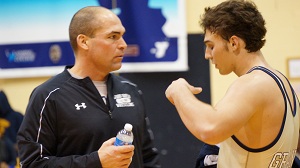
“I believe as school coaches we need to be more involved in youth sports; we understand our programs and how to develop young people,” said James Richardson, wrestling coach of 22 years at Grand Haven High School. “Parent volunteers in our youth programs are extremely important, but most are not educators. The parents need to be educated and made aware of our expectations as much as our student-athletes.”
At such an impressionable time in their lives, athletes in the youth sports realm learn from everyone in the setting, from teammates to coaches to spectators. Not all of the lessons are positive.
“Ultimately we want all athletes to become good citizens and athletics is an excellent avenue for this. If you have ever spent a few minutes in the bleachers at a youth sporting event, you will soon realize we have a long way to go,” said Emeott. “If the fans of these events are who our young athletes are learning citizenship and proper behavior from, then we need to consider spending more of our practice time at all levels teaching citizenship to our athletes, and maybe even to our parents.”
To remedy these situations, greater ties are needed between the school system and community youth programs.
“We need more adult volunteers to help coach and teach our youth in a positive manner,” said Cathy Mutter, competitive cheer coach at Munising for the past 21 years. “We have many opportunities in Munising for students to participate in a variety of sports and activities. The programs are very valuable to the youth of our community. It keeps them active and involved in organized activities. They learn the rules and regulations of the sports they are participating in and the value of teamwork.”
Emeott adds, “I think, at a minimum, each organization should have an extensive parent code of conduct. A parent code of conduct could help educate the parents of our future athletes.”
Mike Van Antwerp, in his ninth year at the helm of the boys lacrosse program at Holt also coaches youth soccer while running a couple summer lacrosse leagues, and can see room for improvement.
“Youth sports should foster teamwork, fun, work ethic, thinking and processing skills as well as respect for the game,” Van Antwerp said. “In many environments it is working, but it depends on the program and the coaches. The focus has to be on teaching the game, not winning the game.”
In some case, it’s becoming increasingly expensive to play the games. The pay-to-play phenomenon is a pothole that most of today’s coaches didn’t have to dodge when they were in high school. Some districts apply a blanket fee to participate in all sports, while others are sport-by-sport, in some cases making the student chose one sport over another.
“We ended pay to play about six years ago, thankfully,” said Ellis. “When we had it, numbers dropped significantly. Those who were tennis players, played. The drop was in those who wanted to ‘try it,’ so it limited the number of new players.”
The use of participation fees to help fund interscholastic athletics in Michigan high schools has doubled during the last nine years, although the percentage of schools assessing them has held steady over the last two, according to surveys taken by the MHSAA.
The most recently completed survey indicates that of 514 member schools responding, 260 schools – 50.5 percent – charged participation fees during the 2011-12 school year.
Yet, in speaking with those directly affected, it’s simply part of the job; almost an afterthought. Simply add another fund raiser in some shape or form.
“We have fundraisers, and I wish we didn’t. They take so much time and effort,” said Jim Niebling, who has organized his share in 23 years as Portland’s boys tennis coach and 18 as the girls mentor. “Our most successful fund raisers have been charity poker events, and ushering at MSU’s Breslin Center.”
Several schools sponsor the typical pop can fund raisers, while Richardson tosses in a couple new wrinkles with mulch sales and a pig roast to help fatten the coffers for his program.
At Portland, the fee is $125 per student, per school year, and in some ways, Niebling thinks it might even be a positive influence.
“The amount is low enough and it’s for a whole year,” Niebling said. “So if anything, it may have even increased participation in some activities so parents could feel that they ‘got their money’s worth.’”
In the cases of newer MHSAA sports such as bowling and lacrosse, generating funds is just a carryover from the days when the schools sponsored club sports.
“We have always been self-funded and it is a challenge to raise money in-season, so we try to do it out of season,” said Kimberly Vincent, Grand Haven girls lacrosse coach for six years. “I work with kids to help them reduce their costs; earn money on the side and with used equipment.”
Fellow lacrosse coach Van Antwerp notes that the annual cost to participate in his sport is nearly $400, but he’s seen no marked decrease in roster size.
Athletics is no different than other sectors of society; not all team rosters offer the same demographic makeup. As such, some sports have been hit a little harder in recent years.
“My husband and I are proprietors and we helped to get high school bowling off the ground when our son was in high school,” said Marshall boys and girls bowling coach Sue Hutchings. “The school charges $50 pay-to-participate. Our bowling program charges $65. It has impacted us more this year due to financial problems in our district. We always work through the situation on a case-by-case basis.”
For others, geographic location can put hardships on students and the budget that other schools can’t fathom.
“There are eight competitive cheer teams in the entire Upper Peninsula. We have to travel almost every weekend at least six hours one way to a meet/competition,” Mutter said. “The time the athletes spend out of school and on the road is challenging physically and academically. The cost adds up as well. With school budget cuts and families struggling to make ends meet, it is a huge burden at times.”
Mutter works as the school nurse for the Munising district, so in that regard, she does have some advantages over many leaders in her sport, which has a fair share of non-faculty coaches. By nature, those who are employed within a school district enjoy some inherent benefits compared to non-faculty personnel.
“The biggest issue is practice times,” said Brenda McDonald, Grand Rapids Kenowa Hills/ Grandville gymnastics coach for 14 years. “I cannot go right after school like many other sports and sometimes that is hard on the girls with homework and other areas.”
Peter Militzer is the boys and girls tennis coach at Portage Central, for 21 and 18 years, respectively. By day, he’s the tennis director at the YMCA of Greater Kalamazoo. By nature, he is partial to tennis, but still champions the cause for multi-sport participation.
“Coaches and parents need to stop pushing kids into one exclusive sport,” Militzer said. “Our athletic director (Jim Murray) pounds the ‘well-rounded athlete’ idea into our heads at every staff meeting. During the off-season I don’t personally work with tennis players or apply pressure on them to only play tennis. I don’t think sport specialization is necessary for athletic success.”
He’d like to be around his players more, but only for familiarity purposes, a yearning many non-faculty coaches share.
“Not having access to players and their info during the day is the greatest challenge I face not being in the building,” Militzer said. “I am fortunate to work with a great athletic director and his assistant, and they keep me in the loop.”
Being kept in the loop is one of the primary challenges facing non-faculty coaches, who often times are well apprised of contest rules, but might not be as familiar with MHSAA regulations.
Brian Telzerow, a youth ministry professor at Kuyper College who coaches boys golf at Forest Hills Northern and girls golf at Forest Hills Eastern, makes a concerted effort to work closely with the schools, saying, “I have to be very intentional in communication with and from the school.”
Grand Haven’s Vincent, a marketing communications professional, echoes the sentiment.
“We are not in the loop of communications, network and friendships. Our kids miss out on some opportunities because of it,” Vincent said. “For instance, the use of special equipment, facilities, and other benefits available to other teams with coaches who are at the school. We have to go onsite to pick up our mail, it is not forwarded to us.”
The gap can at times cause lapses in important communication from the MHSAA for those least familiar with some of the Association’s regulations. Most coaches have preseason meetings for players where rules and regulations are discussed, but it is important that all the right messages are being relayed to team members and parents.
“From the outsider’s perspective I would imagine the MHSAA’s greatest challenge is to empower athletic directors with the knowledge to make the correct decisions for our athletes and coaches,” Emeott said. “The MHSAA can only be as good as the individual school districts.”
Kimble, who is Holland Aquatic Center’s supervisor of competitive swimming in addition to his high school coaching duties, adds that school support can be an issue in certain sports as well.
“Communication as well as off-site involvement of the non-swimming community within the school can create challenges,” Kimble said. “Since our pool is also not part of the campus, not many students and/or faculty attend swim meets, or have even been to the pool.”
Plentiful rewards
Yet, for all the pitfalls and hurdles, coaches are at peace with who they are; and they know that there are others who would take their jobs in a heartbeat. That’s what keeps them in it the most. It’s feelings like this:
- “I coach life more than I coach golf. We teach every day of our lives by the way we live and what we say. Teaching is more of a lifestyle than a job. It is truly a privilege to walk with students through some of their most formative years.” – Telzerow
- “Working with so many high school girls and seeing them succeed in life is probably the most rewarding thing to me. To see many of them go into the coaching field makes me feel that I have done some things right to make them want to coach.” – Laffey
- “I think the most rewarding moments are when we witness real change in a young adult. As coaches, we have a view like no other. We watch a gangly, immature freshman walk into the gym, and a grown adult walk out.” – Emeott
- “Coaching is helpful in teaching as every person on your team has a role, and understanding the differences of young people and what they can contribute to your program makes coaches find ways to incorporate these same methods into the classroom.” – Richardson
- “I have made lasting friendships with coaches and judges from all over the state. I have attended many weddings and baby showers for former athletes.” – Mutter
- “Teaching and coaching are one in the same. The goal in both situations is to help the student develop as an individual; to develop good life skills and attitudes. Athletics provides opportunities that do not exist in the classroom: developing leadership skills and teamwork.” – Ellis
- “It goes beyond just winning games. It’s seeing the growth and development of the young men I’ve coached. It’s seeing them overcome difficulties to reach goals. It’s seeing the academic successes and the accomplishments after they leave our program.” – Van Portfliet
- “On a more personal level, I’ve been able to witness the positive impact the sport has had on many kids, whether it’s them working extremely hard to make a contribution to the team, or their success creating new options for them in terms of school.” – Van Antwerp
- “The most rewarding moments are the small things: an athlete new to the sport suddenly ‘getting it;’ a parent in tears because their child is so happy at what he or she is doing; an athlete who says. ‘Thanks for being a good coach.’” – Hutchings
- “Athletics is second to school. When you teach and coach, you truly understand the reason. It’s not about being eligible, it’s about teaching your athletes proper priorities – school comes first.” – Kanitz
- “The most rewarding moments are when former players stay in touch with you. Next most rewarding is when I see a former player who tells me they still enjoy playing tennis. I’ve coached team state champions, and individual state champions, but those brief moments don’t compare.” – Militzer
- “I’ve been to hundreds of grad parties, weddings, family gatherings, baptisms, etc. I feel honored that these kids and young adults take the time to include me in their lives. Notes and letters I continue to receive from past athletes are very humbling.”– Benjamin
This story is not about strategies, Xs and Os, or gameplans. All of these coaches are fierce competitors who are driven to win. But they are fueled by something deeper.
“I played tennis for Harley Pierce Sr. He was eventually named to the high school football and tennis coaches halls of fame, plus he was named the national tennis coach of the year in the early 1980s,” said Niebling. “I didn’t appreciate him then as much as I did a few years later when I became a teacher/coach. Only after being out of high school and then coaching myself did I realize what in influence he had on me.”
As alluded to in the poem to open this story, that is the real score.
PHOTOS: (Top) Warren Regina coach Diane Laffey, speaking with her players, is the winningest coach in MHSAA softball history and also among the winningest for girls basketball. (Middle) Grand Haven wrestling coach James Richardson, speaking with one of his athletes, has led that program for 22 years.

Click for Hot Weather and Hydration Resources
July 24, 2012
The extreme temperatures this Summer in advance of the start of another season of high school sports give cause for concern about physical activity in such conditions, and the Michigan High School Athletic Association continues its role in providing its member schools educational information to assist them in minimizing the possibility of heat-related catastrophic injuries to student-athletes.
The topic of heat-related injuries receives a lot of attention at this time of year, especially when deaths at the professional, collegiate and interscholastic levels of sport occur, and especially since they are preventable in most cases with the proper precautions. In football, data from the National Federation of State High School Associations shows that 35 high school players have died from heat stroke between 1995 and 2010.
Each year, the MHSAA provides information to its member schools to help them prepare for hot weather practice and game conditions in the late Summer and early Fall. Football practice can begin at MHSAA member schools on August 6, followed by all other Fall sports on August 8.
Even before the days of the Internet, the MHSAA was providing resources each Spring to assist schools in their preparation for hot preseason practices. That same information is now available online for all interested parties to utilize, including a link to a free online course, A Guide to Heat Acclimatization and Heat Illness Prevention, produced by the National Federation of State High School Associations. The Health & Safety Resources page of the MHSAA Website has a set of Frequently Asked Questions about dehydration and a page dedicated to hydration and heat illness where preventative steps are outlined, as well as the signs and symptoms of heat illness and action steps to take when it is observed.
Visit MHSAA.com, click on Schools, and then on Health & Safety Resources to find the information.
“Heat stroke is almost always preventable,” said John E. “Jack” Roberts, executive director of the MHSAA. “We know now more than we ever have about when the risk is high and who is most at risk, and we’re fortunate to be able to communicate that information better than ever before to administrators, coaches, athletes and parents. We encourage everyone to avail themselves of the information on our website and through other sources, and to take the online course through the National Federation.”
Roberts added that the first days of formal practices in hot weather should be more for heat acclimatization than the conditioning of athletes, and that practices in such conditions need planning to become longer and more strenuous over a gradual progression of time.
“Then, schools need to be vigilant about providing water during practices, making sure that youngsters are partaking of water and educating their teams about the need for good hydration practices away from the practice and competition fields,” Roberts said.