

Concussion Testing Pilots Kick Off Fall
August 4, 2015
By Geoff Kimmerly
Second Half editor
The Michigan High School Athletic Association kicked off the 2015-16 school year Monday by hosting 70 member high schools for training in two pilot sideline concussion testing programs aimed at assisting in decision-making regarding the removal of athletes from activity after possible concussion events and record-keeping of those events beginning this fall.
Illinois-based King-Devick Test and Maryland-based XLNTbrain Sport each will be used to monitor approximately 10,000 Michigan high school student-athletes drawn from schools representing all four classes and a variety of regions statewide.
The pilot programs are part of a three-pronged advance by the MHSAA in concussion care this fall. In addition to becoming the first state association to offer pilot sideline concussion testing, the MHSAA will be the first to mandate record-keeping by member schools of all possible concussion events from detection to an athlete’s return to play. The requirement applies to both practices and events, all levels of all sports in grades 7 through 12.
The MHSAA also this fall is the first state association to provide all participants at every MHSAA member high school and junior high/middle school with insurance intended to pay accident medical expense benefits – covering deductibles and co-pays left unpaid by other policies – resulting from concussions sustained during MHSAA practices or competitions. There is no cost to either schools or families.
“These pilot programs are intended to not only improve what’s actually happening on the sidelines at practices and contests in these communities that are part of the pilot programs, they’re intended to spread the word of the need for improved concussion detection across every community,” MHSAA Executive Director John E. “Jack” Roberts said. “We hope these schools involved will become involved in their leagues and conferences and with their peers across the state as we expand the awareness of the need for better sideline detection and provide ways to get it done.”
The MHSAA asked schools at the end of this spring to volunteer for the pilot programs and then selected participants in order to guarantee a variety of schools based on enrollment and location. Schools are committed to involving at least two sports for each gender each season.
Schools participating in the XLNTbrain Sport pilot program are: Adrian, Adrian Madison, AuGres-Sims, Bay City Central, Bear Lake, Brethren, Belding, Birmingham Groves, Brighton, Chesaning, Corunna, Detroit Collegiate Prep, East Kentwood, Fennville, Fowlerville, Gibraltar Carlson, Grand Rapids Christian, Grandville, Greenville, Grosse Ile, Hamilton, Harrison Township L’Anse Creuse, Hazel Park, Kalamazoo Christian, Lansing Christian, Macomb L’Anse Creuse North, Owosso, Pewamo-Westphalia, Portland, Reese, Rochester Hills Lutheran Northwest, St. Clair Shores Lakeview, St. Johns, Stanton Central Montcalm, Vermontville Maple Valley, West Bloomfield and Wyoming Kelloggsville.
Schools participating in the King-Devick Test pilot are: Bay City Western, Benton Harbor, Buchanan, Calumet, Caro, Caseville, Detroit Cody, Detroit Martin Luther King, Fenton, Flint Kearsley, Frankenmuth, Fruitport, Garden City, Grand Ledge, Grand Rapids Northview, Lake Leelanau St. Mary, Lake Linden-Hubbell, Lincoln Alcona, Midland Bullock Creek, Montague, Muskegon, Niles, Pontiac Notre Dame Prep, Romeo, Saginaw Heritage, Scottville Mason County Central, Shelby, St. Charles, St. Joseph, Tawas, Vicksburg, Whitehall and Yale.
The King-Devick Test is a rapid eye movement screening evaluation that requires athletes to read single-digit numbers displayed on a tablet computer in order to detect impairments of eye movement, attention, language, concentration and other symptoms of abnormal brain function. The test has been validated in more than 50 recent peer reviewed articles published in elite medical journals and is associated with the Mayo Clinic.
The test is administered on the sidelines during evaluations for suspected head injuries, and the post-injury results are then compared to an athlete’s preseason baseline. Any worsening of performance (increased time and/or errors) suggests a concussion has occurred and the athlete should be “removed from play” for further evaluation.
“The first and most critical step in managing concussion in the youth athlete is to recognize when one has occurred – not always a simple task,” said Dr. David Dodick, professor of neurology and director of sports concussion services at the Mayo Clinic. “The King-Devick test helps take the guesswork and subjectivity out of the sideline evaluation in a rapid, accurate, and objective way.”
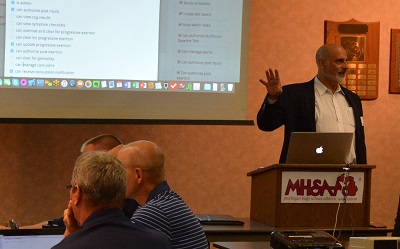 XLNTbrain Sport includes balance and web-based neuro-cognitive tests also used before the start of a season to create a baseline measurement of reaction time, attention, inhibition, impulsivity, memory, information processing efficiency and executive function. The test also assesses mood, anxiety, stress and emotionality.
After a possible head injury, a sideline assessment is done using a smartphone or tablet with those results then compared with the athlete’s baseline measurements. The program documents the severity of a concussion, provides a guide for on-the-field decision making regarding treatment and recovery time and can report results via email to parents, coaches, training staff and medical professionals.
Dr. Harry Kerasidis, who designed the XLNTbrain Sport software, presented at the Coalition for Concussion Treatment Summit at the United Nations building in 2014.
“We included an objective balance test that relies on smartphone accelerometer technology which is effective in the field during practice and game situations,” Kerasidis said. “Should a concussion injury be suspected, the system automatically generates a notification to parents and medical professionals and creates a recovery protocol and post-injury tracking so the right people can monitor the athlete’s progress. Then, the system assists medical professionals with the all-important return-to-learn and return-to-play clearance.”
Click for information on XLNTbrain Sport. Click for information on the King-Devick Test.
For more on Health & Safety, including preseason physical examination, hydration and cardiovascular resources in addition to concussion information and online training sessions, visit the MHSAA’s redesigned Health & Safety web page.
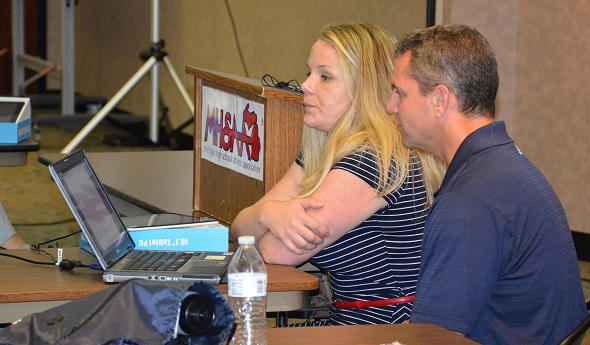
PHOTOS: (Top) Saginaw Heritage athletic director Peter Ryan (right) is administered the King-Devick baseline test by K-D's Samantha Figueroa. (Middle) XLNTbrain Sport creater Dr. Harry Kerasidis provides insight on his program to those being trained to use it Monday.
1st Day of Practice Begins Final Run for Father & Son Ostipow at Forest Hills Northern
By
Geoff Kimmerly
MHSAA.com senior editor
August 12, 2026
GRAND RAPIDS – For one obvious reason, no player on the Forest Hills Northern football team has received more wake-up calls from the head coach over his lifetime than Owen Ostipow.
But the one he and a handful of his teammates received about 4 p.m. Monday may prove memorable – especially if it ends up setting the tone for a successful fall.
The first practice of this season was set to begin at 3:45 p.m. That’s when Ostipow and others arrived, thinking they were early. That not being the case, and a few conversations over the confusion later, the Huskies headed to the goal line where varsity head coach Eddie Ostipow – Owen’s dad – opened what was to be his final first day of practice, at least for a while, by sending his team through push-ups and sprints as a reminder to sharpen up immediately for the work to come.
“Definitely a wake-up call for some of us to just get in line and get order. A lot of the guys were a little late today, me included,” Owen Ostipow said. “Absolutely deserved.”
Most likely, that brief bumpy start will end up as little more than a sidenote as Coach/Dad and his senior all-state candidate son/quarterback ride together through one more season, Owen before heading off to play at Ferris State and Eddie on the way to retiring after 27 years as a head coach in the West Michigan and Greater Lansing areas.
A total of 602 varsity football teams were scheduled to begin practices Monday, as were teams playing every fall sport at every MHSAA member school.
At Forest Hills Northern, that meant the beginning of the end of a recent era.
Eddie Ostipow will be retiring as head coach after this fall and from teaching later this school year, providing more time to watch his oldest son Evan’s football games at Hope College and next season Owen’s as he has committed to sign with the two-time reigning Division II national champion Bulldogs.
 Of course, Owen nor Evan nor younger siter Auden were even on the radar when Eddie began his varsity coaching career at Charlotte as a 24-year-old in 1999 and led the Orioles to a combined 47-17 record over six seasons and the Division 3 Semifinals in 2004. He left after that season to coach three at East Kentwood, then returned to Charlotte for five more seasons before taking over at Ada Forest Hills Eastern and building the Hawks toward an 11-2 record and Division 4 Semifinal run in 2015 that remains that program’s most successful finish.
Ostipow moved on to coach Greenville from 2016-18, then took over at Forest Hills Northern in 2019. He enters this fall with a combined record of 116-112 while frequently matching up at his various stops with statewide powers like DeWitt early on, later Rockford and Muskegon, then Grand Rapids West Catholic and these days Muskegon, Mona Shores and Byron Center all during Ottawa-Kent Conference Green play.
On Monday, about 70 players took to FHN’s stadium turf to get things underway, including 45 varsity players. The Huskies are coming off two straight 4-5 finishes, last year after losing 14 players to injuries – including nearly half of those for the season – during the first half on opening night.
But they also return an all-region quarterback in Owen Ostipow, who ran for 1,435 yards and 22 touchdowns last season and threw for eight more scores. And that’s a great way to start anew.
“We’ve got an opportunity. We have a chance to surprise some people,” Eddie Ostipow said. “I like being the underdog sometimes too, so I think that makes it exciting. If you can get your kids to buy into that, I think that’s something that can be really powerful.
“My thing as a coach, I always try to have a perspective of what’s possible for us and then push them like crazy to get there. If we can get every ounce of effort and intensity and focus out of them, then I think we’ve had a great year.”
Of course, as life roles change, perspectives can evolve as well. Ostipow has gone from teaching and coaching kids who were less than a decade younger to turning 52 years old with Evan graduated, Owen on the way and Auden heading into her sophomore year.
 His football staff at FHN is a collection of coaches who were part of the program before him and others who were with him at some of his other stops. None go back to his days at Charlotte, but athletic director can – he was an all-state receiver for the Orioles under Ostipow before graduating in 2005. Sherman then played at Northern Michigan, came home to coach with Ostipow at Charlotte and again at Forest Hills Eastern, and he inherited his old coach in taking over at FHN in 2024.
“Coaching, he lives it, probably a bit more than he should. But that’s the hobby,” Sherman said. “His passion, he’s always working on something – he always has some nuance or change, something new he’s trying to learn.
“I joke sometimes, when you have kids sometimes you soften up a little bit, but he’s not soft. We’re going to have expectations (this season), we’re going to have all those things. But as you go through it, and then you become a parent, you sometimes see that lens a little different.”
As a now-veteran coach as well, Ostipow has had opportunities to cheer on former players who have gone on to major accomplishments.
In January, his former quarterback Trinidad Chambliss nearly took Ole Miss past Miami at the Fiesta Bowl, just missing out on a chance to play in the College Football Playoff title game. On the opposite sideline celebrating that 31-27 Hurricanes win was Jack Clark, a member of the Miami staff who starred for Ostipow at Forest Hills Eastern and owns a national championship ring after serving on Michigan’s staff during its 2024 run. Another 2005 Charlotte graduate, Chad Richardson, has a Super Bowl ring from serving as director of game presentation for the Los Angeles Rams during their 2022 surge, and he’s now with the Buffalo Bills in the same capacity as they prepare to open a new stadium. Matt Packowski was a junior on that 2004 Orioles team and now is a Division I college football referee.
There surely will be more to come, and Ostipow did not sound Monday like a coach on his way out. But he’ll do his best to be fan for a while and cheer on the Huskies who came through his household as well before possibly making a return to the sideline when their playing days are done.
“I feel like it’s kinda special. Most people don’t get to get coached by their dad, and I think it’s a little more extra special because I remember when my brother was a senior, and I started on varsity as a sophomore, that was the first time I’d seen (my dad) cry,” Owen Ostipow said. “It was just kinda heartbreaking. You watch (your kids) grow, and then they’re just gone.
“Now it’s going to be me. Maybe we’ll see that again from him, but you never know.”
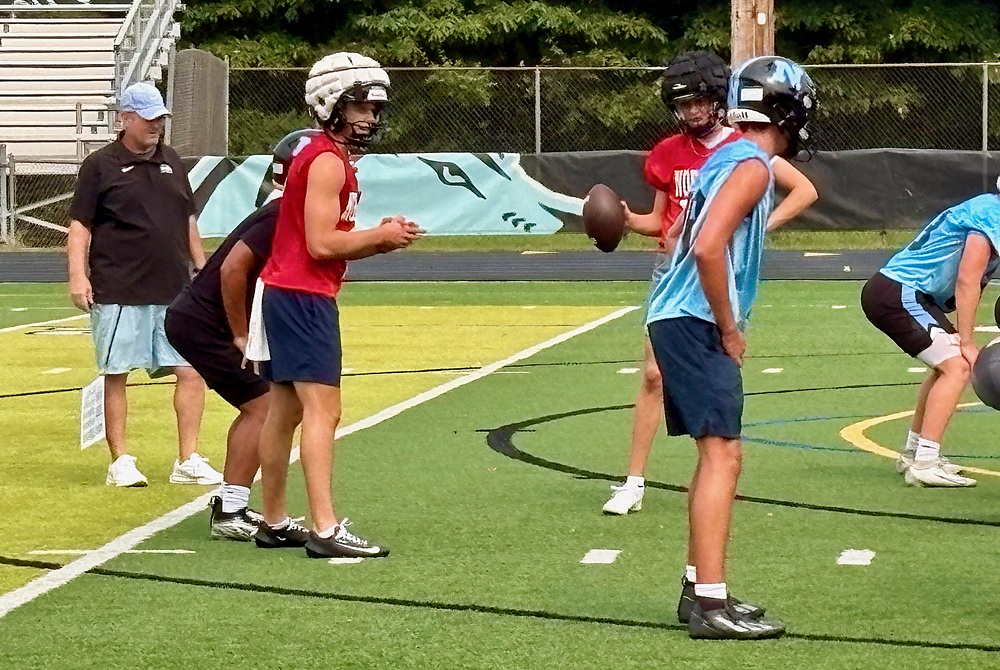
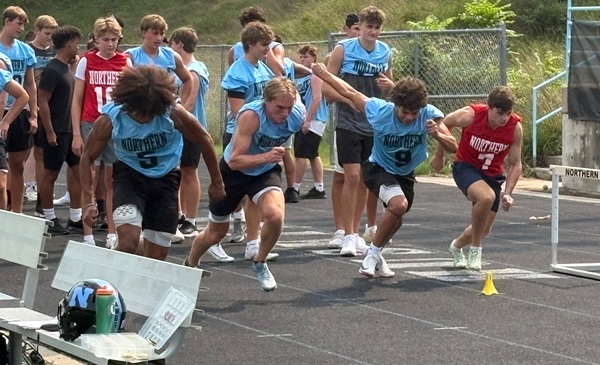
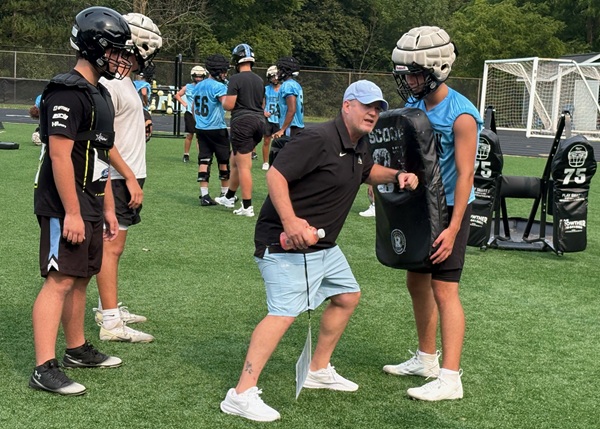
PHOTOS (Top) Forest Hills Northern coach Eddie Ostipow, far left, watches his senior son Owen (white helmet cap) run the offense during Monday’s first practice of the season. (Middle) Owen Ostipow, far right, runs sprints on the track with his teammates. (Below) Eddie Ostipow works with the Huskies linemen.