


Connecting with Coaches
January 28, 2014
In the coming weeks, the MHSAA will meet with the leadership of the high school coaches associations of our state. We have been doing this for more than 25 years, with two primary purposes.
First, we want to provide a forum for these leaders to share with one another their new ideas and initiatives and to discover “best practices” from one another, hoping that this will lead to the better plans being implemented in multiple organizations.
Our second purpose is to present some of the MHSAA initiatives or rules changes that are applicable to all or most sports. It’s not a time when we talk about the baseball pitching rule or the football playoff point system, but a time when we discuss topics of more universal application.
This year those topics included new requirements for coaches education, new rules for athletic-related transfers and proposed rules changes for international students, a simplified scrimmage rule for all sports, and a modified penalty for participation in certain all-star events.
It is intended that these coaches association leaders will be enabled to take these topics to their respective boards and members in order to increase understanding of proposed changes and to facilitate feedback to the MHSAA Representative Council and staff.
A Day in the Life of High School Sports
November 29, 2011
A pile of shoes clutters a doorway. A man teaches algebra to 9th-graders who have the weekend on their minds. A woman screenprints another T-shirt in her basement. A man brooms dead flies from a countertop.
Riverting scenes, for sure.
Yet, people around Michigan pay $5 for these, and other activities on a routine basis, weekend after weekend, during the school year without knowing it. Until now.
Join us for a day (or two) in the life of high school sports.
Introducing the cast
Carly Joseph’s cross country race doesn’t begin in the starting box. Eric Hartley’s whistle to signal the opening kickoff doesn’t begin his day. Vicky Groat doesn’t start coaching her volleyball team with the first serve. And Leroy Hackley’s daily duties do not begin by turning the key to the football stadium gate.
These are moments the spectators wait for; why they pay admission. But, the events are just the end product – and a miniscule part – of a daily intersection of paths, people and preparation played out in scenes like these throughout every community in the state on any given day.
Vicky Groat
Athletic Director
Varsity Volleyball Coach
Battle Creek St. Philip HS/
St. Joseph Middle School
Vicky recently finished her 14th season as the Tigers’ volleyball coach and is in her fourth year as athletic director for both the high school and middle school. She’s a 1985 graduate of St. Philip, and played volleyball for her mother, Sheila Guerra, who coached the Tigers to nine MHSAA titles. Like Guerra, Groat is a member of the MIVCA Hall of Fame, and has coached six MHSAA?Class D championship teams. She played volleyball and basketball at Kellogg Community College before finishing her studies at Central Michigan.
Eric Hartley
MHSAA Football Official
Math Department Head,
Lansing Everett HS
Eric is a 1980 Lansing Everett grad who earned teaching degrees at Western Michigan University and Michigan State University and began teaching math at Everett in 1986. He has been the math department head for 12 years and teaches four classes with one planning period. After a brief foray into coaching, Eric became a registered football and basketball official in 1990, and worked MHSAA?Football Finals in 1994, 1998 and 2002.
Leroy Hackley
Athletic Director
Jenison HS
Leroy is in his seventh year as athletic director at Jenison, following five years in the same position at Byron Center HS. He heads a department which sponsors 23 sports. In a school of 1,475 students, 45 percent participate in at least one sport. Leroy also was an MHSAA?registered official for 27 years, and still officiates collegiate basketball.
Carly Joseph
Junior, Class of 2013
Pontiac Notre Dame Prep
Carly is three-sport athlete at Notre Dame Prep and a member of the MHSAA?Student Advisory Council. She runs cross country and pitched on last spring’s District-winning softball team. Her third sport is unique in the high school setting. Carly started the school’s competitive school snowboarding team, and spends the winter competing against other high school students in boarder cross. Carly is also involved in NDP’s Varsity Club and the NHS.
It begins at sunrise ...
6:45 a.m.
Eric Hartley is in his classroom at Everett High School early today. The end of the first marking period is near, and he needs to post grades and prepare for upcoming parent conferences prior to first period Senior Math class at 7:40. Today’s lesson: “Linear Combinations.”
The previous night was spent the same way this evening will be; on a football field armed with a whistle and flag.
“We were at Dansville,” Hartley says. “Rained a bit, but nothing too bad. It was decent football, and only one game, as opposed to the two we might get on other Thursdays.”
Another game looms on the horizon a half-day away. But first, there is a day’s worth of classes to teach, as the bell sounds for first hour.
7:50 a.m.
Leroy Hackley settles into his office at Jenison, coordinating calendars with Assistant AD Todd Graham and Secretary Moni Marlink. Today’s activities include a subvarsity football doubleheader and a swimming & diving meet, while MHSAA Division 4 Tennis Finals and a water polo tournament during the weekend add additional responsibilities to the routine calendar of events.
“I realize how good we have it here,” Hackley says. “I’ve got a full-time assistant and full-time secretary, and we all complement one another so well. Todd’s a taskmaster who loves to handle the paperwork, Moni is on top of tasks like rosters, game programs, certificates and eligibility and I can focus on schedules, contracts and parents.”
8:00 a.m.
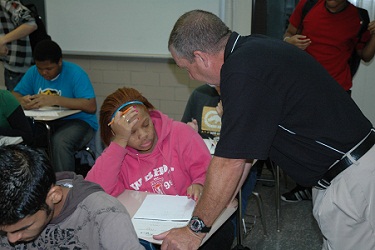
Senior Math students at Everett are checking their first grades of the fall and working on graphs while Hartley makes the rounds assisting students and answering questions.
He began first hour the same way he would start each of his classes that day, encouraging students’ parents to attend teacher conferences the following week. Extra credit would be awarded to students whose parents made it to the conference. Aware that athletic events and an area-wide high school “Battle of the Bands” could create conflicts on conference night, Hartley requests phone calls or emails from parents who plan to attend such approved school-related endeavors in lieu of the conferences.
“Today, we try to do everything possible to keep parents involved and informed on student progress,” Hartley explained. “And, when there are other school activities going on and they are supporting their kids at those events, we should recognize that too.”
Of course, not every scenario can be anticipated in today’s ever-shrinking world. At the end of the period, Hartley is approached by a foreign exchange student who indicates his sponsor family is away in Cuba. And so, before 8:30 a.m., Hartley’s officiating skills click in and he makes a quick ruling, citing the same “rule book” reference that will afford the others credit via an email or phone call.
8:15 a.m.
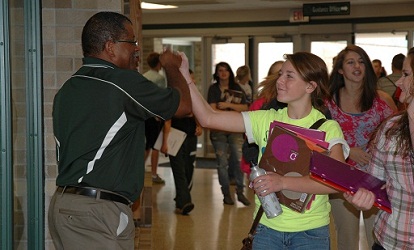
It’s between classes at Jenison High School, and Hackley rushes from his desk to a prime spot in the hallway between the administrative and athletic offices where the pedestrian flow is swift and plentiful. Once there, he delivers his first high-five of the day, but it’ll be far from his last. Hackley might lead the state in high-fives, and is unabashedly the Wildcats’ biggest cheerleader.
“I like to come out between classes and ‘press the flesh,’” Hackley says, beaming.
And the assault begins.
“How’s that knee going?”
“Gonna cheer on our guys tonight, right?”
“Nice job last night!”
The last stragglers make it to the next class, and it’s time to take a visitor on a tour of the facility which, by the way, would be the envy of many a small college.
The tour begins with a stop at the girls swimming & diving donut table, a regular fixture in the corner of a hallway on this day of the week, with proceeds going to the swim team. After a brief stop in the gym and accidental participation in a “speedball” game, it’s off to the football and soccer fields, then a check on the tennis courts, 16 of them with bleacher seating. It’s little wonder the MHSAA?Finals have made the school a regular destination.
9:40 a.m.
Second period trigonometry – complete with some elements of the Pythagorean Theorem mixed in with today’s free-space trig session – comes and goes, and for the first time Hartley begins to think about the night’s football assignment at Fowlerville.
As the crew’s referee, he typically sends emails to his crew and the host athletic director each Sunday confirming arrival time, gametime, travel plans and facility availability.
As gameday closes in, he admits there is a different feel to the day in the classroom, although many of the elements are applicable inside and outside the walls.
“Classroom management, discipline and dealing with kids correlates directly to game management, enforcement of penalties and dealing with coaches,” Hartley said. “It’s managing students and working with administrators both in class and on the field. Like the games, some classes involve mostly teaching and run smoothly. Others require more management, control, discipline and then, ‘Oh yeah, I have to fit in some teaching too.’”
As the wind whips outside, and rain pelts the classroom windows, he wonders if it might not be a better day for basketball.
With the game hours off, but the next class just minutes away, he tunes his laptop to 70s music on Sirius/XM radio and gets the next lesson ready on his Smartboard. A neighboring teacher comes in to borrow pencils; there might not be a need for chalk anymore, but pencils have not been replaced.
9:50 a.m.
Having answered and cleared his email to start the day, Hackley returns from his rounds to find 24 more emails. Most are routinely answered. One will take some coordination with the choir teacher.
“We have a conflict with a choir performance and the last football game of the year,” he says. “We have some cheerleaders who also are in choir, so we need to arrange to have them cheer half the game and get them back for the performance.”
That’s not the only juggling act of the day. Superintendent Tom TenBrink calls shortly before 10 a.m. to discuss impending O-K Conference divisional realignments, not an easy process when 51 schools are involved.
“We are in the Red with Hudsonville, Rockford and East Kentwood and have asked to be relieved from the Red,” Hackley said. “We are one of the smallest schools by far. Travel might be further in other divisions, but we need to be where the enrollments and competition are more equitable.”
It’s not as simple as a vote of ADs. The ADs have advisory votes, the principals have votes to approve plans, then it goes to school boards.
Once again, Hackley is appreciative of his footing at Jenison.
“We – superintendent, principal and I – talk all the time and we are all in the loop. The communication is a real plus for me being an advocate for our kids, because I know it’s not like that at a lot of places,” Hackley said.
10:40 a.m.
Hartley is accustomed to throwing a lanyard around his neck during his avocation of officiating, but he puts one on early today for fourth-hour trig. One of the students in this class has a hearing disability and sometimes is accompanied with a signer for assistance. Today, the student brings a small amplifier for Hartley to wear during the class.
“That’s the first time I’ve been given that to wear,” he said. “Sometimes the student doesn’t have the assistant there either. It depends on the complexity of the classes that day.”
Across the state at Jenison, Marlink has printed programs for the evening’s football and swimming events, and is on her way to Subway to order food for the weekend’s tennis and water polo tournaments. En route, she’ll stop at the football field to drop off a supply of pop before returning to the office.
Graham is preparing money boxes for the ticket gates, when Hackley prepares an email to alert students and staff of special parking procedures and bus routes affected by the MHSAA?Tennis Finals.
Junior high cross country coach and high school teacher Karina White stops by and says, “Thanks for the help yesterday.”
Hackley explains that the high school had no activities so he went to help administer the junior high meet. One gets the feeling this is routine.
11:25 a.m.
Hackley takes a brief moment to look up the Culpepper (Virginia) Football Association online, where he tracks the early football careers of his 3rd, 4th and 5th-grade nephews. The phone cuts his research short, however, as a caller asks where to find MHSAA?Tennis Finals seedings and results for the coming weekend. This is an easy one for Hackley, as he’s the one who will be sending files to the MHSAA during the event.
Noon
Lunchtime is more like crunchtime back in Lansing for Hartley, who has the whole process timed to the minute, as if the play clock were running down on a quarterback.
“Got about 27 minutes by the time all is said and done,” he says on a brisk trip to McDonald's. The meal is ordered to-go, and eaten back in the classroom just before the bell for his final class of the day.
Hackley, meanwhile, has a bit more time and heads to Grand Rapids-area Italian favorite Vitale’s for some dine-in pizza, where an altogether different situation unfolds on the big-screen TVs.
An attempted bank robbery in small-town Ravenna dominates the local channels and the conversation. The ensuing chase and chain of events has closed down a portion of I-96 near Walker, prompting a phone call to Hackley’s son, Mitch. Mitch is a freshman at Muskegon Community College, who comes home to assist on the chain crew at home football games, and I-96 is the quickest route. In this case, Mitch will be traveling East, the opposite direction of the blockade, but Hackley calls nonetheless to advise his son.
12:55 p.m.
While Hackley has recently completed another round of high fives in the Jenison hallway, challenging a football player to test the limits of his scoreboard, Hartley has his own challenge in front of him. He needs to bring out his game management officiating skills a bit early to take control of his Algebra 1 class, made up mostly of freshmen who can smell the weekend.
“One teacher talking, 35 students learning right now. People talking now will be asking questions later, which I will not answer,” he warns, and the chatter subsides through the end of the period.
Perhaps it was a bit of foreshadowing, as it won’t be the last time he’ll need to address behavior on this day.
1:30 p.m.
As if on cue from Hackley’s earlier comments regarding communication up and down the administrative chain of command, Superintendent TenBrink drops by the office to deliver updated news on the O-K realignment.
Moments later, Mitch arrives from Muskegon and gets some last-minute instruction from Dad prior to his work at the stadium.
Hartley’s teaching duties have been completed for another week, but he’ll stay in the classroom a bit longer to tend to his first marking period grades, just as he had done at the beginning of the day.
2:00 p.m.
Hackley goes through a checklist, surfs for a weather forecast, gets a printed itinerary from Marlink for the weekend, then grabs the money boxes and programs and heads toward the field.
On the way, the door to the music room is open and a female student vocalist is performing a stirring solo number. Hackley pauses to watch through its conclusion and applauds. The students and instructor turn to acknowledge Jenison’s No. 1 fan.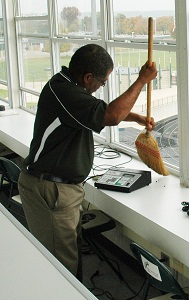
After unlocking the bathrooms and getting the money to the concessions booth, Hackley sets up the officials room, chats with the athletic trainer, and then heads up to the press box where unwanted guests had been seeking refuge from the coming colder weather.
Flies – maybe a hundred – lay dead on the countertops, while a few buzz slowly against the windows certain to meet the same fate. Unfazed, Hackley simply grabs a broom and says, “I’m glad I came out a little early,” then sweeps them up and leaves the windows open a bit just in case the few living pests want to try their luck back outside.
2:45 p.m.
Carly Joseph, a junior at Pontiac Notre Dame Prep, exhales at the sound of the final school bell and utters, “I’m exhausted.” It’s been a long academic week with a course load that includes three AP and two honors classes.
But, Joseph also runs cross country, and this week has already featured a meet on Tuesday and more than 40 miles run during practice. Another practice is on the horizon, one last tune-up for a huge invitational scheduled for Carly and her teammates the next day.
In Lansing, it’s time for Hartley to guide his own “students,” as he heads home for a couple hours before meeting his crew for the trip to Fowlerville. At home, he will make sure sons Trevor and Austin get their homework done.
“I push them to get it done on Fridays after school, because on Saturdays and Sundays they officiate youth football with me, so their time is limited,” Hartley says.
4:00 p.m.
Joseph’s Notre Dame Prep team is headed to Holly High School’s cross country invitational Saturday morning, but first, it gets in one last practice. An easy four-mile run followed by eight progressive strides down the football field marks the shortest practice of the year.
It’s a good time for the short workout, because Joseph and her teammates have dinner plans in Clarkston. The team heads to Carly’s house for a pasta dinner prepared by her parents.
5:00 p.m.
Vicky Groat sends her Battle Creek St. Philip volleyball team home following a two-hour practice, its final preparation for Saturday’s 34th Battle Creek All-City Tournament. Groat has set her players free for the night. They have a curfew of 10 p.m., and although she calls on occasion to keep them honest, she won’t this time. There are other preparations for the next day’s tournament that will keep her busy into the evening, as we’ll see later.
At a parking lot in Okemos, Hartley’s crew gathers for a short ride to Fowlerville, which has a conference battle with Haslett. At this point, there is more talk of the weather than the game, as 30 mile-per-hour winds, rain, and temperatures in the 30s promise to make things uncomfortable.
6:15 p.m.
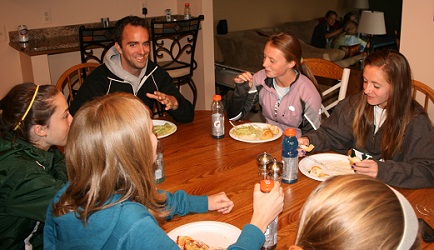
Eighty shoes are piled high just inside the front door of the Joseph house, as 40 Notre Dame Prep runners and coaches gather for the meal. Kids have seized every room in the house, and as one would expect, there’s rarely a quiet moment. Mrs. Joseph serves platefuls of penne, lasagna, salad, rolls and a brownie (or two). Clearly, it is a scene that would dispel the myth that distance runners don’t eat.
In Fowlerville, Hartley and his crew walk from the locker room to the playing field which, remarkably, is in great shape for the amount of rain it’s taken on. The crowd is sparse for Senior Night, as the officials meet with each coach and then conduct the coin toss.
8:00 p.m.
In a modified game of Twister, dozens of people search Shoe Mountain as two-by-two the shoes clear the Joseph house. Suddenly, all is quiet. The Joseph family does some quick cleanup – including vacuuming brownie crumbs out of the carpet – and is able to relax.
At nearly the same time one county over, the mood is anything but serene. It’s time for serious game management as temperatures on the field are beginning to heat up the atmosphere. The Fowlerville-Haslett football game is getting chippy after each play, and Hartley quells the extracurriculars by calling both coaches to the field to discuss matters in the middle of the second quarter. The impromptu summit works, as kids get back to football as it’s meant to be played.
9:00 p.m.
Lights are out for Joseph, with tomorrow’s race in Holly one of the biggest of the year.
The lights are on, however, in Groat’s basement. She wants her team to look good for the All-City Tournament, but she’s not reviewing opponents’ tendencies or diagramming offensive sets. At the moment, she is screen-printing shirts in her basement. St. Philip will debut new red jerseys Saturday. Oh, by the way, Groat also is in her fourth year as the school’s athletic director.
9:49 p.m.
Hartley and Co. head out of Fowlerville High School – roughly 15 hours after his day began – through an empty hallway to an empty parking lot. Haslett pulled away in the second half for a 40-21 win, and another week was in the books for this crew.
The next two days are ones which Hartley relishes, the opportunity to pass along his passion for officiating while mentoring his sons.
Hackley also is calling it a day in Jenison, but the night’s sleep will be fast with the MHSAA Tennis Finals and the water polo invite the next day. The “to-do” list Marlink prepared for him during the day has Saturday’s first item slated for 7 a.m.
11:30 p.m.
Right about now, Groat is probably thankful she’s not coaching a football team, as she completes the last of her team’s shirts. At this point, Saturday is only 30 minutes away.
5:31 a.m.
The alarm goes off in Joseph’s room – it’s race day. After a breakfast of maple brown sugar granola cereal, whole wheat toast and orange juice, she heads to the school for a 7 a.m. bus departure. “I’m our seventh runner, but one of our team strengths is our depth. I have to keep pushing those ahead of me to help the team succeed,” Joseph explains.
7:00 a.m.
While Joseph and her teammates board the bus bound for Holly, tennis courts at Jenison will begin to come to life shortly. Before they do, Hackley (left) is off to Ida’s Bakery to pick up a dozen cinnamon rolls and danishes, followed by a stop at Subway to grab 15 box lunches for tournament officials at the MHSAA?Tennis Finals.
Since it’s Saturday, Hackley and Graham arrive early to pick up trash, replace bags, and open the restrooms. “Saves on maintenance overtime,” he says.
7:45 a.m.
The Notre Dame Prep cross country team arrives at Springfield Oaks County Park, and a long line of busses greet them at the gate. After a short wait, the team de-boards, finds the perfect camp spot and sets up three canopy tents for all the varsity and JV runners. Once their spot is staked out, the varsity girls head out for a warm-up run.
8:05 a.m.
Groat arrives at Pennfield High School, followed over the next 10 minutes by her players. Some of the team’s tournaments mean waking up at 5:45 a.m. for a 7 a.m. departure. This invitational, close to home, has afforded everyone another hour of sleep. Groat is plenty familiar with the All-City. At the end of this day she’ll leave with her sixth championship as St. Philip’s coach. And she was a senior on the 1985 team that won the school’s first All-City title under Groat’s mother, Sheila Guerra.
8:55 a.m.
Joseph and her teammates report to the starting chute, perform some last-minute stride-outs, take off layers of clothing, and grab attention with their unique team cheer. “Everyone always stares at us as we do the cheer, but it helps loosen us up right before the race begins,” Joseph said.
They’re lined up three-deep in the starting box, and at 9 a.m. sharp, the gun sounds and 113 runners take off.
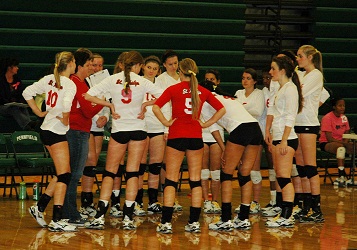
About 100 miles southwest, Groat and the Tigers are ready for the first match of the day vs. Harper Creek. Following warm-ups, the team gathers in a circle for a pre-match prayer – the same one they’ve said before matches for five years. Some girls were in charge of bringing hair ribbon for the team, others had other tasks. Senior Megan Lassen was to find an inspirational quote, and before the huddle breaks she reads it off her hand to her teammates. The match starts at 9:03.
To the northwest, the courts at Jenison again become a hub of activity, as teams vie for the MHSAA?Division 4 title.
9:18 a.m.
In Holly, Rachele Schulist of Zeeland West (the reigning MHSAA Division 2 Cross Country champion) crosses the finish line first, with Notre Dame Prep’s Sara Barron in second. Joseph finishes in 22:41 (sixth on her team) as the Irish run their best team race of the year.
9:37 a.m.
St. Philip finishes the first match of pool play with a 25-12, 25-17 win over Harper Creek. It’s a good sign for a few reasons – Harper Creek is a solid program coming off a District title in 2010, and Groat has to run a home football game kicking off in nine hours. It’s “Parents Night” for the football players, and she’s banking on volleyball being done by 4 p.m. in case she needs to make a pick-up at the florist on the way to setting up.
10:26 a.m.
After beating Pennfield, 25-18, to open the second round of pool play, the Tigers fall in the second game, 26-24. This is a rarity – despite playing a number of much larger schools throughout the fall, St. Philip began the tourney with a 37-3-1 record. Groat doesn’t say much to her players afterward – by design. She expects them to prepare themselves without her giving an additional push. Sometimes it’s hard to not jump in, but she can tell after this split it isn’t necessary.
“By the looks on their faces, they knew they weren’t ready to go,” Groat said. “In Game 2 we didn’t play very well, and Pennfield had the intensity there. Our girls knew they didn’t come ready to play. I didn’t have to say it.”
11:30 a.m.
Teams congregate in the pavilion area for the awards ceremony at Springfield Oaks. Pontiac NDP hasn’t won a trophy in a few years, but fortunes have changed today and 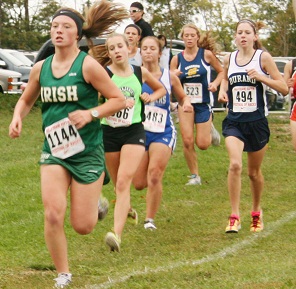 the girls are excited to accept the fourth-place team trophy.
“I can’t wait to show (NDP Athletic Director) Ms. Wroubel. We’ll find a place for it in the trophy case,” Joseph said.
With the great finish today, it’s hard not to talk about making the MHSAA Finals in November.
11:48 a.m.
The Tigers get a bye and then lunch break back-to-back. So after nearly an hour-and-a-half they begin warming up for their third pool play match, against Battle Creek Central. During the bye, St. Philip players kept score or served as line judges for other matches, while Groat talked with parents and watched a little bit of Lakeview – the Tigers’ eventual championship match opponent.
12:15 p.m.
Joseph returns to Clarkston for some homework and rest, but her sporting weekend is far from over. She’ll head to Roseville the next day for three games with her travel softball team, including two where she’ll be on the mound. And then she’ll cap off the weekend with a 12-mile run, get ready for school on Monday and repeat the cycle.
1:36 p.m.
St. Philip has swept Central and Lakeview to finish pool play, and changes into the new red jerseys Groat finished the night before. Next up is a semifinal match against Harper Creek – which the Tigers win in two games. They’ve bounced back while maintaining the cool demeanor of their coach.
“We always just take deep breaths, because if we get riled by anything, we get nervous,” St. Philip junior Amanda McKinzie said. “She’s usually pretty calm about it, which is always helpful. She probably has to hold back pretty hard, because if we start losing, it’s kind stressful.” 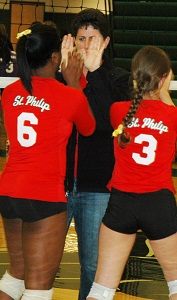
2:27 p.m.
The final begins. By 3:07 p.m., the Tigers have won 25-22 and 25-5 to clinch their fourth-straight All-City title. The Pennfield split might have been a blessing in disguise.
“Sometimes a loss is good for a program. It kind of woke us up,” Groat said. “It can’t happen Oct. 31 (when Districts begin).”
3:24 p.m.
Groat leaves Pennfield for St. Philip to prepare the public address announcements for the football game and pick up flowers, the money box, water and checks for the officials who will work that night. Earlier in the day she’d secured someone to take tickets – her niece, also a former volleyball player – and by 5:45 she’s on her way to Battle Creek Central’s C.W. Post Stadium, less than half a mile from St. Philip and the home field for the Tigers.
3:37 p.m.
The MHSAA receives Hackley’s final email of the weekend after he’s entered data for the Division 4 Tennis Finals. Hackley comments on the great finish that came down to the last match, as Ann Arbor Greenhills claimed the title by one point over runners-up Lansing Catholic and Kalamazoo Christian. The bus routes can go back to normal at Jenison once again on Monday.
9:20 p.m.
Groat’s athletic director duties are done for the night. She picks up a pizza and gets home to Marshall by 10 p.m. It was a busy day, but despite being tired she needs time to wind down before going to sleep at midnight.
Sunday
The day of rest finally is here. For Hackley and Hartley, it means a 9 a.m. meeting at the MHSAA office in East Lansing, where the two attend a mandatory Michigan Community College Athletic Association Women's Basketball Officiating staff meeting. Both work women’s basketball in their “spare” time. Hartley will then be off to another football field to work youth ball again with his sons.
Joseph, meanwhile, is off to Roseville for the softball tripleheader. One thing is for sure: with her daily running regimen, her legs are more than up to that task.
For Groat, it’s a little more low-key, as friends come to her house to watch the Detroit Lions game. But volleyball still owns a time slot in the day – that night, Groat will update her team’s season stats.
Like virtually every other official, administrator, coach and student-athlete around the state, none even stop to think about the frenetic pace. In Groat’s case, there is a little extra motivation. The memory of her mom – who died in 2006 – is never far off.
“I put a little more pressure on myself. I don’t want to let the legacy down,” Groat said. “My driving force is to not let her down and I don’t want to let the kids down. It’s a great opportunity for them to play and make lasting memories.”
In turn, the memories are passed on to countless supporters in communities throughout the state.
Websites and scoreboards display the winners, losers and some statistics. The power is supplied by the people in school sports – whether behind the scenes or on center stage – who simply seem to be wired a little differently.
For that, we all are thankful. One might even agree it’s worth the price of admission.
–Compiled by MHSAA?staff members Rob Kaminski, Andy Frushour and Geoff Kimmerly