


Improving Over the Long Run
October 22, 2013
A participant in a 5K run told me recently that when she first entered races, her goal was just to finish. After those early successes, her goal in entering races was to improve her personal best time.
It was only after several years of consistent improvement that she entertained the thought of actually trying to attain a spot in the top 20. Eventually, a “Top 10” and then a “Top 5” finish became the goal. And only recently has she made it a goal to try to win one of these races.
This is a wise way to approach sports. Engage at first to improve your health and fitness. Then to enhance your speed, coordination and/or endurance. Then to test the limits of your abilities. And only then to test yourself against others.
Adults might look to this as a natural, healthy way to improve themselves in almost any endeavor. And adults who are coaching youth should look to it as a healthy way to lead young people to improve both as athletes and as human beings.
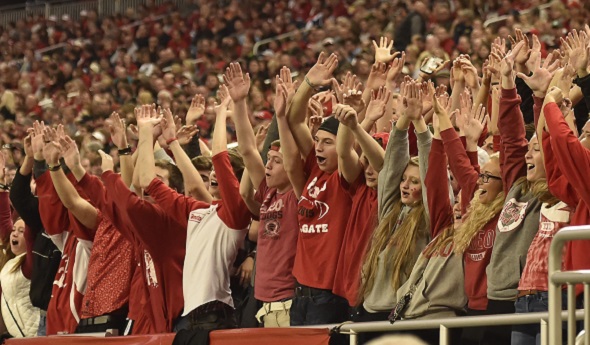
Get on Your Feet for Our Great Games
January 27, 2017
By Rob Kaminski
MHSAA benchmarks editor
Somewhere along the winding road in the long history of interscholastic athletics, gradual change has brought our product to a crossroads.
We, in this business of developing the minds, character and bodies of student-athletes, still understand the far-reaching benefits of school-based sports, and the mission of our programs. We understand their importance to community, the incomparable entertainment value for spectators, the bonds built between teacher and student that an hour a day in the classroom usually can’t match, and the memories and lessons that last a lifetime.
Somewhere along the way, however, some of the allure seems to have faded in the eyes and minds of others.
• Perhaps it’s the many options available to today’s young people, both in and out of athletics. Where once school sports and a letter jacket were THE thing, now it’s just another thing, with travel programs, virtual reality games, nonstop cable sports coverage and social media competing to fill free time.
• Maybe it’s parents, chasing the misguided dream of athletic scholarships for their children and in the process doting on the promises of untrained coaches intent on building their pocket books and reputations over building fundamentals and teamwork in kids.
• It could be that sensational stories from professional and collegiate levels warning of long-range effects of concussions and other sports injuries are causing fear in many parents who are making athletic participation decisions for their children.
• It’s possible that those once relied upon to spread the good word of our good work – our friends in the media – are far fewer. Administrators and coaches alike were once on a first-name basis with sportswriters in every community across Michigan. When a feel-good story took place, we knew whom to call to trumpet the news, and when the big game took place, they were sure to be there. The collapse and contraction of newspapers and the rise of faceless bloggers has delivered a blow.
• And, what of respect for authority? We are losing the keepers of our games – the contest officials – in bunches each year. People see the assaults, both verbal and physical, on these special men and women who give far more of their time than they are compensated for and figure it can’t be worth it to become an official, or to continue.
Ultimately, how we got here no longer matters. It’s what we do next. The focus for the 2016-17 school year is to define and defend educational athletics. We know that educational athletics is the best option. We are certain specialization is becoming a real health and safety issue, as real as concussions. We emphasize safety and risk management through our rules and regulations. We will utilize current media to tell our story. In doing so, maybe we can increase our pool of officials as well.
The following reveals the plan.
Teaching the Teachers
The 2016-17 school year is featuring a multi-faceted plan to Define and Defend Educational Athletics across Michigan, and one of the most critical strides aims at insuring that all varsity coaches – the educators of our programs – receive the proper instruction to pass along the mission of school-based sports to all involved, from students to parents to administrators.
For the first time each first-time varsity head coach of an MHSAA tournament sport needs to have completed Level 1 or 2 of the MHSAA’s comprehensive Coaches Advancement Program, the acclaimed continuing education program for school coaches.
Arming those most closely involved with student-athletes with proper perspective will go a long way in securing the future of interscholastic athletics.
“The role of a secondary school coach is so much more complex than it first appears, and it reaches beyond the responsibility of teaching skills to athletes,” said MHSAA assistant director Kathy Vruggink Westdorp, who oversees the CAP program. “The coach is first and foremost a teacher – that educational leader in an athletic setting – and it is often this coach’s responsibility to reinforce the connection between sports and academics. This defines the MHSAA brand of athletics.”
The connection between sports and academics cannot be overstated, and those sharing the hallways on a daily basis observe positive effects when students see that coaches show concern for their well-being beyond the playing surfaces.
Dan Hutcheson is in his first year as an assistant director at the MHSAA following a decade as athletic director at Howell High School. Prior to that, he served as the Highlanders’ wrestling coach. He knows first-hand the importance of the coach-student relationship.
“As a coach who’s in the building on staff, I know that I’m going to be in contact with my kids every day in class or in the hallways,” Hutcheson said. “When kids see that you care about them beyond the classrooms and fields or gyms, it can equate to improved academics. That is something other sports organizations don’t have.”
During the last three years alone, more than 1,800 individuals each year have attended CAP courses ranging from Levels 1-8, receiving instruction on topics such as “The Coach as Teacher,” to “Psychology of Coaching,” to “Effectively Working with Parents.” These are just three of the 18 courses making a difference in coaches statewide, and those attendance numbers will rise with this year’s requirement.
While some might see the word “requirement” as an added helping onto the already full plates of those who dedicate so much free time, such regulations add value and help define school programs.
“I believe we have a better sense of the bigger picture. Sure, our coaches want to win. But compared to travel sports, it is more educationally sound,” said Tim Ritsema, athletic director at Zeeland East High School, who serves as one of the MHSAA’s CAP instructors. “For those coaches who complete CAP, it gives their profession more credibility – it tells athletes, parents and the community that they take this seriously and want to be knowledgeable in the best practices. In travel ball, there are no regulations on coaches, it costs a lot more, and there can be selfish agendas. Our coaches are ‘All In.’ They recognize the long-lasting impact that they have on our student-athletes.”
Fellow CAP instructor Mike Garvey, athletic director at Kalamazoo Hackett Catholic Prep, sees the same enthusiasm during his experiences in front of the diverse groups of coaches.
“I see buy-in. Coaches of all ages, with a tremendous range of experience, have shared that they learned, that they have gained insight into the profession,” Garvey said. “I had a coach contact me about a couple of theories presented and indicated that it helped her team in two categories: they had more fun and they performed better. It also drew praise for her from the parents.”
Proven results from the methods employed are a big factor in gaining repeat attendees and spreading the word to coaches who have yet to attend CAP. Nothing increases credibility like positive results and peer recommendation.
A couple other factors contribute to the success, including willingness to participate and the widespread availability of courses throughout the state.
“The best sessions are when the majority of the coaching staff is actively participating, and it doesn't always need to be positive; that seems to add to the program,” notes CAP instructor Karen Leinaar, athletic director at Bear Lake HS. “Sometimes this is the first time all the coaches have actively talked about their philosophy, and sharing just makes it more ‘real.’ Hearing from others that they are doing it right is a big affirmation. Making the program available within a reasonable distance also assists in participation.”
CAP also plays a pivotal role in indoctrinating those outside the school setting to the purpose of school-based sports. Non-faculty coaches might have different roots than faculty coaches, but receive the same messages to take with them.
“There really is not a big difference between faculty and non-faculty coaches in the appreciation for coaches education,” Westdorp said. “We have seen 40-year veterans and first-year protégés indicate similar impact regarding the message of educational athletics.
“However, the non-faculty coaches are definitely better linked to their school and the culture of their school after taking CAP. Each module contains the Ten Basic Beliefs of Michigan Interscholastic Athletics. The very first module in CAP 1 is entitled ‘Coaches Make the Difference,’ and works toward the development of a coaching philosophy, core beliefs, understanding your personal reasons for coaching, promoting high expectations and creating team culture. It includes exercises in making difficult decisions, why there are rules and creating team culture.”
Some of the residual effect might be that today’s coaches will become tomorrow’s administrators, a movement which some sense has stalled in recent years.
The National Federation of State High School Associations recently enlisted global communications marketing firm, Edelman, to assist in rolling out a national campaign this fall to elevate awareness of the NFHS and educational athletics.
“In many cases, we need to re-educate our own people,” NFHS Executive Director Bob Gardner said. “We don’t see coaches moving to principal and athletic director jobs much as we once did.”
In Michigan, CAP is assisting in that way.
“We have several athletic administrators, principals and superintendents who recognize the value of their coaches within the building,” Westdorp said. “Many of these administrators have been in CAP sessions and are utilizing the materials. They want trained coaches who know how to deal with student-athletes in regards to safety, sportsmanship and skill development.”
Communication is key to CAP’s success, not only from instructors to the coaches in attendance, but in turn from coach back to other coaches, students, parents and administration moving forward. That’s how the mission of school sports persists.
“I stress that communication is one of the most important things coaches need to do,” Ritsema said. “Being a poor communicator allows for many things to go bad.”
Zeeland East and Bear Lake are classes apart in enrollment, but the rule of communication is universal.
“I am lucky being in a small school; we have very few questions to our rules,” Leinaar said. “I know others that have huge issues, but many have caused their own because they lacked the art of communication. Share with everyone. Make Grandma understand. You’ll not necessarily get 100 percent support, but at least there will be a shared understanding and expectation.”
Ultimately, the component of school sports which ranks above all else is the participants.
“We emphasize working with young people and teaching. Working with young people and leading,” Garvey said, “and keeping young people as the reason for the activity.”
Well-Rounded Task
The MHSAA organized a multi-sport participation task force during 2015-16 to identify the main sources of sports specialization and to generate methods to encourage greater participation in a variety of activities.
During the first meeting last April, Dr. Tony Moreno of Eastern Michigan University and Dr. Brooke Lemmen of the Michigan State University Sports Medicine Clinic each cited research which is inconclusive if specialization is the path to the elite level of sports, but is conclusive that specialization is the path to chronic, long-term negative effects.
The mission ahead for the task force is to change the culture in and around their schools.
“There’s a misconception that, ‘I have to only participate in that one sport to get to that next level,’” Hutcheson said. “But, when you hear college coaches talk, they want the kids who are athletes, who participated in more than one thing.
“I’d hear kids say, ‘I just want to lift weights out-of-season.’ Well, what do you do when you’re tired of lifting weights? You put them on the ground and rest. If you want to be a competitor, you need to compete. Playing another sport provides the opportunity to continue competing and growing as a competitor.”
While the committee discussed potential plans for such items as online resources, printed material and social media discussion to generate heightened awareness, those avenues have already been traveled to various lengths. In fact, the mission has changed little over the years.
“The most remarkable thing is that when I reviewed a couple of old videos we produced on the value of multi-sport participation about 10 years ago, our message really hasn't changed,” said MHSAA Communications Director John Johnson. “We now need to emphasize the injury factor – which is now so much more well-documented – and the fact that an increasing number of recognizable faces at higher levels are now endorsing the playing of multiple sports at youth levels.”
The trick is to develop the most effective delivery system and target those who most need exposure to the topic: coaches and parents.
“The task force sees educating parents as a priority, informing them of the dangers of early specialization in terms of burnout and injuries, as well as the financial burden families take on to advance their child towards a possible scholarship,” said long-time Traverse City Area Public Schools administrator and task force member Patti Tibaldi. “Parents need to understand that only one percent of high school athletes will receive athletic scholarships. Educational athletics should address the needs of the other 99 percent, don't you think?”
In many communities around Michigan, multi-sport athletes are not simply an added benefit; they are a must for programs to exist.
“I’m from a small school,” said Bronson athletic director and task force member Jean LaClair. “For our teams to be successful across the board, we need our student-athletes participating in multiple sports. We had a volleyball and softball team both make the state championship games, and seven kids were on both rosters! And, playing in a championship game, with the small-town support, is something you will never emulate in a club sport.”
It takes support from parents and coaches to build successful school sports programs, and administrators play a pivotal role in steering the ship.
“The biggest thing we discuss is the multi-sport athlete in our high school,” Ritsema said. “Luckily, our coaches are on the same page, and we deliver that message unified to our athletes and parents.”
Those involved with the task force understand the importance of the issues. It’s time for the choir to do the preaching, and project the chords beyond their buildings.
“Multi-sport participation within the school-based system teaches students the valuable lessons athletics should provide: how to work with different groups of people, the discipline of practice, how to respond from failure, how to understand and accept different roles within each sport, recognizing the strengths and weaknesses of each coach and teammate,” said Tibaldi. “School-based sports have a fundamental belief system that, while every sport has its individual differences, all sports need to comply with the philosophy of educational athletics adopted by the school district.”
As Johnson points out, the sooner that message reaches its target, the better.
“We need to literally reach the bottom of the food chain: elementary school kids who play sports, and their parents,” he said.
To that end, the MHSAA is focusing efforts in two ways during 2016-17: increased communication with its junior high/middle school membership, and the formation of regional strike teams.
Going Back to the Future
As the MHSAA moves forward with several initiatives this school year to help in defining and defending educational athletics, some staff members will be working their way backward – in age, that is.
Various findings in recent years through committees, task forces and personal experiences reveal that often times students are reaching secondary schools without positive prior experiences in school sports. That is about to change.
During the 2016-17 school year, the MHSAA is conducting two Junior High/Middle School Committee meetings rather than one, with an emphasis on the MHSAA more closely aligning itself with various JH/MS events through sponsorship efforts.
“The multi-sport task force has been a great discussion tool,” said MHSAA Assistant Director Cody Inglis, who oversees the JH/MS Committee. “You see that no matter the size of the school, everyone has the same problem; it’s become a true health and safety problem. Kids are specializing too soon and too often.”
One of the steps to help combat the trend is to reach children, parents and coaches before they hit the high school hallways.
“The task force recognizes that parents want to do what is best for their children,” Tibaldi said. “Our recommendations include finding ways for schools to offer earlier and better programming, stressing the development of overall physical skills versus the constant competition at an early age which is leading to an exodus from athletics by the age of 13.”
More than 700 junior high/middle schools across Michigan were members of the MHSAA in 2015-16. But just how many participants and parents – or even coaches at that level – are aware of the benefits afforded by that membership? The answer is likely a stark minority. It is the MHSAA’s charge to be more visible in the coming years.
“We’ll discuss becoming a presenting sponsor at some pre-existing league meets at the junior high/middle school level, whether it be track, basketball, cross country or any sport,” Inglis said. “We want to get into those existing leagues and conferences to have a presence.
“We could help financially, to offset the cost of officials and medals, for instance. And, we can brand those events from an educational athletic standpoint, versus the youth sport model which most kids that age have experienced. The goal is to give them a perspective they’ve yet to have in school-based sports. We want to make sure putting on a school uniform is a positive experience.”
Of course, biggest proponents of school sports are those who have dedicated hours, years and careers to the product. Those people, the ones the MHSAA leans on and appreciates the most, will be called upon again to deliver a huge assist at youth levels via forthcoming “Regional Strike Teams.”
“These local teams could be veteran or retired ADs in various areas who understand educational athletics and are familiar with junior high/middle schools in their communities,” Inglis said. “They can emphasize sportsmanship and multi-sport involvement so we can get in on the ground floor.”
The formation of these liaisons between the MHSAA and its youngest members will be discussed at length during the 2016-17 school year.
The junior high/middle school gyms and fields are not only stocked with future high school students, but they also offer a valuable forum for officials recruitment, training and retention, another critical piece to the welfare of school sports.
“With our Regional Strike Teams of people connected to schools and local officials associations, we can increase the connections made at the local, personal level to attract more people into officiating,” said MHSAA Assistant Director Mark Uyl, who oversees the MHSAA’s services to registered officials. “The members of the Strike Teams will know what events are going in an area of the state which could be conducive to officials recruitment events. The best way to recruit is at the local level between people with shared interests, and the Regional Strike folks can make these local connections.”