


Improving Over the Long Run
October 22, 2013
A participant in a 5K run told me recently that when she first entered races, her goal was just to finish. After those early successes, her goal in entering races was to improve her personal best time.
It was only after several years of consistent improvement that she entertained the thought of actually trying to attain a spot in the top 20. Eventually, a “Top 10” and then a “Top 5” finish became the goal. And only recently has she made it a goal to try to win one of these races.
This is a wise way to approach sports. Engage at first to improve your health and fitness. Then to enhance your speed, coordination and/or endurance. Then to test the limits of your abilities. And only then to test yourself against others.
Adults might look to this as a natural, healthy way to improve themselves in almost any endeavor. And adults who are coaching youth should look to it as a healthy way to lead young people to improve both as athletes and as human beings.
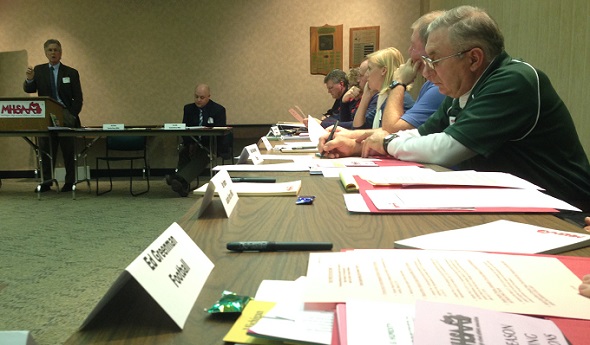
Presidents Converge on MHSAA Office
January 29, 2015
By Geoff Kimmerly
Second Half editor
Coaches serving over three seasons and in a variety of different sports can have a variety of perspectives when it comes to most topics, including MHSAA rules.
 The Coaches Association Presidents Meeting, an annual event hosted Monday at the MHSAA office in East Lansing, allows an opportunity to gather that valuable input as our staff works through pressing issues at the start of each new year.
Presidents from high school coaches associations representing nearly all of our MHSAA-sponsored sports met in East Lansing for an inside look at some of our latest efforts and how that work could affect their sports and the coaches they serve.
On the menu this time was an update on the MHSAA's drive to increase coaches health and safety training, followed by updates on recent research into how the association might better serve junior high and middle schools.
The entrée was discussion on out-of-season coaching rules, and how or if they should be altered to allow high school coaches more contact with athletes during offseasons than currently allowed.
This meeting allows for input on these topics, with the key, again, that the input comes from various sources who face differing circumstances but are all tied together under the umbrella of interscholastic athletics. Input from our coaches associations will be valuable as MHSAA staff and its Representative Council consider potential rules changes over the rest of this school year, and beyond.