


Improving Over the Long Run
October 22, 2013
A participant in a 5K run told me recently that when she first entered races, her goal was just to finish. After those early successes, her goal in entering races was to improve her personal best time.
It was only after several years of consistent improvement that she entertained the thought of actually trying to attain a spot in the top 20. Eventually, a “Top 10” and then a “Top 5” finish became the goal. And only recently has she made it a goal to try to win one of these races.
This is a wise way to approach sports. Engage at first to improve your health and fitness. Then to enhance your speed, coordination and/or endurance. Then to test the limits of your abilities. And only then to test yourself against others.
Adults might look to this as a natural, healthy way to improve themselves in almost any endeavor. And adults who are coaching youth should look to it as a healthy way to lead young people to improve both as athletes and as human beings.
The More Things Change ...
December 20, 2013
By Rob Kaminski
MHSAA benchmarks editor
As we begin another calendar year, let's take a brief look at how the mission of school sports has (or hasn’t) changed since 1955, when former MHSAA Executive Director Charles E. Forsythe presented this practicum to the University of Michigan.
The following is an excerpt:
Presented by Charles E. Forsythe
Practicum in Physical Education
University of Michigan, Ann Arbor
Tuesday, June 21, 1955
WHY DO WE HAVE INTERSCHOLASTIC ATHLETICS IN OUR SCHOOLS?
 To meet the urge for competition which is a basic American tradition – let’s keep it.
- To provide a “whole school” interest and activity, bring in students other than athletes, enlist many student organizations.
- To teach students habits of health, sanitation, and safety.
- Athletics teach new skills and opportunities to improve those we have; this is basic educationally.
- To provide opportunities for lasting friendships both with teammates and opponents.
- To provide opportunity to exemplify and observe good sportsmanship which is good citizenship.
- Athletics give students a chance to enjoy one of America’s greatest heritages, the right to play and compete.
- One of the best ways to teach that a penalty follows the violation of a rule is through athletics.
- There must be an early understanding by students that participation in athletics is a privilege which carries responsibilities with it. Awarding school letter to a student is the second-highest recognition his school can give him – his diploma at graduation is the highest.
- To consider interscholastic athletic squad as “advanced” classes for the teaching of special skills – similar to bands, orchestras, school play casts, members of debating teams, etc. There is no reason why a reasonable amount of attention should not be given to such groups – as well as to those in the middle and lower quartiles in our schools. Both leaders and followers must be taught.
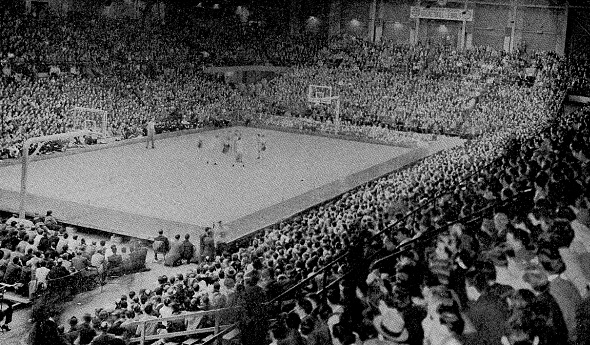
PHOTOS: (Top) Fans filled the arena for this MHSAA boys basketball tournament game. (Middle) Charles Forsythe served as the first executive director of the MHSAA.