

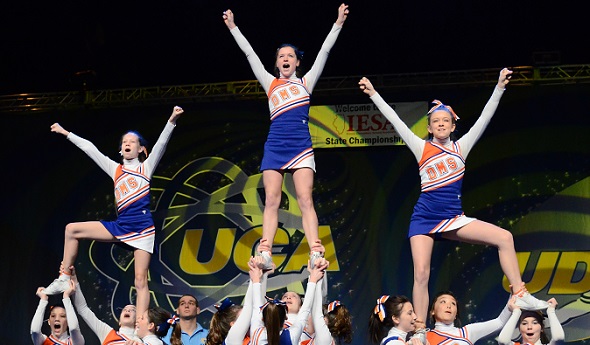
A League of Their Own in Illinois
May 20, 2014
By Rob Kaminski
MHSAA benchmarks editor
Imagine the scene: thousands of spectators roaring their approval as hundreds of cross country runners hit the finish line. A couple thousand others cascade applause on the wrestling mats as referees raise the hands of 19 champions.
Now, here’s the kicker, imagine this is taking place during postseason play for junior high/middle school student-athletes.
Again, that’s postseason, and junior high/middle school.
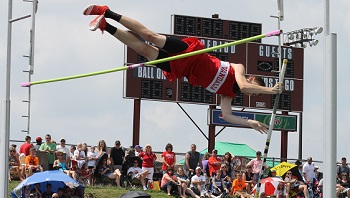
 “I guess when you see a kid cross the finish line in first place and 5,000 people are cheering, or watch a student run a race, throw the shot, or pole vault in front of that many at our track & field series, the proof is in the pudding,” said Steve Endsley, executive director of the Illinois Elementary School Association.
“The environment, the feedback we get; it’s the greatest thing in the world to some who experience our tournaments. But, I temper that in saying this is not the Olympics, the pros, or even high school. Success at our level doesn’t guarantee future success. We want you to do your best, we want to prepare you to do your best, but understand this is junior high.”
If understanding that is difficult for some athletes and parents involved in IESA athletics, it’s also a foreign language to state high school associations across the country. The IESA is the only organization in America which exclusively governs interscholastic activities for grade levels 7-8.
Most states include junior high/middle schools in their rules and regulations, but few, if any, conduct tournaments.
“We’ve been doing it for so long, it’s accepted. Schools know that at the end of the regular season, they enter Regional play. The payoff is we have state series, a culminating activity, and it’s a good thing that’s going on,” Endsley said.
From the organization’s first postseason event in 1930 during which boys basketball tournaments took place in a lightweight (boys less than 100 pounds) and a heavyweight division, the IESA has grown to sponsoring more than 20 boys and girls activities.
 Measures have been taken in recent years to alleviate travel concerns at the end of the season. The IESA has added classifications in some sports, while keeping the number of teams which advance to the Finals the same. So, for instance, where 16 teams might have gone to two different sites in the past, now four different sites host eight schools.
Admittedly, Endsley adds that the tournament series might add to some competitiveness, but since all schools enter the tournament, there might be less emphasis on winning during the regular season, and thus, heightened participation for those of all skill levels.
“If you don’t want the win-at-all-cost mentality, then step up to the plate at your member school and handle it that way,” Endsley said.
The refrain from association leaders around the country is that success in conveying the values and ideals of school sports is totally dependent on those in charge at the local level. Beginning with the 2012-13 school year, the IESA put more of that load squarely on the individual schools by making it a local decision as to whether students could participate with the school team and a club team in the same sport during the same season.
“From an association standpoint, it seemed like only people we were penalizing when had the limitations were the honest schools which self-reported,” Endsley said. “It was difficult to penalize those schools while everyone else knew the school down the street didn’t report.
“In a perfect world, the participation rule would be in place. But, it’s not a perfect world. Club sports schedule in accordance with high school seasons, but disregard our level when it comes to non-school activity. It’s year-round. So it’s practically impossible to equitably enforce it from a state level.”
There are more than 800 member schools in the IESA, which is an affiliate member of the National Federation of State High School Associations, but a separate entity from the Illinois High School Association.
Endsley estimates the IESA comprises 50-60 percent of eligible schools in Illinois, bolstered by unique membership options which differ from the IHSA and many state associations.
“We offer a la carte membership. A school can offer activities and maybe not participate in our state series. It’s only in those activities in which schools participate in the IESA state series that they must abide by our rules and regulations. Schools want some control. I think a la carte way is the way to go.
“If they join the IESA for one sport, they receive all mailings and information, so maybe one sport gets them in, but they may later add activities. If they are not a member, they don’t know about us.”
Yet, while separate bodies, the IESA and IHSA work hand-in-hand in many respects since nearly 100 percent of the IESA’s students will matriculate into IHSA schools.
“We attend the IHSA activity advisory meetings so we can keep a finger on the pulse of topics they are discussing and items they are considering. From the student standpoint, we will take our champions and introduce them in ceremonies at the IHSA Finals when our calendars line up,” Endsley said. “They get tickets, halftime introductions, pictures in the program, and it’s well-received recognition.”
Such activities are possible because the IESA seasons are different than the IHSA’s in some sports, or end sooner. For instance, the IESA plays baseball and softball in the fall, so its champions are recognized at the IHSA Finals in the spring.
“These activities create exposure and help build interests and aspirations for our schools,” Endsley said. “It’s nice P.R. for both associations.”
Whether different seasons or same seasons, the multitude of events throughout Illinois provides ample opportunity for the state’s contest officials as well. That’s another area in which the IESA and IHSA work together.
“We don’t license officials in the IESA, but we require our schools to use IHSA officials,” Endsley said. “We get great cooperation from the IHSA, it’s a good situation for our schools, and it’s a really good thing for officials. There are always plenty of games, and new officials gain valuable experience.”
Now in the midst of its ninth decade, the IESA continues to expand, adding boys and girls bowling and golf to its roster of activities in 2011.
The Association sponsors athletics for 7th- and 8th-graders, but 5th- and 6th-graders enrolled in a member school may participate with 7th-and 8th-grade teams within that building without a waiver. If such students are in an elementary school which feeds a member school, waivers are necessary.

MHSA(Q&)A: Menominee football coach Ken Hofer
June 28, 2012
By Brian Spencer
Second Half
Ken Hofer has been nothing short of legendary during more than three decades as Menominee’s head football coach -- a tenure that came to an end earlier this month when he announced his retirement.
In 41 seasons -- including his first two, at Stephenson -- he won three MHSAA championships (1998, 2006, and 2007) and built a record of 342-136-3. He is one of nine coaches in MHSAA football history with at least 300 wins.
He guided more than a thousand athletes, and that influence extended to league rival Kingsford -- where his son Chris Hofer is the football coach. Ken also is known statewide as the guru of the single wing offense, a rarely-used but for the Maroons frequently unstoppable attack that does not utilize a traditional quarterback.
Hofer is a member of the Michigan High School Football Coaches Association and Upper Peninsula Sports Halls of Fame. He also served as the Menominee athletic director, principal, and assistant principal. He grew up in Stephenson, where he was an all-stater in football and track and field, and later competed in both sports at the University of Wisconsin.
Did you always want to become a football coach?
I was predicted to be a coach somewhere in our (Stephenson) annual (yearbook). So I suppose I was always predetermined to coach. However, before coaching I was in the service as a Lieutenant and spent two years in Germany. After Germany, I spent another five years working for Wilson Sporting Goods before I finally came back in 1964 to coach football and teach social studies for Stephenson.
How did you decide it was time to hang up the whistle?
Well, I’m 77 years old, so age was definitely a determinant. The biggest factor was that as much as my mind said I could continue, my body said “slow down.” So I guess age and my inability to continually go full throttle and stay energetic helped me make my decision.
In your 45 seasons, what is the most helpful piece of advice you are going to take away?
The best advice I will take away is to treat young people the way I like to be treated.
 What do you plan to do with your free time, now that your schedule has opened up slightly?
I am going to try and catch up on stuff that should have been done a long time ago. I’m sure that my wife will give me plenty of stuff to do, too. I also want to try to travel more and visit my kids. I now have a grandson who will be playing for Kingsford, so I will become a fan of my grandson’s at his Kingsford games.
Now that your grandson and son both have affiliations with Kingsford, will you become a Kingsford man?
No (chuckling), I will cheer for my son and grandson, but I will forever be connected with Menominee and Stephenson.
What was it like to be recognized by both the Michigan High School Football Coaches Association and Upper Peninsula Sports Halls of Fame?
It was like a utopia for coaching. When your peers give that honor it is a pretty special time. As a coach you don’t strive for that kind of accolade; however, it is definitely a special honor to receive.
What has been, in your opinion, your greatest achievement as Menominee’s head football coach?
My greatest achievement will always be working with younger people; I think that is the most important thing that most coaches would like to have, is the ability to stay young by working with these young men. You don’t always have to win to have that experience. Winning on the field doesn’t always correlate winning in other aspects of your life.
What advice can you give aspiring or current coaches who look to share similar successes as a head coach?
The biggest thing is to make sure that you treat the players like you like to be treated. Using that approach will get a great response.
Of your 300-plus career wins, is there any one that you find particularly special?
I always found that whenever I could beat Kingsford when my son was coaching (he said, followed by a bellowing laugh). My son Chris will like that one.
There are so many that I consider to be special. There were a ton of close games, too many to count. Two years ago, we had one of those close games where we played Morley-Stanwood, and won 41-40 in overtime (in a 2010 Regional Final). The young men played very hard. It was very special.
Do you think that your son will follow in your footsteps and coach for 45-plus seasons?
I think Chris has that type of coaching in his blood. He’s struggling physically with a knee injury; however he has a coaching mind that is as strong as ever. I think he’ll coach until he won’t be able to.