

The More Things Change ...
December 20, 2013
By Rob Kaminski
MHSAA benchmarks editor
As we begin another calendar year, let's take a brief look at how the mission of school sports has (or hasn’t) changed since 1955, when former MHSAA Executive Director Charles E. Forsythe presented this practicum to the University of Michigan.
The following is an excerpt:
Presented by Charles E. Forsythe
Practicum in Physical Education
University of Michigan, Ann Arbor
Tuesday, June 21, 1955
WHY DO WE HAVE INTERSCHOLASTIC ATHLETICS IN OUR SCHOOLS?
 To meet the urge for competition which is a basic American tradition – let’s keep it.
- To provide a “whole school” interest and activity, bring in students other than athletes, enlist many student organizations.
- To teach students habits of health, sanitation, and safety.
- Athletics teach new skills and opportunities to improve those we have; this is basic educationally.
- To provide opportunities for lasting friendships both with teammates and opponents.
- To provide opportunity to exemplify and observe good sportsmanship which is good citizenship.
- Athletics give students a chance to enjoy one of America’s greatest heritages, the right to play and compete.
- One of the best ways to teach that a penalty follows the violation of a rule is through athletics.
- There must be an early understanding by students that participation in athletics is a privilege which carries responsibilities with it. Awarding school letter to a student is the second-highest recognition his school can give him – his diploma at graduation is the highest.
- To consider interscholastic athletic squad as “advanced” classes for the teaching of special skills – similar to bands, orchestras, school play casts, members of debating teams, etc. There is no reason why a reasonable amount of attention should not be given to such groups – as well as to those in the middle and lower quartiles in our schools. Both leaders and followers must be taught.
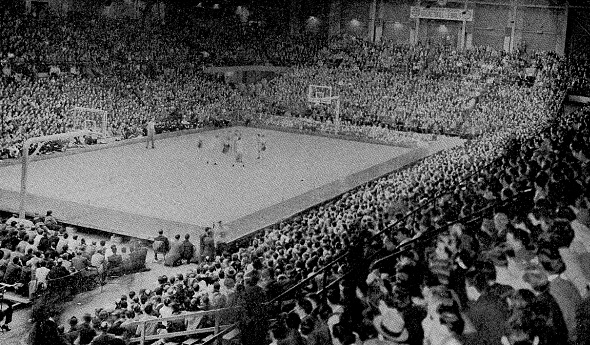
PHOTOS: (Top) Fans filled the arena for this MHSAA boys basketball tournament game. (Middle) Charles Forsythe served as the first executive director of the MHSAA.
NFHS Honors 4 of Michigan's Finest
By
Geoff Kimmerly
MHSAA.com senior editor
January 14, 2015
By Geoff Kimmerly
Second Half editor
Three longtime Michigan high school coaches and one of the state’s most highly-respected athletic directors were recognized Wednesday by the National Federation of State High School Associations Coaches Association.
Leland volleyball coach Laurie Glass, Trenton softball coach John Biedenbach and Traverse City Central boys track and field coach John Lober were named Coaches of the Year in their respective sports. Longtime Troy athletic director Jim Feldkamp – currently an instructor for the MHSAA’s Coaches Advancement Program – was honored as this year’s National Coach Contributor Award winner as an individual “who has gone above and beyond and who exemplifies the highest standards of sportsmanship, ethical conduct and moral character.”
Feldkamp served one year as a teacher and coach of three sports at Romeo in 1970-71 before moving on to New Baltimore Anchor Bay, where he taught, coached varsity boys basketball for 14 years, subvarsity basketball for five seasons and served as athletic director at the high school.
He moved on to West Bloomfield as director of health, physical education and athletics in 1985, then became citywide athletic director for the Troy School District from 1988-2004. Feldkamp consulted at Detroit University Prep from 2007-12, then served as district athletic director of L’Anse Creuse Public Schools during the 2012-13 school year.
Feldkamp received the MHSAA’s Charles E. Forsythe Award in 2005 for his outstanding contributions to the interscholastic athletics community after retiring from the Troy district, where he was responsible for 178 teams, more than 4,800 athletes and 315 coaches. He also received the MHSAA’s Allen W. Bush Award and has served as a CAP instructor for the last decade while co-authoring the program module Administrative Responsibilities of Coaching. He also previously was named Athletic Director of the Year by the Michigan Interscholastic Athletic Administrators Association and received a National Award of Merit from the National Interscholastic Athletic Administrators Association.
“Jim Feldkamp is an outstanding educator who understands and recognizes the qualities of leadership necessary in educational athletics while also appreciating the meaning and applications of the rules,” said MHSAA assistant director Kathy Vruggink Westdorp as part of the association’s nomination of Feldkamp for the award. “He has a great understanding of the coach’s role and has worked with thousands of coaches throughout Michigan in a continued effort to improve the sport experience of participating students.”
The following brief bios on Michigan coaching award winners include excerpts from coaching philosophies they were asked to submit after being identified as candidates:
Laurie Glass this fall led Leland to the Class D Volleyball Final and has taken her program to four MHSAA championships over three tenures stretching 20 seasons. Including four seasons at Traverse City Central, Glass has a 909-302-108 record dating to her first season at Leland in 1990-91.
“Athletics is all about opportunity, both for the athlete and the coach. Opportunity to learn life lessons that will help them as the move on outside of the athletic arena. Opportunity for personal growth. Opportunity to be passionate about something that you are willing to work hard for. … Most importantly, the opportunity to develop young women into strong young women who believe in themselves and value what they have to offer.”
John Biedenbach took over the Trenton softball program in 1975. He has led teams to more than 940 wins and was inducted into the Michigan High School Softball Coaches Association Hall of Fame in 1997. He also coached basketball teams to 445 wins beginning in 1977.
“Building that sense of being a ‘team’ is my most important job as a coach. The team leaves no one out in the cold; each member of the team plays as hard as they can for the sake of their teammates and for the sake of themselves. As coach, I lead by example, always stressing hard work and dedication, long hours practicing and the fundamentals of the game. If I have done my job, my players will start their adult lives stronger and better prepared for the challenges ahead.”
Lober has coached the Traverse City Central boys track and field team since 1977 and also the boys cross country team since 1989. His 1992 track team won the Class A championship, and he has coached 17 individual MHSAA Finals champions. He has built a record of 334-33-3 and was inducted into the Michigan Interscholastic Track Coaches Association Hall of Fame in 2006.
“Athletics are an integral part of the educational setting that should provide experiences through a variety of sports for every student, regardless of ability. While being part of the team, these experiences should foster the qualities of hard work, dependability, fitness and dedication to the team’s goals. Student athletes should be challenged, motivated, counseled and led through activities that develop their mental, social, physical and psychological needs.”