

The More Things Change ...
December 20, 2013
By Rob Kaminski
MHSAA benchmarks editor
As we begin another calendar year, let's take a brief look at how the mission of school sports has (or hasn’t) changed since 1955, when former MHSAA Executive Director Charles E. Forsythe presented this practicum to the University of Michigan.
The following is an excerpt:
Presented by Charles E. Forsythe
Practicum in Physical Education
University of Michigan, Ann Arbor
Tuesday, June 21, 1955
WHY DO WE HAVE INTERSCHOLASTIC ATHLETICS IN OUR SCHOOLS?
 To meet the urge for competition which is a basic American tradition – let’s keep it.
- To provide a “whole school” interest and activity, bring in students other than athletes, enlist many student organizations.
- To teach students habits of health, sanitation, and safety.
- Athletics teach new skills and opportunities to improve those we have; this is basic educationally.
- To provide opportunities for lasting friendships both with teammates and opponents.
- To provide opportunity to exemplify and observe good sportsmanship which is good citizenship.
- Athletics give students a chance to enjoy one of America’s greatest heritages, the right to play and compete.
- One of the best ways to teach that a penalty follows the violation of a rule is through athletics.
- There must be an early understanding by students that participation in athletics is a privilege which carries responsibilities with it. Awarding school letter to a student is the second-highest recognition his school can give him – his diploma at graduation is the highest.
- To consider interscholastic athletic squad as “advanced” classes for the teaching of special skills – similar to bands, orchestras, school play casts, members of debating teams, etc. There is no reason why a reasonable amount of attention should not be given to such groups – as well as to those in the middle and lower quartiles in our schools. Both leaders and followers must be taught.
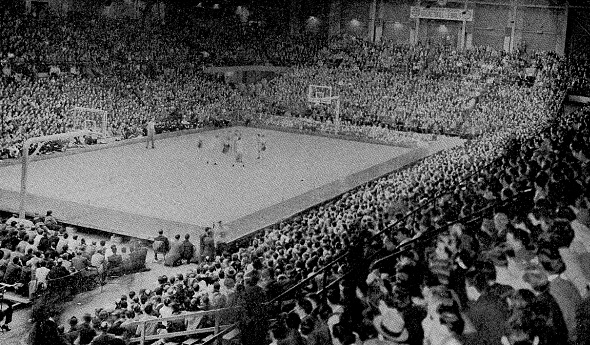
PHOTOS: (Top) Fans filled the arena for this MHSAA boys basketball tournament game. (Middle) Charles Forsythe served as the first executive director of the MHSAA.
MHSAA Vault: Shooks a Legend as Freshman Coach
By
Geoff Kimmerly
MHSAA.com senior editor
September 4, 2026
The following originally appeared in the Lansing State Journal on Oct. 28, 2004, and was reprinted by the MHSAA that winter.
Wayne Shooks retired from coaching entirely in 2008 and died Tuesday at the age of 84.
Wayne Shooks tried the varsity football thing once. Some time during the late 1980s, longtime DeWitt coach Gail Thornton asked Shooks to be his offensive coordinator.
“I didn't sleep a night. My wife, after three weeks, said, ‘You're going back to freshmen,’” Shooks remembered.
And those three weeks were in the month of June.
But Shooks' wife must have been on to something. Because few, if any, freshman football coaches have accomplished what Shooks finished with one last win last fall.
He ended his 16th and final season as freshman coach with a 135-2-1 record.
Amazing.
“You can't lose a game for him, or you'll feel bad,” DeWitt senior Mat Brynick recalled from his days as a freshman. “Coach never says it, but it's what everyone expects.
“He taught us how to win.”
 Guys like Shooks, 62, usually go unappreciated.
They get the kids fresh to high school, fresh to high school sports, and still learning things like not spiking the ball after a touchdown.
But few freshman football coaches are as legendary as Shooks is in DeWitt. They are so unappreciated that it's impossible to find out if anyone has accomplished what he's done.
Shook is not big on numbers. Never has been during his 41 years teaching in the district, or more than 20 coaching everything from football to basketball to wrestling to tennis. Oh, and track since 1980.
He also coached 8th-grade football for a few years, junior varsity for one season and was a varsity assistant. But he'll be remembered for what he did with the freshmen.
The losses came in 1993 to Mason during a terrible wind storm, and in 2002 to Greenville. That same year, the Panthers tied Haslett, meaning it was the only year during his tenure that DeWitt wasn't sure if it finished first in its league, since league titles aren't handed out at the freshmen level.
“The kids felt bad. They did their best,” Shooks remembered.
But the losses, however few, were more of a relief for Shooks than a letdown.
Don't take that to mean Shooks doesn't like to win.
Sure, he embraced the role of teacher as much as any freshman coach. But as DeWitt varsity coach Rob Zimmerman said, “If he was a 5th-grade coach, he'd be the most competitive 5th-grade coach you've ever seen.”
“I never pointed (our record) out, it was not our goal,” Shooks said. “Our goal was to win the next week. Although the kids knew it. They just assumed we were going to go 9-0, I guess.”
Guess so.
Shooks had more easily-attainable goals:
- Have fun
- Learn fundamentals
- Emphasize the logical stuff, like the importance of bringing equipment to school every day
“He does a really good job teaching expectations about being young men and being great students,” Zimmerman said. “It's gigantic.”
And it kept kids coming back to junior varsity and varsity. You could hear the fun coming out in Brynick's voice.
He was remembering his freshman football experience, remembering his time with perhaps Michigan's most successful coach at that level.
“I remember a few games, we'd find one play that works, and we ran it to death, pounding it and pounding it,” Brynick recalled. “He loves running the same play over and over. If you can do that, march 80 yards down the field, you're doing something right. No one could stop us.”
That was not all Brynick remembered, or didn't.
Shooks almost never yelled. If he did, it meant a kid messed something up over and over and over again.
He has a doctorate in zoology. Education is obviously a big deal. He loves to win, but he loves to teach. And he's hesitant to go looking for any attention for what he's done.
All made him a perfect freshmen football coach.
“Sometimes I don't think people understand about coaches. You think college level, they are coaches first, that's their job, but not at the high school level,” Shooks said.
“It's not what I've done, it's what they've done. I've always believed the focus should be on the kids. My job is a teacher. I coach because I love to coach.”
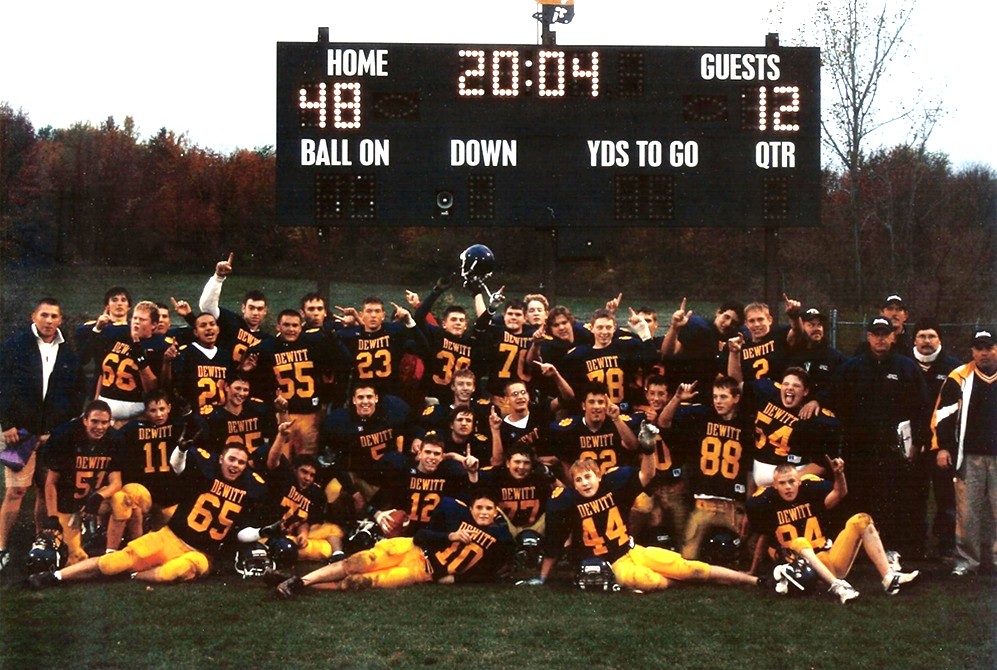
PHOTO DeWitt freshman coach Wayne Shooks, fourth from right, stands for a photo with this final football team in 2004. (Photos courtesy of the DeWitt football program.)