

Przystas Helps 'Shape' Fitness for Future
By
Geoff Kimmerly
MHSAA.com senior editor
December 20, 2016
By Geoff Kimmerly
Second Half editor
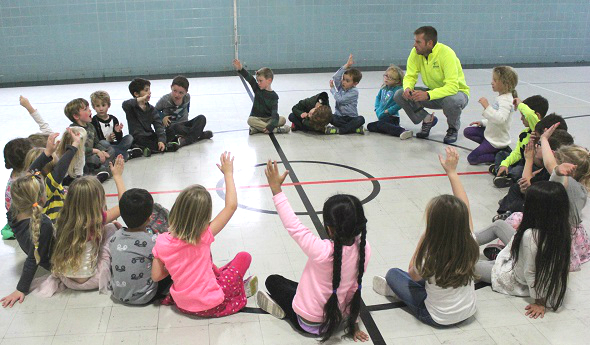
Scott Przystas had plans earlier this week to “crash” a Grand Haven schools party with vegetables grown in his classroom’s hydroponic garden. It may be winter outside, but in his physical education class, it’s time to harvest.
But the Michigan chill doesn’t mean his students – ranging from Young 5’s to fourth grade – will be restricted to the gym for the next three months. When they return in 2017, they’ll head outside and give snow-shoeing a try.
Teaching includes a lot more than daily dodgeball or rolling out the basketballs for Przystas, a member of the MHSAA Multi-Sport Task Force and this fall’s honoree as Michigan Physical Education Teacher of the Year by the state’s chapter of Society of Health and Physical Educators (SHAPE).
The task force over its first few months has determined that the message on the many benefits of participating in multiple sports must be delivered to students and their families long before these students reach high school and even junior high – making passionate educators like Przystas especially key. He passes on a perspective that “PE is the most important thing we can teach kids, how to be physically active for life” while teaching students at Grand Haven’s Mary A. White and Rosy Mound elementary schools.
“That’s our goal with the elementary PE department in Grand Haven, to make it relevant again,” Przystas said. “Because it’s really easy in our profession (to say) here’s the ball kids, do you want to do. But it’s not gratifying at all. It’s not satisfying to the kid or the teacher.”
Przystas brings the MHSAA task force a wealth of experience as a coach – he’s in charge of the high school’s girls cross country team, serves as freshman coach and varsity assistant for girls basketball and leads the middle school track & field teams. But he also provides an important voice for physical education, an area the task force considers crucial to growing interest in playing many sports instead of specializing in one – which studies have shown can lead to chronic injuries when playing that one sport while leading those children to become adults who are less likely to be physically active and fit. He is in his eighth year in the Grand Haven district and has taught in nine buildings at the elementary, middle, high school and alternative education levels.
“Scott has been instrumental in leading changes to the PE program in Grand Haven,” Mary A. White principal Valerie Livingston said in a report for the Grand Haven Tribune. “His excitement about life-long fitness and nutrition is contagious in the school. Under Scott's direction we have students who look forward to smoothie bars at lunch and are excited to see our new tower garden grow.”
Many teachers
Przystas’ philosophy is deeply-rooted in the positive experience he had growing up in Gladwin, a much smaller community than Grand Haven located north of Midland and Mount Pleasant.
His father Ronald – who formerly worked at the Lansing State Journal and Cadillac Evening News before becoming a reporter, editor at later publisher at the Gladwin County Record – died in a car crash in 1996. But he left his then 10-year-old son a love for sports photography – Scott minored in journalism at Michigan State University – and also plenty of familiarity with athletics. A track & field meet hosted by Gladwin Junior High School bears Ron’s name.
Sports provided an outlet during that tough time. During middle school, Scott would go from a basketball game to hockey practice that same night, filling his time with those sports, golfing and a variety of other like activities.
A few years after his dad’s death, Przystas became a manager for the Flying G’s boys basketball varsity coached by Kirk Taylor, who had gotten to know Ron well over the years. Ron had made sure Kirk understood the importance of Gladwin beating county rival Beaverton – they play for a trophy dating back to 1937 – and so it was memorable when Scott, as a senior during the 2005-06 season, scored a career-high 25 points to help the Flying G’s beat the Beavers despite the fact he really wasn’t a scorer as much as a solid all-around player.
“Scott was part of the best group of captains I have had here at Gladwin in the past 23 years,” Taylor said. “One of his co-captains was quiet and out-worked everybody. Another of his tri-captains was very direct with players. Scott was a little of both, but he always delivered the message with the most positive manner.
“I did not know that Scott would become a teacher and/or a coach, but I did know that he would be very successful at whatever profession he chose.”
Przystas made the all-Jack Pine Conference second team as a senior in 2004 while also earning all-league honors in golf and serving as a pinch-runner in baseball for a couple of seasons – but that was just a start on his athletic endeavors. At MSU, as he was studying toward a degree in kinesiology, Przystas played on the practice scout team that daily took on the women’s basketball team as the Spartans prepped for multiple NCAA Tournament runs. He knew he wanted a career in sports, and that experience got him interested in coaching. He also participated on the MSU triathlon club team, which got him into endurance sports.
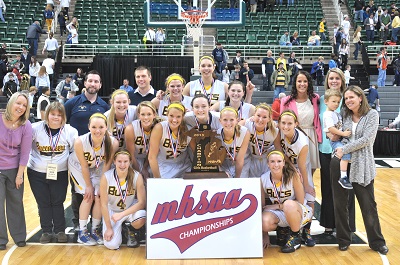 He graduated from MSU and before the fall of 2009 latched on at Grand Haven. His first call was to Buccaneers girls hoops coach Katie Kowalczyk-Fulmer, and he was on her bench as an assistant for the program’s back-to-back Class A championships in 2012 and 2013 – while also for a time living in her basement before marrying his wife Renee.
Przystas also inherited the high school’s girls cross country program, which he coaches with Renee, and which has made the MHSAA Finals 17 straight seasons. In addition, he became the Lakeshore Middle School track & field coach – and he sees all of these as being related.
“At a Class A school like this, I’d like to say having most (students) participating in high school sports is because of the elementary PE teachers rocking it,” Przystas said. “Our numbers in cross country are up there (50-60 athletes the last few seasons), our numbers in track are getting up there, and the kids are seeing a familiar face and enjoying the process and sticking with it.”
Passing those lessons on
In addition to Taylor and Kowalczyk-Fulmer, Przystas credits his high school golf coach Ben Ball and Gladwin’s former girls varsity and boys subvarsity boys basketball coach Andy Miceli among those who helped shape his growing up. He also gained valuable experience during his student teaching as an assistant with the Bath High School girls under Craig Poppema, and retired longtime Grand Haven boys hoops coach Craig Taylor – Kirk’s dad – has provided plenty of mentoring.
Przystas – who has served a two-year term on the Governor’s Council on Physical Fitness, Health and Sports – teaches from a philosophy based on a pyramid. The bottom level is health and knowing how to take care of oneself, with the middle level physical literacy and the body’s ability to solve movement problems to avoid injury. The top of his pyramid is adventure, and that’s what he’s trying to deliver to his students.
But to do so, he also has to be able to relate and communicate with them.
“Scott makes it fun. He’s just very organized – and he connects with whatever age group, whether it’s kindergarten kids or high school girls,” said Kowalczyk-Fulmer, recalling how excited her 5-year-old son was to have “Coach P” as a teacher. “Freshman girls can sometimes be an interesting group to coach … but he never changes who he is. I’ll stand in the locker room after games and listen to the things he says. Just the quality of person he is, he’s a role model, he and his assistant Kelly Kieft. He’s just a good, positive role model for young people.”
Przystas noted how SHAPE America is pushing for the generation of children being born now becoming an “active” next generation, and as a newer father this hits home – and also helps fuel his desire to help.
He said it’s harder to plant that seed when students are older – but that’s where his responsibility as a cultivator at the elementary level comes in.
“I had a great childhood experience,” Przystas said. “That was the big thing. I fully remember all of the pickup games we had in our neighborhood, the outdoor adventures exploring, playing ping-pong on a chipped-up table.
“(That’s why) I promote to kids in middle school, elementary school, to go check out a lacrosse game. Go to swim camp. Be active this summer. Don’t just be sitting around. We’ve just got to get them outside more and have kids be active.”
PHOTO: (Top) Teacher Scott Przystas (kneeling) works with one of his elementary school classes in Grand Haven. (Middle) Przystas (back row, second from left) has been an assistant on two Class A girls basketball championship teams. (Top photo courtesy of the Grand Haven Tribune.)

Coaches Hehs, Ritz Honored by NFHS
January 12, 2016
By Geoff Kimmerly
Second Half editor
Two championship-winning Michigan high school coaches were honored Monday by the National Federation of State High School Associations Coaches Association.
Bloomfield Hills Academy of the Sacred Heart girls tennis coach Judy Hehs and Wayland softball coach Cheri Ritz were recognized as National Coaches of the Year in their respective sports after both led their teams to MHSAA championships during the 2014-15 school year.
The following brief bios on Michigan’s winners include excerpts from coaching philosophies they were asked to submit after being identified as candidates:
 Judy Hehs has coached girls tennis at Bloomfield Hills Academy of the Sacred Heart since fall 1996 and served as co-coach of three MHSAA Lower Peninsula Division 4 championship teams over the last four seasons, including last spring. She also coached the school's varsity girls basketball team from 1988-95 and two sports at Detroit Country Day – field hockey in fall 1987 and then junior varsity boys tennis (while also serving as the varsity assistant) from spring 1988-2000. Hehs was inducted in 2015 into the Michigan High School Tennis Coaches Association Hall of Fame and her girls tennis teams have a record of 141-16-14. She also serves as Sacred Heart’s associate head of school and director of the upper school.
“Why do I coach? I coach to give back to the profession of coaching and to the sport of tennis. Tennis has been a large part of my life since I was young. I coach because I can make a difference in the lives of the young women whom I coach – I can help build character and teach resilience, I can bear witness to their individual and team success and I can be present during those moments when hard lessons are learned. I coach for selfish reasons – I love spending afternoons and weekends with young people. In my classroom, the tennis court, the challenge isn’t making great tennis players. It is about building great people. … There is no better place than a tennis court to teach real life lessons – lessons about work ethic, teamwork, problem solving, independence and the moment when efforts turn into believing and believing turns into accomplishments.”
 Cheri Ritz has coached the Wayland softball team to two MHSAA Division 2 championships, in 2006 and again last spring. She began her varsity softball coaching career at Middleville Thornapple Kellogg from 1991-94 and has led Wayland since 1995. She ranks 12th in MHSAA history for softball coaching victories with a career record of 818-207. Ritz also teaches in the Wayland Union district.
“Patience, passion, dedication, virtue, teamwork and love are present daily. I will open the minds and hearts of my athletes, and they will treat people the right way. I will enhance their soul by having them grow righteous values from within. We will instill that maximum effort is simply a way of life. … Our goal will be to be as competitive as possible every year. We will compete every year with high expectations of our players, on and off the field. We will control what we can control, such as effort, attitude and the way that we treat our teammates. We will pay close attention to details. We will work on the basic fundamentals every day in practice. Everything matters, from the way we treat custodians and bus drivers to the way we clean our opponent's dugout after a game to the way we warm up before the game. We will win with class in everything that we do!
The NFHS has been recognizing coaches through an awards program since 1982. Winners of NFHS awards must be active coaches during the year for which they receive their award.