

Seng Leads, Coaches Others to do Same
By
Geoff Kimmerly
MHSAA.com senior editor
January 25, 2018
Meg Seng misses coaching – in her words, “those relationships really are what it’s all about … stronger than just about anything other than family.”
But the coach in Seng continues to show the way in her work every day.
Seng will be honored next month with the MHSAA’s 31st Women in Sports Leadership Award for her work at Ann Arbor Huron and Greenhills over more than 30 years in educational athletics.
The award also will recognize Seng’s teaching, training and empowering of the next generation of coaches and especially women aspiring to follow her into leadership positions in a field where they remain underrepresented.
“I’ve always loved sport, and early on found I had a knack and an interest in coaching. So to be able to share with other young women what I think is a really noble profession makes it a passion for me,” Seng said. “I think it’s a great endeavor, and I’d love for more women to have the opportunity and the confidence to seek out some of those positions.”
Seng will receive this year’s award during the WISL Banquet at the Crowne Plaza Lansing West.
Each year, the Representative Council considers the achievements of women coaches, officials and athletic administrators affiliated with the MHSAA who show exemplary leadership capabilities and positive contributions to athletics.
Seng is in her 28th year at Greenhills School, serving as the athletic director the last 15 after 13 teaching physical education and health. Previously a scholarship athlete playing both volleyball and softball at Indiana University – and winning a pair of Big Ten championships on the diamond – Seng coached both sports at Ann Arbor-area high schools over nearly two decades and has continued as a role model for emerging coaches.
“I’m pretty sure I’ve been to every single (WISL) conference, and so for years, I’ve certainly been in the audience watching these great women be recognized,” Seng said. “To have followed for that long and now be on stage, it’s a tremendous honor for me – that group of women and their value to sport in Michigan is not lost on me at all. I truly respect that group, and I’m really proud to be part of it.”
 A 1977 graduate of Maine South High School in Park Ridge, Ill., Seng began coaching at the college level after her playing days with the Hoosiers were done. She served first as a graduate assistant softball coach at Louisiana Tech University in 1983-84 while studying for her master’s degree, and then as a softball assistant at Illinois State University for 1984-85.
Seng took over the Ann Arbor Huron volleyball program in 1985, and over 12 seasons stretching two tenures led her team to five league titles and a District championship in 1993. She also served as Huron's co-head varsity softball coach from 1986-90.
She completed her teacher certification at Eastern Michigan University in 1990 and began teaching at Greenhills that year, later coaching that school’s varsity volleyball team from 1993-2000 and leading the Gryphons to a District title in 1997.
In 2001, Seng co-founded The Academy of Sports Leadership (TASL), a non-profit organization that provides education and training for women interested in becoming coaches and hosts a five-day residential camp for high school girls with that aspiration. In 2003, Seng became Greenhills’ athletic director and began her work as well contributing to the Michigan Interscholastic Athletic Administrators Association (MIAAA) and National Interscholastic Athletic Administrators Association (NIAAA), serving on committees for both including as part of the MIAAA’s Leadership Academy faculty since 2011 and the NIAAA’s certification committee since 2014. She served as the MIAAA’s Executive Board president in 2013-14.
At Greenhills, Seng has hosted more than 20 MHSAA tournament events in various sports at the District, Regional and Quarterfinal levels, and she’s served on a variety of MHSAA committees as well as currently the Multi-Sport Participation Task Force. She also is an instructor for the MHSAA Coaches Advancement Program.
“Meg Seng has been a leader at every level of educational athletics – as an accomplished coach, respected athletic director and someone who empowers women interested in following her lead and filling the need we have in school sports for more women in all forms of leadership positions,” MHSAA Executive Director John E. “Jack” Roberts said. “She personifies the Women In Sports Leadership Award, and we’re delighted to present her with this honor.”
Seng received the MIAAA Jack Johnson Distinguished Service Award in 2012 and her region’s Athletic Director of the Year Award in 2008. She also received the Pathfinder Award in 2004 from the National Association for Girls and Women in Sports (NAGWS), and under her leadership Greenhills received the Exemplary Athletic Program Award from the MIAAA in 2017. She also received the Girl Scouts’ Leaders and Best Award in 2005.
In addition to her work with The Academy of Sports Leadership, she’s served since 2009 on the board as a founding member of the Michigan Softball Academy, which annually raises money for the American Cancer Society. She is published for her work in coaching education and recruitment and has spoken on various occasions on ways to provide opportunities for young women in coaching. She will present on recruiting and retaining female leaders at the annual statewide MIAAA conference this March.
 “Meg sees a need and takes initiative to put a committee, group or process in place to solve and satisfy this need,” Holly athletic director Deb VanKuiken said in her letter recommending Seng for the WISL Award. “I truly respect and admire her. She has a great mind and a great heart for athletes and coaches alike. She leads, and she serves.”
Part of filling that need is helping athletic directors find candidates and helping candidates feel confident.
Seng monitors coaching at the high school and college levels, and has watched the percentage of female coaches at the college level fall drastically since Title XI. She also hears a few things – from women finishing college athletic careers who don’t feel qualified to coach, and also from athletic directors who would love to hire women coaches but aren’t finding candidates.
“Our Academy is a grassroots organization just trying to get young girls to follow that dream and show them the possibilities,” Seng said. “It’s a primer on coaching; we show them all the things coaches do and hope it sticks, that they say, ‘I can do that.’
“Part of what we do is try to empower them to take some of those risks.”
In addition to the MIAAA and NIAAA, and NAGWS, Seng is a member of the National Association for Sport and Physical Education (NASPE) and American Alliance for Health, Physical Education, Recreation and Dance (AAHPERD).
The first Women In Sports Leadership Award was presented in 1990
Past recipients
1990 – Carol Seavoy, L’Anse
1991 – Diane Laffey, Harper Woods
1992 – Patricia Ashby, Scotts
1993 – Jo Lake, Grosse Pointe
1994 – Brenda Gatlin, Detroit
1995 – Jane Bennett, Ann Arbor
1996 – Cheryl Amos-Helmicki, Huntington Woods
1997 – Delores L. Elswick, Detroit
1998 – Karen S. Leinaar, Delton
1999 – Kathy McGee, Flint
2000 – Pat Richardson, Grass Lake
2001 – Suzanne Martin, East Lansing
2002 – Susan Barthold, Kentwood
2003 – Nancy Clark, Flint
2004 – Kathy Vruggink Westdorp, Grand Rapids
2005 – Barbara Redding, Capac
2006 – Melanie Miller, Lansing
2007 – Jan Sander, Warren Woods
2008 – Jane Bos, Grand Rapids
2009 – Gail Ganakas, Flint; Deb VanKuiken, Holly
2010 – Gina Mazzolini, Lansing
2011 – Ellen Pugh, West Branch; Patti Tibaldi, Traverse City
2012 – Janet Gillette, Comstock Park
2013 – Barbara Beckett, Traverse City
2014 – Teri Reyburn, DeWitt
2015 – Jean LaClair, Bronson
2016 – Betty Wroubel, Pontiac Notre Dame Prep
2017 – Dottie Davis, Ann Arbor Huron
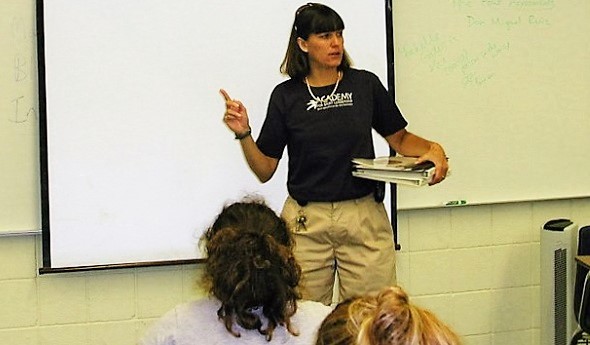
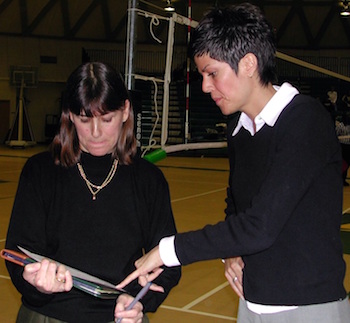
PHOTOS: (Top) Ann Arbor Greenhills athletic director Meg Seng instructs in the classroom; she taught at Greenhills for 13 years and continues teaching as part of CAP and the Academy of Sports Leadership. (Middle) Seng, left, also was a successfull volleyball coach at Ann Arbor Huron and Greenhills. (Photos courtesy of Meg Seng.)
Prepping for the Long Run
May 9, 2014
By Rob Kaminski
MHSAA benchmarks editor
Case studies of Middle Child Syndrome range far and wide in the world of family psychology. But at the center of most dialogue regarding those affected is a feeling of being ignored or left out.
Within the family tree of scholastic sports, however, there’s no better time to be in the middle, as the tween and early teen generation is commanding the MHSAA’s utmost attention.
While participation numbers for high school athletics continue to hold steady in Michigan, junior high/middle school membership in the MHSAA is on the decline. In just the last seven years, membership among the vital group has dropped by exactly 100 buildings, from 831 schools in 2005-06 to 731 this year. That figure represents just 36.5% of the nearly 2,000 schools in the 2013 Michigan Education Directory serving 7th- and 8th-graders.
The number of high schools comprising the MHSAA now is greater than that of the feeder schools, bewildering when considering that a large percentage of high schools draw students from at least two junior high/middle schools.
To reverse the trend, the first order of business is to identify reasons junior highs and middle schools are leaving the MHSAA, or in more numerous cases, not joining the association at the start.
Armed with data from the 2013 MHSAA Update Meeting Survey and positions advanced by the MHSAA Junior High/Middle School Committee, a task force has been formed to examine problems and recommend solutions.
“We didn’t have an overwhelming ‘Yes’ or ‘No,’ or definitive answers, through the Update Meeting Survey on the various junior high/middle school topics. There are so many models in existence throughout the state. Some have grades 5-8, some 6, 7 and 8, some K-12,” said MHSAA Representative Council member Karen Leinaar, explaining her motion at the December Council meeting that a task force be formed.
“We hope the task force can provide information and direction by putting different minds together to narrow down some action plans to encourage more junior high/middle school membership,” added Leinaar, athletic director at Bear Lake, a K-12 building.
“When you see the numbers, it makes you scratch your head and think, ‘What can we do to get that number to at least 50 percent,” said fellow Council member Jason Mellema, superintendent at Pewamo-Westphalia Schools. “I’d like the task force to approach schools which aren’t members currently and ask, ‘Why?’ Those responses will be valuable.”
At the heart of the matter are separate but parallel discussions aimed at making junior high/middle school membership more attractive. Implementing either of the two requires different measures of MHSAA protocol.
The first matter would require MHSAA Representative Council action. These issues pertain to lengths of contests and seasons at the middle school level. Lengthening seasons and/or contests could provide more ample playing time for schools which currently find it difficult to mete out opportunities for all students in the program.
The second consideration involves the inclusion of 6th-graders into school athletic programs. Such action would require an MHSAA Constitutional change which would be confirmed by a two-thirds favorable vote on a ballot authorized by the Representative Council.
Extending the arm of MHSAA membership to 6th-graders might enable smaller school districts to begin programs and teams where currently none exist due to low enrollments.
In communities of all sizes, 6th-grade participation could encourage students to join school teams at an earlier age, exposing them to the values and benefits of school-based sports vs. community sports in which many youngsters are already participating.
“AAU (Amateur Athletic Union) and community-based sports aren’t going away,” said MHSAA Council member Steve Newkirk, principal at Clare Middle School. “What is our rationale when we examine lengthening seasons or extending our role to include 6th-graders? If we’re jumping into this attempting to control something that we can’t control, that’s not the right reason. But, if we can increase participation in some schools which otherwise wouldn’t have programs, then we need to figure out how to do that.”
In a nutshell, the keys to increasing membership among the MHSAA’s younger students are speculative at this point.
There does seem to be growing consensus, however, that when a new model is unveiled, it will be up to local leadership to grab the keys and drive the vehicle down the right roads.
Matter of minutes
Like an older or younger sibling, “burnout” gets a lot of attention from sports study professionals as a significant reason many young people walk away from sports.
Too much, too soon. Too much specialization. Data certainly exists to support both.
Often overlooked is exclusion. Not getting enough playing time, not feeling like part of the team, practicing just as hard but only playing the meaningless “fifth quarter.”
The MHSAA sets forth season and contest limitations for both its senior high schools and junior high/middle schools.
 Survey data illustrates that Michigan is more restrictive than some neighboring states, and there seems to be growing momentum among constituents to lengthen contests rather than seasons.
“It’s interesting to see what some of the other states have in place, and in many instances we allow significantly fewer contests,” said Mellema. “Maybe increasing the number of contests would be the hook for increasing our membership.”
Michigan’s restrictions on the number of contests are a bit more stringent from others surveyed. However, the mood from January’s Junior High/Middle School Committee Meeting at the MHSAA, along with the flavor from last fall’s Update Meetings, seems to signify little desire for change.
When invested personnel were asked whether they would favor increased basketball and soccer schedules at the middle school level, the answer was ‘No,’ to the tune of 60 percent regarding basketball and 68 percent when it came to soccer.
“Our coaches want practice time, and increasing the number of games would actually take away from practice time,” said Kevin Polston, who heads the athletic department at a 7th-8th-grade building in Grand Haven. “Increasing the length of contests would be favored over playing more actual games.”
Early dismissal from school, increased transportation, contest officials and game management expenses also work against the notion of upping the number of events.
“When we talk about adding games, I see dollar signs,” said Blissfield’s Steve Babbitt. “More buses, more officials, more game management.”
Adding dates to schedules might also bring unwanted consequences to the school calendar.
“If we were to add contests, particularly in the fall, then the practice start dates might become an issue to get in the proper number of days before the season begins,” said Joe Alessandrini of Livonia. “We’d have to start practice before school begins.”
One problem inherent to late summer practice at the junior high/middle school level is that, unlike high school, many coaches use the first weeks of school simply to recruit kids to try out for their teams.
Gaining far greater momentum at the recent Committee Meeting was the advocacy for longer games through the addition of a couple minutes per quarter.
That position is further bolstered by the Update Meeting Survey, which revealed respondents’ favoring an increase in basketball quarters from six to 8 minutes, and for a “fifth quarter” in football to allow more students the opportunity to compete.
Just over half of the survey takers (52 to 48 percent) were more reluctant to add minutes to football quarters, but several JH/MS Committee Members point to longer football games as a key to participation. On many occasions, it was reported, football teams have run nearly all the time out of a quarter without the other team touching the ball. And, kids who only play the “fifth quarter” aren’t fooled by their roles if they only play when the game is over and nothing counts. Incorporating them into the flow of the game is preferred.
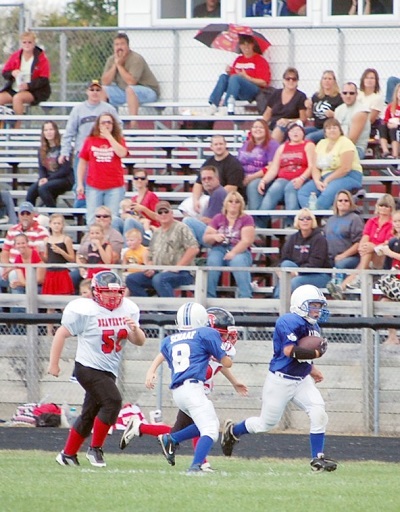 Others in the meeting discussed ways in which coaches rotated team units during a contest, and conference guidelines which have been established to promote participation while still allowing teams to be competitive at the ends of games.
“My concern when looking at game times is that we need to be specific and put constraints on how many minutes or quarters kids can play. That becomes tricky,” said Mellema.
“I’d like to have this meeting recorded to show that our opinions are not isolated; that we all share the same views, values and issues throughout the state,” said Constantine’s Mike Messner during the January meeting.
And that’s where influence at the local level from experienced school leaders is paramount.
“Our good intentions sometimes are not carried out the way we meant for them to be,” Leinaar said. “We have to impress on our schools why these changes are taking place, if we change things like length of seasons or contests.
“If it’s about winning, adding eight or 10 minutes to each game won’t change anything. If we add games, we see it as increased opportunities for kids, but coaches might not use it that way.”
Former MHSAA Assistant Director Randy Allen, who presided over JH/MS Committee Meetings in recent years, added, “The details of this can never be carried out or achieved by the state association. We can provide a tool to help achieve the goal of increased participation, but our schools have to implement it to be effective.”
Pleading the 6th
Even altering season and contest limits won’t address participation issues if kids can’t play.
Enter the debate over welcoming 6th-graders into the scholastic sports mix, an even hotter and more divided topic than game and season duration.
Whereas support for amending the MHSAA Constitution once lingered just below level ground, the most recent Update Meeting Survey is creating a groundswell, if not yet of seismic proportions.
In 2008, 47.5 percent of member schools indicated a desire to include 6th-graders in the MHSAA Handbook. Last fall, that figure rose to 59.4 percent overall, and up to 61.1 percent for just those individuals responsible for 7th and 8th-grade students in their districts.
It is worth noting that in more nearly 80 percent of school districts which include MHSAA member schools, 6th-graders share the same building with 7th- and 8th-graders.
Let the opening arguments begin.
“We’re talking 60 percent who are in favor of amending the Constitution. That’s a significant number,” Mellema said. “For larger schools with good numbers and only 7th- and 8th-graders in the buildings, it’s not an issue. But some smaller schools wouldn’t have teams without 6th-graders.”
Yet, in most places, 6th-graders are playing anyway, just not wearing the school colors.
“Because there are so many outside groups that have keyed in on kids at such a young age, I think it’s time to reach out to the younger grades to maintain educational athletics,” said Leinaar. “Fewer kids are on the playgrounds. Parents have them scheduled for soccer, judo, piano, and anything else you can think of. So, we should take the opportunity to develop the team concept in an educational setting without the little league mom and dad coaches.”
There is sentiment that the work needs to be focused in-house, or in the hallways, with deference to non-school athletic opportunities.
“It’s not about competing with outside entities,” said Brian Swinehart, athletic director of Walled Lake schools. “It’s about providing the best experience for those who are in our schools; getting them more opportunity to play.”
And getting them to play with structured coaching regulations. Within the MHSAA, members are strongly encouraged to hire coaches who are employed by the school district. Non-faculty coaches are required to be listed on forms submitted to the MHSAA, and in the very near future, all MHSAA coaches will be required to complete Coaches Advancement Courses and courses in basic safety and first aid.
“I coach my son in AAU wrestling, and my eyes opened up when I found that anyone with $18 and a computer could be a coach,” Newkirk said. “Anyone under the sun can coach.
“We need to get to the root of what it is we’re trying to accomplish. Is our goal the opportunity to play school sports or is the undercurrent to impact AAU sports? Maybe there’s a way to work with the coaches who are coming into our buildings and collaborate with them to have them buy into our values and philosophies.”
Polston echoed those sentiments at the JH/MS Committee meeting.
“If adding 6th-graders is to further our competitive nature versus non-school activities, I don’t think we’re ever going to do well at that,” Polston said. “Their philosophy is to win, and ours is education and value based.”
Just as school-based athletics differ from outside organizations, there also can be marked differences in the lives of youths as they move from elementary to junior high and middle schools. Such social transition periods are also considered.
“We’re already asking kids to grow up way too fast,” said Newkirk, whose school in Clare is 5th-8th grade. “It used to be Hot Wheels, Barbie Dolls and G.I. Joes, and now it’s all cell phones and texting and dating. Adding sports to those dynamics might create just another source of stress.”
The counterpoint could spotlight the exclusion factor again.
“I’m in a 6th-8th-grade building, and there’s a void for 6th-graders,” said Alan Alsbro of Berrien Springs.
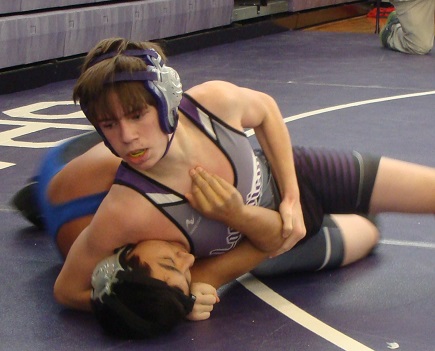 Messner reiterates concerns that 6th-grade sports might be too much, too soon at a pivotal age for students, and also mentions certain buzzwords that are like nails on a chalkboard to all levels of school sports leaders: finances and facilities.
“We’re a 6-8 building, and we’ve always felt that the 6th-grade year is a year of adjustment academically and socially, so let’s start athletics in 7th grade,” Messner said. “And, we’ve already had to budget out freshman-level sports at the high school, so how can we justify 6th-grade? We’re not going to find a pot of money.”
Cash will always be a concern for school programs, but the facilities and transportation arguments are quickly debunked by some.
“We have 5th- and 6th-grade teams that are school-based right now. We don’t pay the coaches, don’t collect participation fees or take physicals, but they do use our facilities, and we find room and time in the schedule,” Mellema said.
“Some schools treat the lower grades as intramurals, still hosting the events in their facilities, so it can be done if we expand our programs down a grade,” Leinaar said. “People say, ‘Oh that’d be a lot of work.’ Yeah. It would, but you just have to figure out a way to do it.”
The facility and finance issue could, in fact, be a moot point. A change to the Constitution would not necessarily force schools to sponsor stand- alone 6th-grade teams. In fact, the change might not mandate schools include 6th-graders at all.
A change would simply provide the opportunity for participation. The underlying feeling within the JH/MS Committee was that local boards and conferences would determine the extent of 6th-grade participation.
“I think the fear of 6th-grade stand-alone teams could deter some districts from having their middle schools join the MHSAA,” said Sean Zaborowski of St. Clair Shores. “It’s not viable to have 6th-grade-only football teams, basketball teams, etc. The question becomes whether to allow them to participate with 7th-and 8th-graders.”
For some, it might simply be a question of need, on a sport-by-sport basis.
“We have enough numbers that we don’t need 6th-graders to fill out rosters,” said Muskegon’s Todd Farmer of his 7-8 building. “Only the cross country people are asking about it. And, if we allow 6th-graders to participate, then do we allow 7th-graders to play with 8th-graders?”
That is another piece to the puzzle with which administrators are wrestling, in some cases quite literally.
Contact list
Wrestling is one of the sports most in need of 6th-grade participants, if for nothing more than filling the lightest weight classes.
The Update Meeting Survey showed nearly 42 percent in favor of 6th-graders competing with 7th- and 8th-graders in wrestling. Among “contact” sports, only basketball received slightly more support at 52 percent.
“Non-contact sports is where the focus should be,” Alsbro said. “In the non-contact sports, I think it’s a no-brainer to get students exposed to competition without getting their brains knocked out.”
The fall survey backs that sentiment with support as high as 73 percent in cross country and 67 percent in track & field. Football, ice hockey and lacrosse yield percentages of 72 or above opposed to 6th-graders playing with 7th- and 8th-graders.
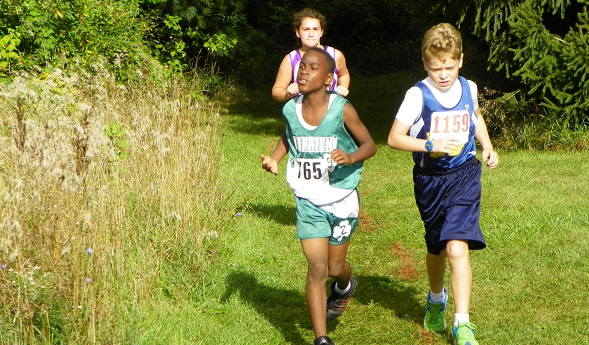 Leinaar speculates that it might be time to include 6th-graders in all “non-combative” sports.
Wrestling certainly falls in the contact category, but it is individual in nature. The JH/MS Committee suggested that the MHSAA Task Force consider the merits of team vs. individual sports as the natural division as to the inclusion of 6th-graders on the same teams as their 7th- and 8th-grade classmates.
Recent MHSAA waiver requests indicate a movement for such action to be taken. Consider the following:
- During the 2011-12 school year, 40 school districts made requests to the MHSAA Executive Committee to waive Regulation III, Section 1, pursuant to what is now Interpretation 262 so that 6th-graders could compete with and against 7th- and 8th-graders. The Executive Committee approved 37 of those requests.
- During the 2012-13 school year, 50 school districts made this request to allow 6th-graders on 7th- and 8th-grade teams, and 46 requests were approved.
The majority of these requests came in the sports of basketball, cross country, and track & field. On several occasions, schools were granted permission in all sports other than football, ice hockey and wrestling.
Interpretation 262 also states that requests may be submitted by the administration of “smaller member junior high/middle schools.” This might have deterred some districts from seeking 6th-grade participation and, in turn, eliminated the possibility of fielding a team in some cases.
In light of such history and language, the JH/MS Committee asked to forward the following positions to the Task Force and beyond:
- Change the current 6th-grade waiver process to allow schools of any enrollment size to be considered for waivers on a case-by-case basis that is need-specific, not granted only to small enrollment schools.
- Eliminate the waiver requirement for 6th-grade participation in individual sports, and maintain the waiver process and criteria for team sports.
Even with a Constitutional amendment to include 6th-graders in programs statewide, decisions would have to be made locally as to which teams they may be a part.
Outside the hallways
In addition to the primary topics of season and contest limitations and 6th-grade participation, the JH/MS Committee was asked for suggestions on how the MHSAA could retain current JH/MS members and make membership more attractive to schools not currently members. The following thoughts were expressed for consideration:
- Make membership required for those junior high/middle schools of MHSAA senior high schools. In other words, require district-wide membership (fully recognizing the difficulty with private school members).
- Provide MHSAA CAP courses at no charge or at a greatly reduced cost to JH/MS members.
- Modify the Limited Team Membership Rule at grades 7-8 to allow some participation in the same sport with non-school programs during the school season. Such allowance would have restrictions, to be determined.
- Give member schools flexibility on the start of fall football practices.
- Allow more local league and conference decision-making within broad statewide MHSAA regulations.
This input from the JH/MS Committee will be an important voice in the deliberations of the JH/MS Task Force that will convene multiple times during 2014 to bring a breadth and depth of study unprecedented on this topic in the MHSAA’s long history.
The quest for increased membership among the state’s junior high/middle schools – and thus, increased participation within the framework of educational athletics – is of utmost importance to the health and future of high school athletics.
Quoting MHSAA Executive Director Jack Roberts from his blog Oct. 8 on MHSAA.com, “School sports needs to market itself better, and part of better is to be available earlier – much sooner in the lives of youth.”
It is an age group that can no longer be ignored, or take a back seat to its older brothers and sisters.