


Strategize for First Parent Meeting
November 12, 2014
 By Scott Westfall
Coaches often cite parents as one of the most uncontrollable and frustrating aspects of coaching.
Let’s face it, when this relationship goes south, there can be pent-up frustration and hard feelings between the two parties which can result in a negative experience for everyone involved – especially the player who often is caught in the middle.
Establishing positive relationships with parents should happen from the moment you stand in front of them at your annual parent meeting.
Throughout this meeting parents will be asking themselves: “Can I trust this coach with my child?” “Will this coach be fair in his/her decisions?” and “Will this coach always have my child’s best intentions in mind?”
In order to put them at ease, you must do everything possible to establish yourself as a person of integrity who is altruistic and 100 percent trustworthy. Below is a coaching checklist that will help you establish trust and credibility with your team’s parents:
- Transparency – Do things openly and share information as much as possible. If something bad happens on your team, be sure that you do not sweep it under the rug. Be open and consistent with your decisions, and always follow through on what you say you are going to do.
- Demonstrate Respect – Be polite and sincere with parents and let your actions show that you care. Sometimes the little things you do will resonate louder than the big things.
- List Expectations – Have high expectations for the conduct of both the players and parents in your program. List these expectations, distribute them, and then talk about them with the parents. Meanwhile, let them know what they can expect from you in return (proper dress attire, appropriate language, great sportsmanship, impeccable conduct, proper treatment of game officials, etc.).
- Express Loyalty – As often as possible, be sure to praise your players, assistants, and the people associated with your program. Be sure that you never take credit for other people’s work, and remember to use the word “we” as often as possible.
- Be Accountable – This means taking the blame for bad results– even when it wasn’t necessarily your mistake. Admitting when something goes wrong on your watch doesn’t mean that you are a bad coach or you’ve lost control of your program. True leaders are accountable for the mistakes that happen in their programs.
- Deliver Results – This is not necessarily wins and losses. Instead, deliver results on the things that really matter, such as developing a respectable team, coaching players with all passing grades and having players who do not get into trouble or break the law.
No parent meeting would be complete without a healthy dose of paperwork. To make it easier for parents to keep these papers organized, try to color-coordinate the forms and go over them slowly one at a time. Below are the basic documents you should supply at the parent meeting (Note: Try to also have these documents accessible on your team’s website):
- Coaching Philosophy – Drafting a coaching philosophy will allow parents to better understand who you are and the reasons why you coach. In this document, be sure to include your fundamental beliefs along with your personal approach to coaching. (Note: Be honest in this section – Do not advertise yourself as one type of coach, but then act like another.) Include a lot of “I statements” such as, “I coach for the purpose of teaching life lessons,” “I believe that student comes before athlete,” and, “I am demanding but never demeaning.” Developing and drafting a coaching philosophy not only gives parents insight into you and your program, but also gives you an opportunity to reflect upon why you do things the way you do.
- Team Policies – This is perhaps the most important document you will distribute to your team’s parents. It should list all team rules pertaining to player conduct, grades, eligibility, attendance, discipline, communication, and of course playing time! Include statements such as, “Playing time is earned – not given,” “All decisions will be made based on what is best for the team,” and, “If you have a problem, please talk to the coach.” Inform parents that student-athletes will receive equal opportunities but not equal things. These opportunities include instruction, off-season strength and conditioning programs, and support for their classes. How well student-athletes take advantage of these opportunities (attendance, focus, effort, attitude, and self-discipline) often dictates their levels of success. (Note: Before distributing this document, make sure that your school’s administration/athletic director supports your team policies 100 percent).
- Student-Athlete Character Contract – While many schools have had an athletic code of conduct in place for years, teams today are including an additional written set of norms for players to follow. A character contract outlines how players agree to conduct themselves as a person, student, and athlete. If you want to create more buy-in, consider drafting this contract each season with your players!
- Parent Pledge Form – This document establishes the expectations you have for the parents in your program. Be sure that you include expectations for their conduct at games, having a positive disposition around the team, the treatment of players on your team along with the treatment of your opponents, letting the coaches coach, and how to act toward game officials.
- Team Calendar – Be sure to include detailed information on the times and locations of all practices, team events, games, and places that players need to be. If changes are made to the team calendar throughout the course of the season, be sure you inform parents through several forms of communication (a printed note sent home, an announcement on the team website, email list, social media, etc.).
- Athletic Physicals – While most doctors’ offices have a copy of these blank forms on hand, it is convenient for parents to have access to them through your school.
- Athletic Fees (if you are in a “pay for play” district) – Some districts have a mandatory athletic participation fee, while other districts do not. Some districts have a waiver form for students who are on free/reduced lunch. In any of these cases, make sure that you are on top of this information so you can properly inform your team’s parents at the meeting.
- Conflict Resolution – The occasional conflict is almost inevitable while working in an emotionally charged environment such as athletics. However, conflicts can often be avoided or at least more easily resolved through proper forms of communication.
1. Inform parents that you are always willing to listen to their concerns; let them know that you would prefer they address an issue with you, rather than taking their frustrations to the next game and venting to anybody in the bleachers who is willing to listen.
2. In in your team documents consider a statement such as, “The best tool we have in our relationship is an open line of communication. My door is always open, and so is my mind.”
3. Finally, be sure to let them know that if they are upset about something to not send it through email. Email is good for information, but not communication. Try to communicate and resolve conflicts in person as much as possible.
Once you have established trust and credibility with your team’s parents, you can start building the relationship. Caution: Building a relationship with your team’s parents is not developing close friendships with them. Becoming close friends with parents can actually lead to bigger problems as you open yourself to criticism of playing favorites.
Instead, build working relationships, generated through mutual respect and understanding for each other’s position in the quest of helping the young individual become a successful student-athlete. These working relationships help parents understand their optimal level of involvement, such as where and how they can fit into your program. Below are some tips for building working relationships with parents:
- Learn their names and where they work.
- Learn what the family likes to do when they are outside of the school setting.
- Invite them to a team event such as a team picnic, fundraiser, or team trip.
- Ask parents for help with certain jobs. Many parents appreciate being asked to help with team functions as it gives them an opportunity to get to know other parents and makes them feel like they matter.
- Call them at least once per season to say hello, report on their child’s progress, and ask if there is anything you can do to be of assistance.
- Offer additional support for their child. Helping the student-athlete outside of coaching with things such as academics and typical teen issues shows that you care.
- Offer support to the parents as well. If they are struggling to get a message across to their child, oftentimes a coach sending or reinforcing the same message makes all the difference. As a coach you hold a powerful platform with your student-athletes; use it to help with their development and maturity whenever possible.
Establishing yourself as a trustworthy and credible coach is the first step in getting parents to buy into your program. Meanwhile, providing parents with sufficient information will help them feel like you are keeping them informed and want them as a partner in your program.
Creating working relationships with parents takes time, but will be the cornerstone in establishing a positive experience for the years their children are involved with your program. While some parents may have a different background or mindset, listing your expectations will help them better understand your team’s culture and how they can fit in. If done right, these positive working relationships should alleviate much of your coaching frustration and pay tremendous dividends in the future.
Scott Westfall previously spent 10 years as a teacher, coach, and athletic director in Fort Collins, Colo. He currently is working on his Doctorate at Michigan State University, with an emphasis in Sport Psychology and Athletic Administration, and assisting the MHSAA with its student leadership programs. Westfall is a former athlete who participated in football, wrestling, tennis and cross country at the high school level, and rugby at the collegiate level. He can be reached at [email protected].
Soodsma Reaches 700 Boys Hoops Coaching Wins as Unity Launches Another Title Pursuit
By
Dean Holzwarth
Special for MHSAA.com
February 26, 2026
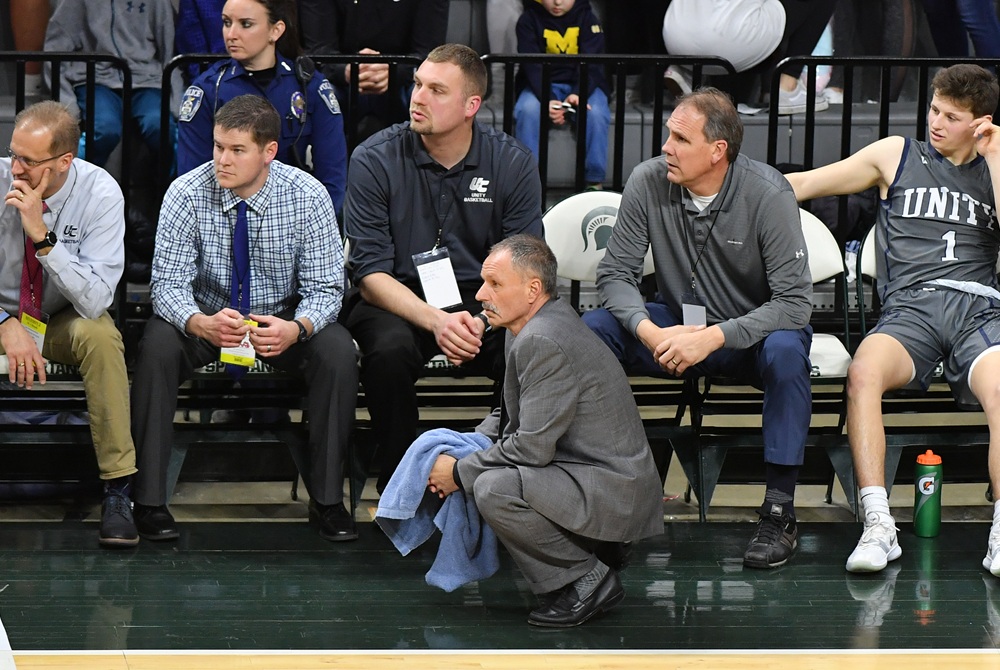
HUDSONVILLE – Hudsonville Unity Christian boys basketball coach Scott Soodsma has been a fixture on the sidelines for more than 40 years.
 And while he’s known as a man of faith, a fierce competitor and a coach who pours everything he has into his players, he’s most commonly known as the coach with the blue towel.
“I’ve had the same blue towel for 34 years at Unity, and it’s had holes in it and been sewed up a few times,” the 66-year-old Soodsma said. “It’s been around for a long time.”
The blue towel has been with Soodsma at every game, except for the first game this season against Grandville Calvin Christian.
“I had no idea where it was,” said Soodsma, who retired from teaching last year. “I stuck it in an old diaper bag and thought I would remember that I put it in there, but I didn’t. Luckily, my wife found it. I’ve never not had it except for that first game this year.”
The comfort of having a towel with him during games started during his first season (1983-84) at James Valley Christian, located in Huron, South Dakota.
It has been a lasting presence ever since, although the colors have changed.
“I had a pink towel when I coached girls at Unity, a yellow one at James Valley, and a maroon towel at McBain Northern Michigan Christian,” he said. “I don’t know, it’s just something I started having with me and I’ve had my wife run home from games when I've already been there and forgot it.
“I've sent her back home to get it because I didn’t want to coach without it. It’s been the thing I've been known for, for a long time.”
 Soodsma had it with him when he earned his 700th career win as a boys coach in a 69-28 victory over Zeeland West on Feb. 12.
He currently is fifth on the list of winningest coaches in MHSAA boys basketball history with a 688-258 record coaching at Northern Michigan Christian and Unity.
“It’s really amazing, and I've been very blessed to be able to go the length I have gone,” Soodsma said. “There were times when I thought I was done and I was dumb enough to do girls for five years at the same time and I did one season when the girls and boys were together.
“I’ve had a lot of texts and calls from kids after the 700 wins went out in the public and those are things that make it all worthwhile, to hear the comments and the thank-yous for what you did and the part you played in their life. More valuable than that, wanting to be part of their journey and their faith as well has been a big deciding factor in why I've stayed in it.”
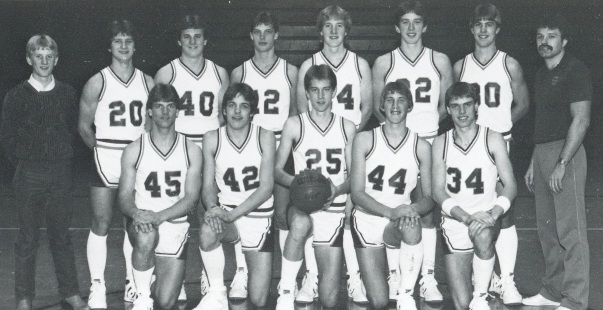
Soodsma, who has won over 800 games combined as a boys and girls coach, led McBain Northern Michigan Christian to the Class D boys title in 1987. He won the Division 2 championship at Unity in 2019.
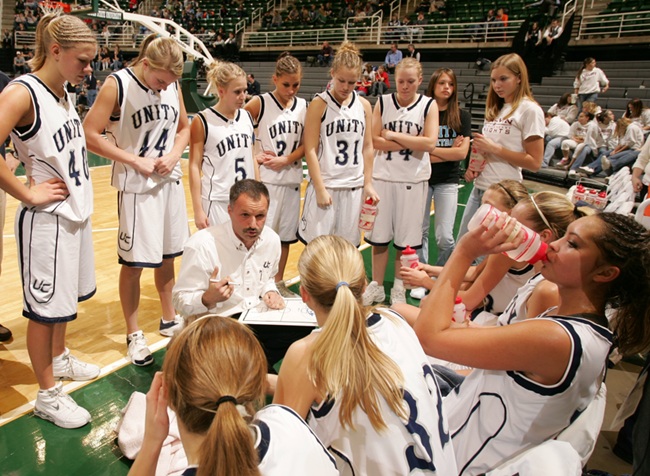
He also coached Unity’s girls to the Class B crown in 2006.
“I still love it,” he said. “I love the kids and I love the competition, but over the years, most people don't realize it, but I have mellowed a lot and I think I’m in it for the right reasons because I enjoy the kids. I want to be a factor in their life, not only from a basketball perspective, but from a Christian perspective and a faith perspective. It means a lot more to me now at my age than when I was 35-40. It’s not about wins and losses anymore.”
Unity Christian senior Kyler Berguis said Soodsma has had a profound impact on his life.
In my three years of having him as my coach I’ve never had someone motivate me more to accomplish a goal we both love so much, and that is winning,” he said. “He’s an amazing motivator, always pushing kids to be their very best every single time he steps on the court, whether that is in practice, games or shootarounds, it doesn't matter.
“You will never not feel the energy that Coach brings to the court, and the crazy thing is he’s been doing it forever. He not only has pushed me in basketball but most importantly he pushes the players off the court in how to be a man of God.”
Past Crusaders standout Gabe Newhof, currently a senior at Division I James Madison in Virginia, said Soodsma’s compassion for his players runs deep.
 “Coach has had an incredible impact on my development as a young man,” Newhof said. “Through the mountains and valleys of my life, he has been there for me. When I suffered an awful broken leg, he came and visited me at my house to let me know he cared.
“During my successes in college he has always been a voice of encouragement. I am so glad to have had a coach like him who truly cares about me on a much deeper level than just a player.”
Soodsma has guided this year’s squad to an Ottawa-Kent Conference Black title, which included going a perfect 12-0 in league play, and a 20-3 overall record after Wednesday night’s Division 2 District Semifinal win over host Wyoming Godwin Heights.
The Crusaders’ losses were to state-ranked Rockford, Hudsonville and Freeland. Unity hopes for a deep postseason run but has been hampered recently by sickness and without a couple of its top players.
“This has been a special group,” said Soodsma, who boasts seven seniors. “The one thing we pride ourselves on at Unity is getting better as the year progresses, and I could really see the kids stepping up.
“We knew we had some good kids coming back, but I didn’t think we were playing exceptionally well in December or early January. But in the middle of the month, I started to see some kids really take some huge strides in a lot of ways. The kids have done a great job of coming together as a team, and it’s definitely shown. We’ve been playing some of the best ball we have all year.”
Soodsma has been asked frequently over the past few years when he is going to step away from coaching and retire.
He said he takes each season one at a time, but as he gets older he doesn’t want to miss out on moments with his grandkids, who are scattered through the country.
“I evaluate after every year, and I will evaluate again after this season, but this could be it,” Soodsma said. “I always like to wait till the end of the season before I make any rash decisions.
“I have family all over the United States in Seattle, Denver and South Dakota, so I really want to spend some quality time with my grandkids before they get too old."
 Dean Holzwarth has covered primarily high school sports for Grand Rapids-based WOOD-TV for five years after serving at the Grand Rapids Press and MLive for 16 years along with shorter stints at the Ionia Sentinel and WZZM. Contact him at [email protected] with story ideas for Allegan, Kent and Ottawa counties.
PHOTOS (Top) Unity Christian boys basketball coach Scott Soodsma, kneeling, confers with his staff during his team’s 2019 Division 2 Boys Semifinal win over Ludington. (Middle) Soodsma, far right, stands for a photo with his 1987 Northern Michigan Christian Class D boys basketball champion. (Below) Soodsma maps out strategy during a break in the 2006 Division 2 Girls Basketball Final. (MHSAA file photos.)