


Teaching ABC's of Pressure Situations
October 30, 2013
 By Eric Martin
MSU Institute for the Study of Youth Sports
Coaches have seen the signs: Athletes having too much or not enough energy prior to a game, quickening breathing, sweating more than usual, being unable to focus on important details, and having their minds wander from the present to “what if” scenarios and past mistakes.
Athletes deal with pressure in many ways. Although some handle it well, many do not have the tools to perform to their full abilities in these situations. Most athletes place a high importance on succeeding in sport, and when athletes reach regional, district, or state championships, the pressure they feel may become overwhelming.
How athletes handle this increased pressure can often mean the difference between winning and losing. Therefore, helping athletes deal with it is something coaches should consider prior to athletes encountering these high-stakes situations.
Unfortunately, there is no magic elixir for helping your athletes work under pressure. But if these ABC’s of pressure situations are followed, your athletes will be much better equipped to cope, and the chances of their performance levels dropping significantly will be reduced.
1. Act the Part
How you as coaches act influences your athletes. For better or worse, athletes notice your emotions in response to these situations and take cues from how you handle pressure.
You are a demand on your players’ attention – you can add or reduce your players’ perceived stress by how you act. Understanding the demand you place on players requires self-awareness. How do you respond when a key call goes against you? Do you have nervous habits that athletes may notice? What messages are you providing to your athletes – both verbally and non-verbally? Athletes pick up on these non-verbal cues, so you must be aware of how you respond to these situations.
It is important to remember emotions are not always negative – rather acting differently than normal can be a signal to your athletes that you are stressed. Strive to be consistent in your actions – whether you are coaching during a preseason match or championship contest. These situations are stressful for you too, but you need to be the constant your athletes look to for stability.
2. Breathing – Remember to do it
It seems like a simple thing, but when athletes’ emotions are running high, they forget how to breathe – or, at least, forget how to breathe properly. Worse, they often think they are breathing normally but don’t notice breaths are becoming shorter and shallower. Teaching athletes to breathe properly when not in pressure situations will help them have the tools to rely on when they encounter more intense scenarios.
For proper breathing, athletes need to do so from the belly and not the chest. The pace of this breathing should be 6-2-7; that is, have athletes take a deep breath from the abdomen for six seconds, hold for two seconds, and then finally slowly exhale completely for seven seconds. This breathing strategy is ideal for pregame situations to quiet nerves and help athletes get ready to play, but a condensed version (3-2-3) can also be used for quick breaks in the action like a timeout or court change.
3. Control the controllables
During times of high pressure, athletes sometimes feel they do not have control over their own performances. It is important to help athletes focus on things they can control and not worry about those that cannot be changed or are outside their influence.
Instead of athletes dwelling on aspects that are out of their control like unusual game times for championship finals or a referee’s bad call, help them focus on completing their warm-up preparations and how they can respond to poor calls. Helping focus athletes’ attention on things they can control will help them better handle pressure situations and leave them feeling less helpless
Athletes’ emotions are typically out of their control, but how they view them and respond to these emotions are under their control. Author and preacher Charles R. Swindoll said, “Life is 10 percent what happens to you and 90 percent how you react to it!” Be sure your athletes know how to respond when difficult situations arise.
Conclusion: Fearlessness is an assembly
Not all athletes react to pressure situations in the same manner, but all athletes can benefit from these simple suggestions. Remember to ACT THE PART of how you want your athletes to act, teach your athletes proper BREATHING techniques, and help athletes focus on CONTROLLING THE CONTROLLABLES.
Good preparation is the key to performance. Increase self-monitoring and give athletes the tools to succeed in pressure situations; they, in turn, can be in a better position to succeed. However, like any skills, they must be practiced accordingly, and one session will not solve all issues. Devote the time to train athletes in these skills, and when the need arises they will have them ready to use.
Good luck this season!
Martin is a third-year doctoral student in the Institute for the Study of Youth Sports at Michigan State University. His research interests include athlete motivation and development of passion in youth, sport specialization, and coaches’ perspectives on working with the millennial athlete. He has led many sessions of the MHSAA Captains Leadership Clinic and consulted with junior high, high school, and collegiate athletes. If you have questions or comments, contact him at [email protected].
Peck Bands Together to Honor Welch's Memory as Pirates Return to Diamond
By
Paul Costanzo
Special for MHSAA.com
April 15, 2026
Bill Kerr didn’t need to spend much time back at the Little League fields in Peck before his childhood friend James Welch caught his ear.
 Not in conversation, but from the dugout, doing one of the things he loved most – coaching kids.
“When I got back to Peck 10 years ago, he was coaching Little League. We started talking about how we could get him in front of more kids and doing more,” said Kerr, the Peck superintendent. “I always joked that I was recruiting him. I’ve been around coaches forever, evaluated coaches forever, and you could just hear it, even at the Little League fields. You could hear his message and how strong it was.”
Kerr brought Welch on board at Peck, first as the baseball coach and eventually as athletic director, and over a few short years he made an out-sized impact on the kids he worked with and the community at large.
Welch died unexpectedly on Nov. 6, 2025, but that impact is still being felt today on the baseball diamond and beyond.
“He was always so authentic and positive with (students),” Kerr said. “In this day and age, a lot of adults are kind of hesitant to kind of address some of the things that don’t apply on the field. He and I talked a lot about making them good people and leaders rather than worry about what type of athlete they were. That was the most important thing to him, with his baseball players, he wanted to make sure they were good people.”
The Peck gymnasium was required to host all the people who showed up for Welch’s memorial service, and school was canceled the day after his passing.
His players were there, however.
“The next day we had school off, but the school was open because staff had to report,” said Jen Kluger, Welch’s friend and assistant coach. “All the boys came in. We all sat in James’ office and talked and cried. We were just together.”
Kluger, who began working in Peck in 2023, was surprised at how much the community came together in the days after Welch’s passing.
“It happened on a Thursday, and that Sunday we had a booster meeting because the funeral was going to be at the school and the boosters were going to handle everything,” Kluger said. “Normally, we have five or six people show up, and on that day, I don’t even know how many people were there. I was blown away. Jessica Royle is the booster president and we were texting a couple days later, I was like, ‘I am blown away by all these people that just showed up.’ She was like, ‘That’s Peck. That’s what they do.’”
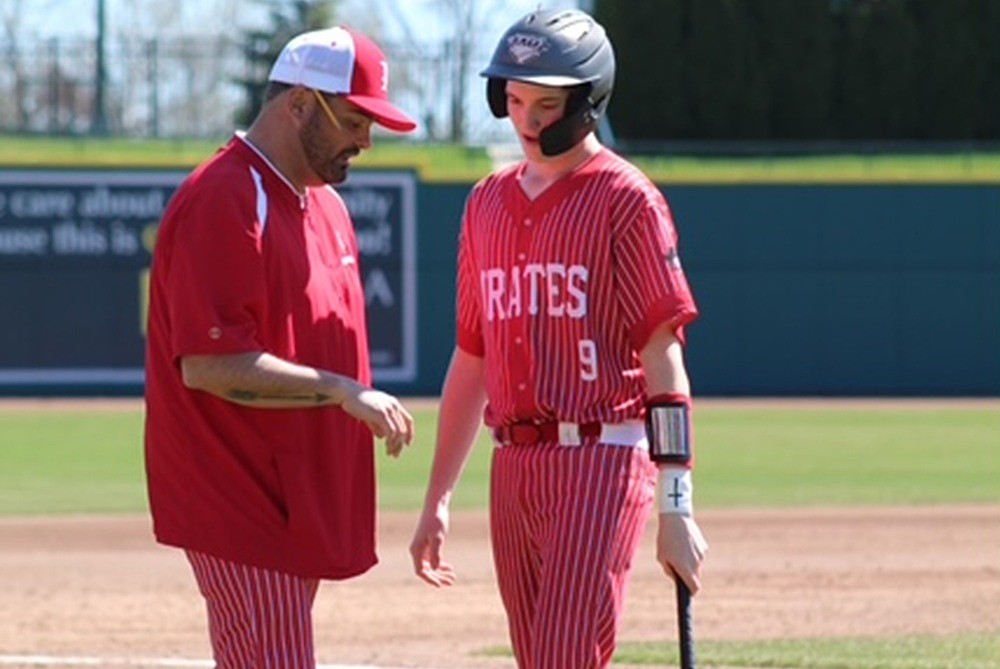
While the entire community was mourning Welch, it was also there to support his family – his wife Shane and son Grady, who is a junior at Peck.
 “I would say it definitely helped,” Grady said. “I felt like I wasn’t alone in grieving. Everyone in the whole community knew him, knew everything about him and what he stood for.”
The Welch family was part of the Peck community long before James began working at the school. He was a star athlete for the Pirates during the 1990s, playing football, basketball and baseball. He was part of the 1995 Peck football team that advanced to the Semifinals, and the 1994 baseball team that advanced to the Quarterfinals.
That 1994 team was inducted into the Peck High School Hall of Fame – something Welch worked with Kerr to establish – shortly after his passing.
“He was like one of those five-tool guys,” said Kerr, who graduated from Peck a year before Welch. “His best sport was football, but he was a very good baseball player.”
Now, while weather has not allowed them to get onto the field much for practice let alone play a game, Welch’s players are together again for the start of baseball season. Kluger has taken over the program as coach, which was announced in December.
“The day before we went on Christmas break, I called them all down to the gym, and I couldn’t say anything until the board approved it, so I had to sit on it for three weeks,” Kluger said. “I sat them all down, and I didn’t know how they were going to react. They didn’t seem upset about it. I got some hugs, got some claps, got some high fives.”
Not only were the players not upset, it’s the move they wanted as they had to move into a world without their coach.
“It definitely helped a lot,” Grady Welch said. “She knew how my dad ran practices, everyone knows her and she’s a nice person. It definitely helps to transition into baseball season knowing that things aren’t going to change.”
Of course, for Grady, it’s much more than simply not having a coach. He admits that the beginning of the season has been difficult – as does Kluger – but his teammates have been there to lift him up when he needs it. Many of them have been his teammates, and played for his father, since T-ball.
“I always have my space if I do need to take space,” Grady said. “But we’ve always been a group that’s been together all the time. We have a very good friendship between all of us.”
To honor James Welch, Kerr said supporters are working to create a scholarship in his name, and that his former high school number will be hung on the outfield fence at Peck.
Welch wore No. 9, as his father’s favorite player was Roger Maris. That number has been worn the past two years by Grady, who switched to it in middle school because of his dad.
Stepping onto the field in a game for the first time – which would be Thursday if weather permits – is certain to be an emotional moment for Kluger, Grady, his teammates and everyone in attendance. But it will also be the next step in honoring Welch by being together and playing the sport he loved.
“There’s a few that are going to struggle (emotionally),” Kluger said. “But I think at this point, they all want to be on the field and want to play.”
 Paul Costanzo served as a sportswriter at The Port Huron Times Herald from 2006-15, including three years as lead sportswriter, and prior to that as sports editor at the Hillsdale Daily News from 2005-06. He can be reached at [email protected] with story ideas for Genesee, Lapeer, St. Clair, Sanilac, Huron, Tuscola, Saginaw, Bay, Arenac, Midland and Gladwin counties.
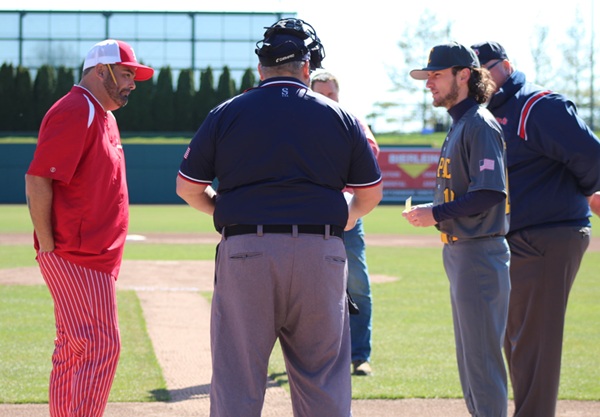
PHOTOS (Top) Peck baseball coach James Welch, left, talks with son Grady during a game from a recent season. (Middle) Welch, far left, stands at the plate for a pregame conference before taking on Capac. (Photos provided by Jen Kluger.)