


Teaching ABC's of Pressure Situations
October 30, 2013
 By Eric Martin
MSU Institute for the Study of Youth Sports
Coaches have seen the signs: Athletes having too much or not enough energy prior to a game, quickening breathing, sweating more than usual, being unable to focus on important details, and having their minds wander from the present to “what if” scenarios and past mistakes.
Athletes deal with pressure in many ways. Although some handle it well, many do not have the tools to perform to their full abilities in these situations. Most athletes place a high importance on succeeding in sport, and when athletes reach regional, district, or state championships, the pressure they feel may become overwhelming.
How athletes handle this increased pressure can often mean the difference between winning and losing. Therefore, helping athletes deal with it is something coaches should consider prior to athletes encountering these high-stakes situations.
Unfortunately, there is no magic elixir for helping your athletes work under pressure. But if these ABC’s of pressure situations are followed, your athletes will be much better equipped to cope, and the chances of their performance levels dropping significantly will be reduced.
1. Act the Part
How you as coaches act influences your athletes. For better or worse, athletes notice your emotions in response to these situations and take cues from how you handle pressure.
You are a demand on your players’ attention – you can add or reduce your players’ perceived stress by how you act. Understanding the demand you place on players requires self-awareness. How do you respond when a key call goes against you? Do you have nervous habits that athletes may notice? What messages are you providing to your athletes – both verbally and non-verbally? Athletes pick up on these non-verbal cues, so you must be aware of how you respond to these situations.
It is important to remember emotions are not always negative – rather acting differently than normal can be a signal to your athletes that you are stressed. Strive to be consistent in your actions – whether you are coaching during a preseason match or championship contest. These situations are stressful for you too, but you need to be the constant your athletes look to for stability.
2. Breathing – Remember to do it
It seems like a simple thing, but when athletes’ emotions are running high, they forget how to breathe – or, at least, forget how to breathe properly. Worse, they often think they are breathing normally but don’t notice breaths are becoming shorter and shallower. Teaching athletes to breathe properly when not in pressure situations will help them have the tools to rely on when they encounter more intense scenarios.
For proper breathing, athletes need to do so from the belly and not the chest. The pace of this breathing should be 6-2-7; that is, have athletes take a deep breath from the abdomen for six seconds, hold for two seconds, and then finally slowly exhale completely for seven seconds. This breathing strategy is ideal for pregame situations to quiet nerves and help athletes get ready to play, but a condensed version (3-2-3) can also be used for quick breaks in the action like a timeout or court change.
3. Control the controllables
During times of high pressure, athletes sometimes feel they do not have control over their own performances. It is important to help athletes focus on things they can control and not worry about those that cannot be changed or are outside their influence.
Instead of athletes dwelling on aspects that are out of their control like unusual game times for championship finals or a referee’s bad call, help them focus on completing their warm-up preparations and how they can respond to poor calls. Helping focus athletes’ attention on things they can control will help them better handle pressure situations and leave them feeling less helpless
Athletes’ emotions are typically out of their control, but how they view them and respond to these emotions are under their control. Author and preacher Charles R. Swindoll said, “Life is 10 percent what happens to you and 90 percent how you react to it!” Be sure your athletes know how to respond when difficult situations arise.
Conclusion: Fearlessness is an assembly
Not all athletes react to pressure situations in the same manner, but all athletes can benefit from these simple suggestions. Remember to ACT THE PART of how you want your athletes to act, teach your athletes proper BREATHING techniques, and help athletes focus on CONTROLLING THE CONTROLLABLES.
Good preparation is the key to performance. Increase self-monitoring and give athletes the tools to succeed in pressure situations; they, in turn, can be in a better position to succeed. However, like any skills, they must be practiced accordingly, and one session will not solve all issues. Devote the time to train athletes in these skills, and when the need arises they will have them ready to use.
Good luck this season!
Martin is a third-year doctoral student in the Institute for the Study of Youth Sports at Michigan State University. His research interests include athlete motivation and development of passion in youth, sport specialization, and coaches’ perspectives on working with the millennial athlete. He has led many sessions of the MHSAA Captains Leadership Clinic and consulted with junior high, high school, and collegiate athletes. If you have questions or comments, contact him at [email protected].
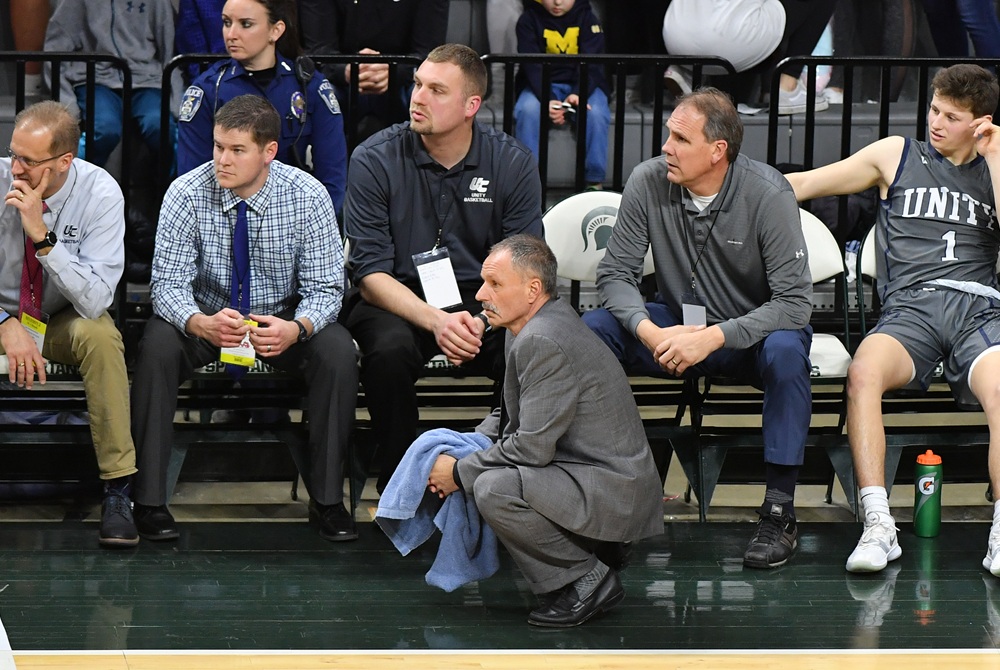
Soodsma Reaches 700 Boys Hoops Coaching Wins as Unity Launches Another Title Pursuit
By
Dean Holzwarth
Special for MHSAA.com
February 26, 2026
HUDSONVILLE – Hudsonville Unity Christian boys basketball coach Scott Soodsma has been a fixture on the sidelines for more than 40 years.
 And while he’s known as a man of faith, a fierce competitor and a coach who pours everything he has into his players, he’s most commonly known as the coach with the blue towel.
“I’ve had the same blue towel for 34 years at Unity, and it’s had holes in it and been sewed up a few times,” the 66-year-old Soodsma said. “It’s been around for a long time.”
The blue towel has been with Soodsma at every game, except for the first game this season against Grandville Calvin Christian.
“I had no idea where it was,” said Soodsma, who retired from teaching last year. “I stuck it in an old diaper bag and thought I would remember that I put it in there, but I didn’t. Luckily, my wife found it. I’ve never not had it except for that first game this year.”
The comfort of having a towel with him during games started during his first season (1983-84) at James Valley Christian, located in Huron, South Dakota.
It has been a lasting presence ever since, although the colors have changed.
“I had a pink towel when I coached girls at Unity, a yellow one at James Valley, and a maroon towel at McBain Northern Michigan Christian,” he said. “I don’t know, it’s just something I started having with me and I’ve had my wife run home from games when I've already been there and forgot it.
“I've sent her back home to get it because I didn’t want to coach without it. It’s been the thing I've been known for, for a long time.”
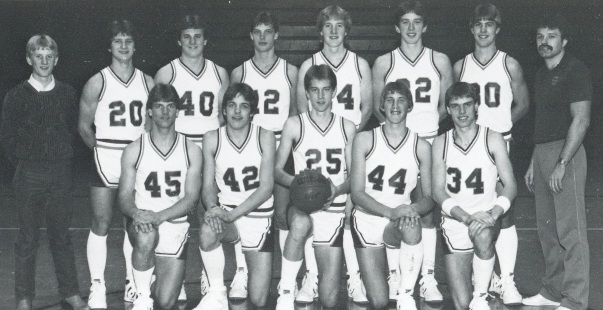 Soodsma had it with him when he earned his 700th career win as a boys coach in a 69-28 victory over Zeeland West on Feb. 12.
He currently is fifth on the list of winningest coaches in MHSAA boys basketball history with a 688-258 record coaching at Northern Michigan Christian and Unity.
“It’s really amazing, and I've been very blessed to be able to go the length I have gone,” Soodsma said. “There were times when I thought I was done and I was dumb enough to do girls for five years at the same time and I did one season when the girls and boys were together.
“I’ve had a lot of texts and calls from kids after the 700 wins went out in the public and those are things that make it all worthwhile, to hear the comments and the thank-yous for what you did and the part you played in their life. More valuable than that, wanting to be part of their journey and their faith as well has been a big deciding factor in why I've stayed in it.”
Soodsma, who has won over 800 games combined as a boys and girls coach, led McBain Northern Michigan Christian to the Class D boys title in 1987. He won the Division 2 championship at Unity in 2019.
He also coached Unity’s girls to the Class B crown in 2006.
“I still love it,” he said. “I love the kids and I love the competition, but over the years, most people don't realize it, but I have mellowed a lot and I think I’m in it for the right reasons because I enjoy the kids. I want to be a factor in their life, not only from a basketball perspective, but from a Christian perspective and a faith perspective. It means a lot more to me now at my age than when I was 35-40. It’s not about wins and losses anymore.”
Unity Christian senior Kyler Berguis said Soodsma has had a profound impact on his life.
In my three years of having him as my coach I’ve never had someone motivate me more to accomplish a goal we both love so much, and that is winning,” he said. “He’s an amazing motivator, always pushing kids to be their very best every single time he steps on the court, whether that is in practice, games or shootarounds, it doesn't matter.
“You will never not feel the energy that Coach brings to the court, and the crazy thing is he’s been doing it forever. He not only has pushed me in basketball but most importantly he pushes the players off the court in how to be a man of God.”
Past Crusaders standout Gabe Newhof, currently a senior at Division I James Madison in Virginia, said Soodsma’s compassion for his players runs deep.
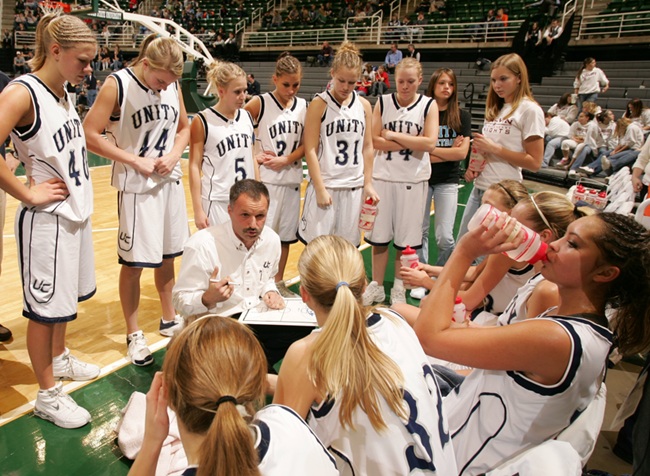 “Coach has had an incredible impact on my development as a young man,” Newhof said. “Through the mountains and valleys of my life, he has been there for me. When I suffered an awful broken leg, he came and visited me at my house to let me know he cared.
“During my successes in college he has always been a voice of encouragement. I am so glad to have had a coach like him who truly cares about me on a much deeper level than just a player.”
Soodsma has guided this year’s squad to an Ottawa-Kent Conference Black title, which included going a perfect 12-0 in league play, and a 20-3 overall record after Wednesday night’s Division 2 District Semifinal win over host Wyoming Godwin Heights.
The Crusaders’ losses were to state-ranked Rockford, Hudsonville and Freeland. Unity hopes for a deep postseason run but has been hampered recently by sickness and without a couple of its top players.
“This has been a special group,” said Soodsma, who boasts seven seniors. “The one thing we pride ourselves on at Unity is getting better as the year progresses, and I could really see the kids stepping up.
“We knew we had some good kids coming back, but I didn’t think we were playing exceptionally well in December or early January. But in the middle of the month, I started to see some kids really take some huge strides in a lot of ways. The kids have done a great job of coming together as a team, and it’s definitely shown. We’ve been playing some of the best ball we have all year.”
Soodsma has been asked frequently over the past few years when he is going to step away from coaching and retire.
He said he takes each season one at a time, but as he gets older he doesn’t want to miss out on moments with his grandkids, who are scattered through the country.
“I evaluate after every year, and I will evaluate again after this season, but this could be it,” Soodsma said. “I always like to wait till the end of the season before I make any rash decisions.
“I have family all over the United States in Seattle, Denver and South Dakota, so I really want to spend some quality time with my grandkids before they get too old."
 Dean Holzwarth has covered primarily high school sports for Grand Rapids-based WOOD-TV for five years after serving at the Grand Rapids Press and MLive for 16 years along with shorter stints at the Ionia Sentinel and WZZM. Contact him at [email protected] with story ideas for Allegan, Kent and Ottawa counties.
PHOTOS (Top) Unity Christian boys basketball coach Scott Soodsma, kneeling, confers with his staff during his team’s 2019 Division 2 Boys Semifinal win over Ludington. (Middle) Soodsma, far right, stands for a photo with his 1987 Northern Michigan Christian Class D boys basketball champion. (Below) Soodsma maps out strategy during a break in the 2006 Division 2 Girls Basketball Final. (MHSAA file photos.)