


Teaching ABC's of Pressure Situations
October 30, 2013
 By Eric Martin
MSU Institute for the Study of Youth Sports
Coaches have seen the signs: Athletes having too much or not enough energy prior to a game, quickening breathing, sweating more than usual, being unable to focus on important details, and having their minds wander from the present to “what if” scenarios and past mistakes.
Athletes deal with pressure in many ways. Although some handle it well, many do not have the tools to perform to their full abilities in these situations. Most athletes place a high importance on succeeding in sport, and when athletes reach regional, district, or state championships, the pressure they feel may become overwhelming.
How athletes handle this increased pressure can often mean the difference between winning and losing. Therefore, helping athletes deal with it is something coaches should consider prior to athletes encountering these high-stakes situations.
Unfortunately, there is no magic elixir for helping your athletes work under pressure. But if these ABC’s of pressure situations are followed, your athletes will be much better equipped to cope, and the chances of their performance levels dropping significantly will be reduced.
1. Act the Part
How you as coaches act influences your athletes. For better or worse, athletes notice your emotions in response to these situations and take cues from how you handle pressure.
You are a demand on your players’ attention – you can add or reduce your players’ perceived stress by how you act. Understanding the demand you place on players requires self-awareness. How do you respond when a key call goes against you? Do you have nervous habits that athletes may notice? What messages are you providing to your athletes – both verbally and non-verbally? Athletes pick up on these non-verbal cues, so you must be aware of how you respond to these situations.
It is important to remember emotions are not always negative – rather acting differently than normal can be a signal to your athletes that you are stressed. Strive to be consistent in your actions – whether you are coaching during a preseason match or championship contest. These situations are stressful for you too, but you need to be the constant your athletes look to for stability.
2. Breathing – Remember to do it
It seems like a simple thing, but when athletes’ emotions are running high, they forget how to breathe – or, at least, forget how to breathe properly. Worse, they often think they are breathing normally but don’t notice breaths are becoming shorter and shallower. Teaching athletes to breathe properly when not in pressure situations will help them have the tools to rely on when they encounter more intense scenarios.
For proper breathing, athletes need to do so from the belly and not the chest. The pace of this breathing should be 6-2-7; that is, have athletes take a deep breath from the abdomen for six seconds, hold for two seconds, and then finally slowly exhale completely for seven seconds. This breathing strategy is ideal for pregame situations to quiet nerves and help athletes get ready to play, but a condensed version (3-2-3) can also be used for quick breaks in the action like a timeout or court change.
3. Control the controllables
During times of high pressure, athletes sometimes feel they do not have control over their own performances. It is important to help athletes focus on things they can control and not worry about those that cannot be changed or are outside their influence.
Instead of athletes dwelling on aspects that are out of their control like unusual game times for championship finals or a referee’s bad call, help them focus on completing their warm-up preparations and how they can respond to poor calls. Helping focus athletes’ attention on things they can control will help them better handle pressure situations and leave them feeling less helpless
Athletes’ emotions are typically out of their control, but how they view them and respond to these emotions are under their control. Author and preacher Charles R. Swindoll said, “Life is 10 percent what happens to you and 90 percent how you react to it!” Be sure your athletes know how to respond when difficult situations arise.
Conclusion: Fearlessness is an assembly
Not all athletes react to pressure situations in the same manner, but all athletes can benefit from these simple suggestions. Remember to ACT THE PART of how you want your athletes to act, teach your athletes proper BREATHING techniques, and help athletes focus on CONTROLLING THE CONTROLLABLES.
Good preparation is the key to performance. Increase self-monitoring and give athletes the tools to succeed in pressure situations; they, in turn, can be in a better position to succeed. However, like any skills, they must be practiced accordingly, and one session will not solve all issues. Devote the time to train athletes in these skills, and when the need arises they will have them ready to use.
Good luck this season!
Martin is a third-year doctoral student in the Institute for the Study of Youth Sports at Michigan State University. His research interests include athlete motivation and development of passion in youth, sport specialization, and coaches’ perspectives on working with the millennial athlete. He has led many sessions of the MHSAA Captains Leadership Clinic and consulted with junior high, high school, and collegiate athletes. If you have questions or comments, contact him at [email protected].
Pilots' Record-Setting Coach Always Eager to Play Role in Helping Students Soar
By
Keith Dunlap
Special for MHSAA.com
November 13, 2025
As if they were fans standing outside an arena’s exit waiting for a famous rock star or professional athlete to come out, Warren De La Salle Collegiate students congregated outside a gate at Grand Ledge High School with bated breath.
 Instead of a rock star or athlete, the students had phones up waiting for Thaier Mukhtar, and let him know just how much he was loved.
“Mr. Mukhtar! Mr. Mukhtar!” the students chanted while mobbing him with praise.
Given what he has meant to the school and Michigan high school soccer for nearly four decades, it’s no wonder why the students waited him out.
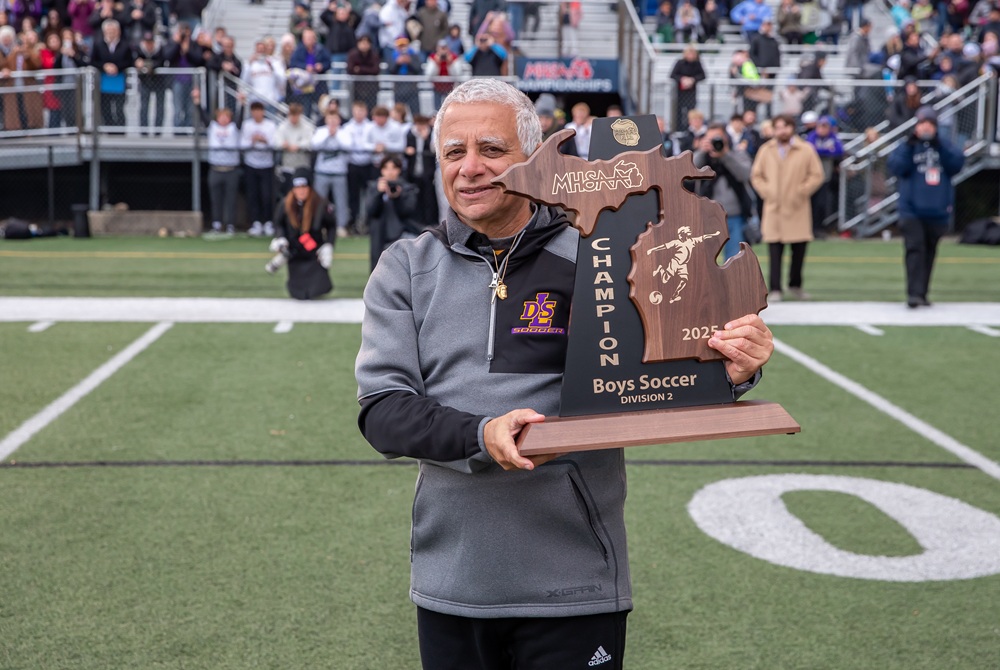
Mukhtar had just helped lead De La Salle to its seventh Finals championship with a 2-0 win over Hudsonville Unity Christian, and Mukhtar said he was now in elite company with a famous NFL quarterback.
“Everyone was making fun of me because Tom Brady had one more ring than me,” Mukhtar quipped. “Now he doesn’t.”
The Division 2 title was the second straight for De La Salle and finished off a recent stretch full of milestones.
Two seasons ago, Mukhtar became the all-time winningest boys soccer coach in state history when he surpassed Nick Archer of East Lansing by earning his 661st victory.
This year, Mukhtar reached the 600-win mark coaching for De La Salle. That achievement didn’t come with much fanfare, but that was by design and true to form.
“He didn’t celebrate a lot because it’s more about the team,” Pilots senior James Spicuzzi said. “We got him a signed ball, but that was really it. It’s more about the team for him than it is about himself.”
Mukhtar has tried to make that his emphasis since becoming the head coach of De La Salle in 1983 at the age of 23.
The Pilots won their first championship, in Class A, in 1990, and then consecutive titles in 1992 and 1993.
 After sharing the 2000 Division 1 title with Bloomfield Hills Brother Rice and then defeating Brother Rice to win the championship in 2005, De La Salle went on a title drought.
Mukhtar actually left his coaching post at De La Salle in 2011 and coached boys and girls soccer at Fraser from 2012-17 before returning as Pilots coach in 2018.
A social studies teacher at De La Salle for 30 years – a job he still holds – Mukhtar admits his coaching style can rub some the wrong way.
“I’m a demanding coach,” he said. “I’m a perfectionist. I call out every little mistake, and I make sure we work on those mistakes. I don’t care if we win 4-1 or 4-0, but are making mistakes. You’re not going to make those mistakes at the end of the year if you don’t want to send your team home.
“I have people – whether it’s parents or players – look at me like, ‘That guy is crazy. They just won the game.’ It ain’t about winning the damn game. It’s about getting here (to the state final) and not making those mistakes. Not committing the foul. Not being out of position. Not communicating in the back. Different things we harp on over and over again.”
Junior Andrew Corder, who led De La Salle with 38 goals this year, said it’s tough love that players have learned to embrace.
“It’s been kind of hard at times, but he just wants the best for us,” he said. “It’s all worth it.”
Mukhtar said he often thinks about retirement, but then points to something his son told him as a reason to keep running it back.
“Every year it’s a battle with me and my administration and, ‘Am I returning? Am I not returning?’ I say to take it year by year,” Mukhtar said. “My CEO at De La Salle made me guarantee that I give him two years (notice) at least. … I give two and then I always say, ‘Why am I doing this?’ My knee is killing me. But when my son says to me, ‘Dad, the fact that you get nervous and the fact you get excited means that you’re not ready (to retire).’ He said it perfectly, and he’s 100 percent right.”
Which is why Mukhtar is likely to continue coaching for the foreseeable future, and why more student celebrations should be in store.
“I’m still teaching at school when I don’t have to, and I’m still coaching when honestly I’ve done everything I’ve needed to do in my life,” Mukhtar said. “I’m like three wins away from 900 career victories coaching boys and girls. I’m still doing all these things because I feel like I can play a role in their life. It’s not just soccer. I want you to be able to believe in yourself and believe that you can accomplish whatever you work hard for. I teach my students the same thing.”
 Keith Dunlap has served in Detroit-area sports media for more than two decades, including as a sportswriter at the Oakland Press from 2001-16 primarily covering high school sports but also college and professional teams. His bylines also have appeared in USA Today, the Washington Post, the Detroit Free Press, the Houston Chronicle and the Boston Globe. He served as the administrator for the Oakland Activities Association’s website from 2017-2020. Contact him at [email protected] with story ideas for Oakland, Macomb and Wayne counties.
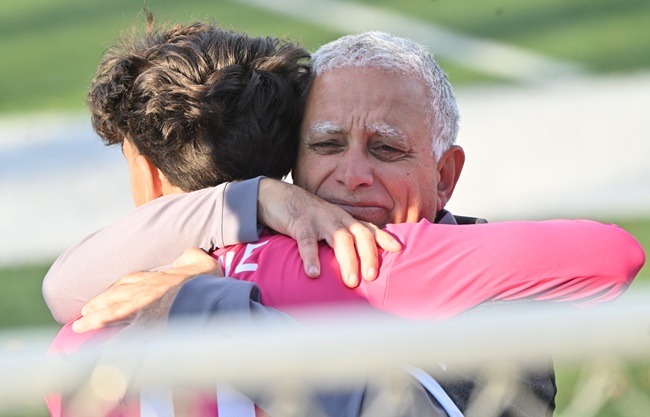
PHOTOS (Top) De La Salle boys soccer coach Thaier Mukhtar holds up his team’s championship trophy after the Pilots clinched the Division 2 title Nov. 1 at Grand Ledge High School. (Middle) Mukhtar embraces keeper Giovanni Vitale after his team’s 2024 championship win.