


Teaching ABC's of Pressure Situations
October 30, 2013
 By Eric Martin
MSU Institute for the Study of Youth Sports
Coaches have seen the signs: Athletes having too much or not enough energy prior to a game, quickening breathing, sweating more than usual, being unable to focus on important details, and having their minds wander from the present to “what if” scenarios and past mistakes.
Athletes deal with pressure in many ways. Although some handle it well, many do not have the tools to perform to their full abilities in these situations. Most athletes place a high importance on succeeding in sport, and when athletes reach regional, district, or state championships, the pressure they feel may become overwhelming.
How athletes handle this increased pressure can often mean the difference between winning and losing. Therefore, helping athletes deal with it is something coaches should consider prior to athletes encountering these high-stakes situations.
Unfortunately, there is no magic elixir for helping your athletes work under pressure. But if these ABC’s of pressure situations are followed, your athletes will be much better equipped to cope, and the chances of their performance levels dropping significantly will be reduced.
1. Act the Part
How you as coaches act influences your athletes. For better or worse, athletes notice your emotions in response to these situations and take cues from how you handle pressure.
You are a demand on your players’ attention – you can add or reduce your players’ perceived stress by how you act. Understanding the demand you place on players requires self-awareness. How do you respond when a key call goes against you? Do you have nervous habits that athletes may notice? What messages are you providing to your athletes – both verbally and non-verbally? Athletes pick up on these non-verbal cues, so you must be aware of how you respond to these situations.
It is important to remember emotions are not always negative – rather acting differently than normal can be a signal to your athletes that you are stressed. Strive to be consistent in your actions – whether you are coaching during a preseason match or championship contest. These situations are stressful for you too, but you need to be the constant your athletes look to for stability.
2. Breathing – Remember to do it
It seems like a simple thing, but when athletes’ emotions are running high, they forget how to breathe – or, at least, forget how to breathe properly. Worse, they often think they are breathing normally but don’t notice breaths are becoming shorter and shallower. Teaching athletes to breathe properly when not in pressure situations will help them have the tools to rely on when they encounter more intense scenarios.
For proper breathing, athletes need to do so from the belly and not the chest. The pace of this breathing should be 6-2-7; that is, have athletes take a deep breath from the abdomen for six seconds, hold for two seconds, and then finally slowly exhale completely for seven seconds. This breathing strategy is ideal for pregame situations to quiet nerves and help athletes get ready to play, but a condensed version (3-2-3) can also be used for quick breaks in the action like a timeout or court change.
3. Control the controllables
During times of high pressure, athletes sometimes feel they do not have control over their own performances. It is important to help athletes focus on things they can control and not worry about those that cannot be changed or are outside their influence.
Instead of athletes dwelling on aspects that are out of their control like unusual game times for championship finals or a referee’s bad call, help them focus on completing their warm-up preparations and how they can respond to poor calls. Helping focus athletes’ attention on things they can control will help them better handle pressure situations and leave them feeling less helpless
Athletes’ emotions are typically out of their control, but how they view them and respond to these emotions are under their control. Author and preacher Charles R. Swindoll said, “Life is 10 percent what happens to you and 90 percent how you react to it!” Be sure your athletes know how to respond when difficult situations arise.
Conclusion: Fearlessness is an assembly
Not all athletes react to pressure situations in the same manner, but all athletes can benefit from these simple suggestions. Remember to ACT THE PART of how you want your athletes to act, teach your athletes proper BREATHING techniques, and help athletes focus on CONTROLLING THE CONTROLLABLES.
Good preparation is the key to performance. Increase self-monitoring and give athletes the tools to succeed in pressure situations; they, in turn, can be in a better position to succeed. However, like any skills, they must be practiced accordingly, and one session will not solve all issues. Devote the time to train athletes in these skills, and when the need arises they will have them ready to use.
Good luck this season!
Martin is a third-year doctoral student in the Institute for the Study of Youth Sports at Michigan State University. His research interests include athlete motivation and development of passion in youth, sport specialization, and coaches’ perspectives on working with the millennial athlete. He has led many sessions of the MHSAA Captains Leadership Clinic and consulted with junior high, high school, and collegiate athletes. If you have questions or comments, contact him at [email protected].
Century of School Sports: Predecessors Laid Foundation for MHSAA's Formation
By
Geoff Kimmerly
MHSAA.com senior editor
January 14, 2025
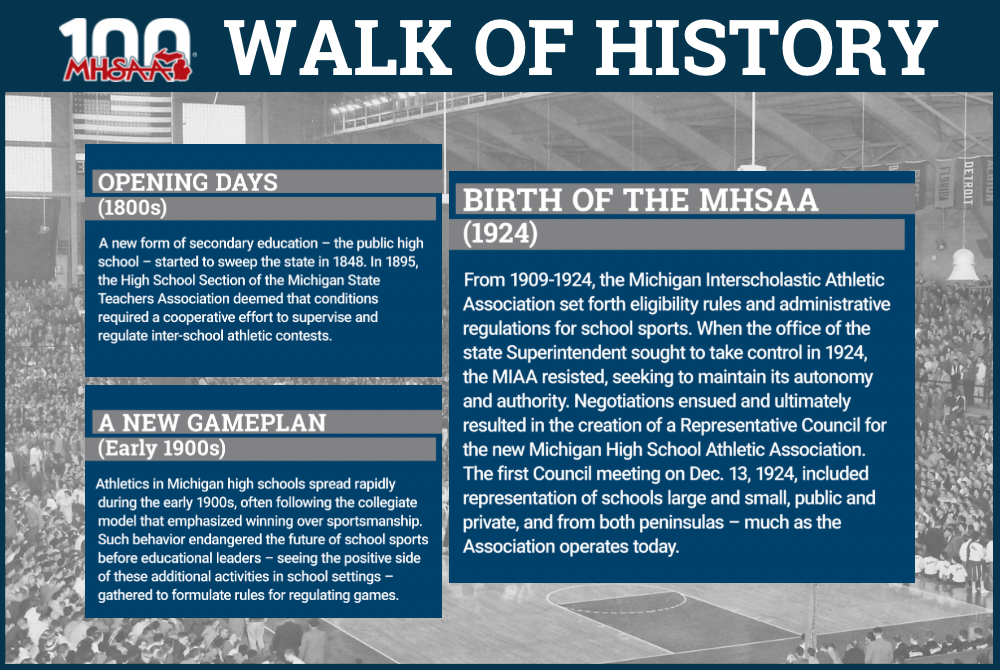
We have celebrated throughout this school year the 100th anniversary of the Michigan High School Athletic Association – our “Century of School Sports.” But the first high school sports in this state were being played more than a half-century before the MHSAA was established in December 1924 – and it’s important to recognize our predecessor organizations for their pioneering work.
To keep things very brief, it’s fair to say that high school athletics in Michigan followed the increase in number high schools across the state – especially public schools – as well as interest in sports predominantly at the college level.
In lieu of citing detail by detail, the following is based on research from “Athletics in Michigan High Schools – The First Hundred Years” by L.L. Forsythe, who served as the first president of the MHSAA Representative Council after playing a leading role in its creation as an officer of the previous Michigan Interscholastic Athletic Association. Newspaper reports of the day also contributed to what's summarized below.
It is also key to keep in mind a few things about the organizations that regulated high school athletics before the MHSAA, and to understand their relation to our work today:
- Schools at the start of organized athletics sought primarily to create competitive equity and a safe playing environment for their teams and athletes.
- Schools looked to the statewide organization to uphold and consider appeals for those rules regulating eligibility and fair play.
- Schools later asked for the statewide organization to take over sponsorship of the statewide championship events that began to crop up over the 30 years before the MHSAA formed.
According to Forsythe’s research, the first public high schools in Michigan opened during the middle of the 19th century – as of 1850, only 3-4 existed, but after the Civil War that number began to grow, and with it an interest in athletics as part of student life. Football and baseball were main draws, later to be joined by basketball and track & field – which would be among the MHSAA’s first championship offerings several years later.
The Beginning (1895-1909)
Forsythe notes that 1895 saw the first steps toward regulating high school athletics on a statewide basis. A few entities took on roles in an attempt to bring structure.
- The Michigan State Teachers Association, which in 1895 began to recruit schools to become part of an organization that would require eligible athletes to be enrolled students, succeeding academically with at least a “passing grade,” and participating in no more than five seasons or years of a sport. However, the MSTA did not have a program of activities, as those of the day were generally organized by universities.
- The University Athletic Association was formed by University of Michigan in 1898, and was the main organizer of invitational “state” championships in partnership with the MSTA.
- Another organization, the Michigan Inter-School Athletic Association, also pops up in 1895 as the host of what aspired to be an annual field day.
Michigan Interscholastic Athletic Association (1909-1924)
The Michigan Schoolmasters’ Club absorbed control of athletics from the MSTA in April 1909, forming the MIAA and immediately introducing a series of regulations including an age limit of 21 years old, an eligibility limit of four years, and a restriction on participation by athletes who had competed professionally.
The MIAA would continue to set other eligibility rules, charge dues ($1), and also write into bylaws that member schools could play only member schools. That latter detail was a big driver of growth – the revised MIAA constitution in 1921 added that regulation, and the association grow from 26 schools in 1920 to 130 in 1921, to 284 in 1922 to 305 schools in 1923.
On the event side, the MIAA conducted its first state track meet in 1912, then did so coordinating with Michigan State College. The 1921 basketball tournament saw the first mention of classes – Class B for schools with 250 or fewer students, and Class A for schools with more than 250.
It should also be noted that during the early 1920s, MIAA representatives helped form the organization (first of Midwest states) that would become the National Federation of State High School Associations (NFHS) – which continues to write game rules for nearly all MHSAA sports.
The MIAA continued operating into its annual meeting in December 1923, when leaders were presented with an unwelcome surprise announcement – the Michigan legislature, at the close of its recent session, had transferred supervision of interscholastic athletics to the state Superintendent of Public Instruction (to the superintendent's surprise as well, Forsythe noted).
The negotiations between schools and the state over the following year resulted in the dissolution of the MIAA on Dec. 5, 1924 – and the first meeting of the MHSAA eight days later.
Previous "Century of School Sports" Spotlights
Jan. 9: MHSAA Blazes Trail Into Cyberspace - Read
Dec. 31: State's Storytellers Share Winter Memories - Read
Dec. 17: MHSAA Over Time - Read
Dec. 10: On This Day, December 13, We Will Celebrate - Read
Dec. 3: MHSAA Work Guided by Representative Council - Read
Nov. 26: Finals Provide Future Pros Early Ford Field Glory - Read
Nov. 19: Connection at Heart of Coaches Advancement Program - Read
Nov. 12: Good Sports are Winners Then, Now & Always - Read
Nov. 5: MHSAA's Home Sweet Home - Read
Oct. 29: MHSAA Summits Draw Thousands to Promote Sportsmanship - Read
Oct. 23: Cross Country Finals Among MHSAA's Longest Running - Read
Oct. 15: State's Storytellers Share Fall Memories - Read
Oct. 8: Guided by 4 S's of Educational Athletics - Read
Oct. 1: Michigan Sends 10 to National Hall of Fame - Read
Sept. 25: MHSAA Record Books Filled with 1000s of Achievements - Read
Sept. 18: Why Does the MHSAA Have These Rules? - Read
Sept. 10: Special Medals, Patches to Commemorate Special Year - Read
Sept. 4: Fall to Finish with 50th Football Championships - Read
Aug. 28: Let the Celebration Begin - Read