

Using Heads in the Heat of Competition
December 20, 2013
By Rob Kaminski
MHSAA benchmarks editor
With so much recent attention to the risks and recognition of concussions in collision sports, athletic leaders have put their heads together to address far more common – but often overlooked – threats to the health of our student-athletes: heat and sudden cardiac arrest.
The No. 1 killer of young athletes is sudden cardiac arrest, while heat stroke victims can surpass that during the year’s hottest months. While the moment of impact leading to a concussion is totally unpredictable, athletic trainers, coaches and administrators have the ability to diminish the occurrences of cardiac arrest and heatstroke. Typically, there is a pre-existing condition, or family history suggesting probabilities for sudden cardiac arrest, which can be treated when detected. And, the perils associated with hot weather – heat stroke, prostration – are almost always completely preventable.
The MHSAA has addressed both issues recently. With assistance from numerous medical governing bodies, the annual pre-participation physical form was revamped and expanded prior to the 2011-12 school year to include comprehensive information regarding participants’ medical history.
In May, the Representative Council adopted a Model Policy for Managing Heat & Humidity (see below), a plan many schools have since adopted at the local level. The plan directs schools to monitor the heat index at an activity site once the air temperature reaches 80 degrees and provides recommendations when the heat index reaches certain levels, including ceasing activities when it rises above 104 degrees.
The topic of heat-related illnesses receives a lot of attention at the start of fall when deaths at the professional, collegiate and interscholastic levels of sport occur, especially since they are preventable in most cases with the proper precautions. In football, data from the National Federation of State High School Associations shows 41 high school players died from heat stroke between 1995 and 2012.
“We know now more than we ever have about when the risk is high and who is most at risk, and we’re now able to communicate that information better than ever before to administrators, coaches, athletes and parents," said Jack Roberts, executive director of the MHSAA. “Heat stroke is almost always preventable, and we encourage everyone to avail themselves of the information on our website.
“Schools need to be vigilant about providing water during practices, making sure that students are partaking of water and educating their teams about the need for good hydration practices.”
All of which is not to say concussions aren’t a serious matter; they are. In fact, leaders in sport safety can take advantage of the concussion spotlight to illuminate these additional health threats.
A recent New York Times story (May 2013) by Bill Pennington featured a February 2013 gathering in Washington organized by the National Athletic Trainers Association. In the article, Dr. Douglas J. Casa, professor of kinesiology at the University of Connecticut and Chief Operating Officer of the Korey Stringer Institute (founded in the late NFL offensive lineman’s name to promote prevention of sudden death in sport), suggests just that.
“All the talk about head injuries can be a gateway for telling people about the other things they need to know about, like cardiac events and heat illness,” said Casa in the article. “It doesn’t really matter how we get through to people as long as we continue to make sports safer.”
Education and prevention methods need to find a permanent place in school programs if those programs are to thrive and avoid becoming targets at which special interest groups can aim budgetary arrows.
Dr. Jonathan Drezner, the president of the American Medical Society for Sports Medicine, said in the New York Times piece that sudden cardiac arrest is “so incredibly tragic and stunning that people aren’t comfortable putting it into the everyday conversation. I do wish, to some extent, it was something people talked more about because we are getting to a place where we could prevent many of these deaths.”
When it comes to heat-related deaths or illnesses, the prevention efforts can be even more successful by educating the masses. And, these efforts can be done at minimal cost to schools.
“That’s the thing about curtailing exertional heat illness: it’s 100 percent preventable, and unlike other health threats to athletes, the solutions can be very low-tech and inexpensive,” said Dr. Michael F. Bergeron, the director of the National Institute for Athletic Health & Performance at the University of South Dakota’s Sanford Medical Center, in the New York Times story.
To assist with cost and data maintenance, the MHSAA has teamed with Sports Health to provide schools with psychrometers (heat measurement instruments) at a discounted rate, and has built online tools to track heat and humidity conditions.
Managing heat and humidity policy
- Thirty minutes prior to the start of an activity, and again 60 minutes after the start of that activity, take temperature and humidity readings at the site of the activity. Using a digital sling psychrometer is recommended. Record the readings in writing and maintain the information in files of school administration. Each school is to designate whose duties these are: generally the athletic director, head coach or certified athletic trainer.
- Factor the temperature and humidity into a Heat Index Calculator and Chart to determine the Heat Index. If a digital sling psychrometer is being used, the calculation is automatic.
If the Heat Index is below 95 degrees:
All Sports
- Provide ample amounts of water. This means that water should always be available and athletes should be able to take in as much water as they desire.
- Optional water breaks every 30 minutes for 10 minutes in duration.
- Ice-down towels for cooling.
- Watch/monitor athletes carefully for necessary action.
If the Heat Index is 95 degrees to 99 degrees:
All Sports
- Provide ample amounts of water. This means that water should always be available and athletes should be able to take in as much water as they desire.
- Optional water breaks every 30 minutes for 10 minutes in duration.
- Ice-down towels for cooling.
- Watch/monitor athletes carefully for necessary action.
Contact sports and activities with additional equipment:
- Helmets and other possible equipment removed while not involved in contact.
- Reduce time of outside activity. Consider postponing practice to later in the day.
- Recheck temperature and humidity every 30 minutes to monitor for increased Heat Index.
If the Heat Index is above 99 degrees to 104 degrees:
All Sports
- Provide ample amounts of water. This means that water should always be available and athletes should be able to take in as much water as they desire.
- Mandatory water breaks every 30 minutes for 10 minutes in duration.
- Ice-down towels for cooling.
- Watch/monitor athletes carefully for necessary action.
- Alter uniform by removing items if possible.
- Allow for changes to dry T-shirts and shorts.
- Reduce time of outside activity as well as indoor activity if air conditioning is unavailable.
- Postpone practice to later in the day.
Contact sports and activities with additional equipment
- Helmets and other possible equipment removed if not involved in contact or necessary for safety.
- If necessary for safety, suspend activity.
Recheck temperature and humidity every 30 minutes to monitor for increased Heat Index.
If the Heat Index is above 104 degrees:
All sports
- Stop all outside activity in practice and/or play, and stop all inside activity if air conditioning is unavailable.
Note: When the temperature is below 80 degrees there is no combination of heat and humidity that will result in need to curtail activity.
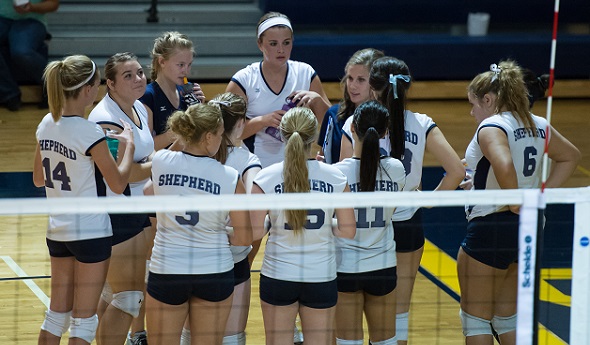
PHOTO: The Shepherd volleyball team includes hydration during a timeout in a match this fall.

2020 Bush Awards Honor Dedicated ADs
By
Geoff Kimmerly
MHSAA.com senior editor
October 21, 2020
East Grand Rapids’ Tim Johnston, Maple City Glen Lake’s Mark Mattson, Vicksburg’s Michael Roy and Gaylord’s Christian Wilson all lead programs that frequently earn headlines for success in competition.
But these four athletic directors also are known in their local and statewide sports communities for the positive experiences they help provide students, their own as well as those who take part in the same leagues or tournament events they frequently host.
To honor their often unsung work in creating these experiences for athletes, all four have been named recipients of the Michigan High School Athletic Association’s Allen W. Bush Award for 2020.
Al Bush served as executive director of the MHSAA for 10 years. The award honors individuals for past and continuing service to prep athletics as a coach, administrator, official, trainer, doctor or member of the media. The award was developed to bring recognition to men and women who are giving and serving without a lot of attention. This is the 29th year of the award, with selections made by the MHSAA's Representative Council.
“Leaders among peers, ceaseless dedication, never saying ‘no’ when needed – these are how this year’s Bush Award honorees are described by their colleagues, and how we’ve come to know them as well,” MHSAA Executive Director Mark Uyl said. “What they give willingly for school sports goes far beyond awards they’ve received, and at the same time often receives little attention. We’re delighted to recognize all of their continuing contributions.”
Johnston has begun his 39th year in education, with the last eight for East Grand Rapids Public Schools, where he has led one of the state’s most successful athletic programs – EGR, which offers 34 varsity sports, was named a Michigan Exemplary Athletic Program in 2018 by the Michigan Interscholastic Athletic Administrators Association (MIAAA). Johnson was chosen as his region’s Athletic Director of the Year by the MIAAA in 2017. He previously served as a teacher and coach at Grand Rapids Catholic Central, and then as an athletic director and principal at Hastings.
 He has made significant contributions to Michigan’s largest high school league, having served as president, vice president, secretary and realignment chairperson for the Ottawa-Kent Conference, and hosted various MHSAA Tournament competitions for the District, Regional and Finals rounds. Johnston also has served on multiple MHSAA sport committees and its board of canvassers, and as part of the Scholar-Athlete Award selection committee. Additionally, he has served as an instructor for the MHSAA’s Coaches Advancement Program (CAP) and as a program presenter at conferences for both the MIAAA and National Interscholastic Athletic Administrators Association (NIAAA) – and served as Michigan’s delegate to the latter.
After graduating from Grand Rapids Catholic Central, Johnston earned an associate degree from Grand Rapids Junior College and a bachelor’s from Grand Valley State University, and then a master’s in education leadership from Michigan State University. He earned his certified athletic administrator (CAA) designation from the NIAAA.
“Tim has always been incredibly positive in advocating for kids,” MHSAA Executive Director Mark Uyl said. “I’ve known Tim for years as a principal and as an athletic director, and there’s absolutely no one who better sees the big picture of how academics and athletics fit together.”
Mattson is into his 22nd year coaching, teaching or serving as an administrator in Michigan high schools, and in his second tenure as athletic director at Maple City Glen Lake. He previously served in the same role and others at Marquette High School for 11 years and then as athletic director at Traverse City Central before returning to Glen Lake as athletic director and assistant principal. He also coached and taught in Rhinelander, Wis., to begin his career, and served as an undergrad men’s basketball assistant coach at Northern Michigan University.
 Mattson also is a frequent MHSAA Tournament host and participated on sport committees for skiing, football, basketball, cross country and track & field, and has served as an MIAAA regional representative and as secretary for the Big North Conference. He received MIAAA regional Athletic Director of the Year awards in both 2008 and 2018, and was selected as the Upper Peninsula Athletic Director of the Year in 2006.
A current member of the MHSAA Representative Council – representing Class C and D schools in the northern Lower Peninsula – Mattson is a graduate of L’Anse High School and earned his bachelor’s degree and then his master’s in educational administration both from NMU. While at NMU and into his tenure at Marquette, Mattson also was a registered MHSAA official in football and basketball for a decade and briefly for softball and volleyball.
“Mark, having served his career in northern Michigan and the Upper Peninsula, always brings a unique perspective on how the largest schools survive in northern Michigan,” Uyl said. “Schools like Marquette and Traverse City Central face a unique challenge. He’s always been an advocate for schools with those unique circumstances – but also for all schools up north, and especially now as part of the Representative Council.”
Roy is a graduate of Paw Paw High School who returned to Michigan after earning bachelor’s and master’s degrees – the latter in curriculum and instruction – at the University of Nevada-Las Vegas, where he also was a member of the football team for two years. He is into his 22nd year as an athletic administrator, serving three years at Lawton before joining the Vicksburg administration at the start of the 2001-02 school year. He has hosted more than 100 MHSAA postseason events and numerous CAP sessions while also serving as a CAP instructor, and his Vicksburg program received the Exemplary Athletic Program award in 2020.
 Roy served as president of the MIAAA during the 2019-20 school year and has made vast contributions as part of the athletic directors’ professional organization with more than 15 years as a regional representative and 10 times serving as the state’s NIAAA delegate at the National Federation of State High School Associations (NFHS) national conference. He has served more than a decade as a Leadership Training Institute instructor for the MIAAA and as part of the NIAAA national teaching faculty.
He has received three certifications from the NIAAA including the certified master athletic administrator designation in 2005. Roy was named his region’s Athletic Director of the Year by the MIAAA in 2009 and state Athletic Director of the Year in 2012 – when he was also a finalist for national Athletic Director of the Year from the National High School Coaches Association.
“Mike has been incredibly giving with his time, especially with his leadership with the MIAAA,” Uyl said. “He has a can-do attitude, whether it be in hosting events or with other problem-solving he’s provided our entire MHSAA staff over many years.”
Wilson is into his 19th year in education, serving as athletic director and assistant principal for Gaylord Community schools; he also briefly served as athletic director at Novi High School and as high school athletic director in Mount Gilead, Ohio, and taught in Auburndale, Wis.
 Wilson also is a frequent host of MHSAA Tournament events – he hosted more than 10 during the 2019-20 school year alone – and also has served on various MHSAA committees. He has served as president of the Big North Conference and provided his expertise to the local Little League and youth football boards. He was named his region’s Athletic Director of the Year by the MIAAA in 2016.
A graduate of Chassell High School, Wilson then earned his bachelor’s degree from Northern Michigan University and a master’s in athletic administration from Western Michigan University. Prior to beginning his career in education, Wilson served as an assistant men’s basketball coach at both Michigan Technological University and Western Michigan. He played at Michigan Tech before finishing his career at NMU.
“Christian has been a successful administrator for many years because of his outstanding temperament and the way he connects with people,” Uyl said. “He’s someone who takes the work seriously, but never takes himself too seriously. He has served as a mentor to so many, and he’s very gifted at building relationships. At the end of the day, that’s what our business is about – those relationships.”
The MHSAA is a private, not-for-profit corporation of voluntary membership by more than 1,500 public and private senior high schools and junior high/middle schools which exists to develop common rules for athletic eligibility and competition. No government funds or tax dollars support the MHSAA, which was the first such association nationally to not accept membership dues or tournament entry fees from schools. Member schools which enforce these rules are permitted to participate in MHSAA tournaments, which attract more than 1.4 million spectators each year.