


Using Heads in the Heat of Competition
December 20, 2013
By Rob Kaminski
MHSAA benchmarks editor
With so much recent attention to the risks and recognition of concussions in collision sports, athletic leaders have put their heads together to address far more common – but often overlooked – threats to the health of our student-athletes: heat and sudden cardiac arrest.
The No. 1 killer of young athletes is sudden cardiac arrest, while heat stroke victims can surpass that during the year’s hottest months. While the moment of impact leading to a concussion is totally unpredictable, athletic trainers, coaches and administrators have the ability to diminish the occurrences of cardiac arrest and heatstroke. Typically, there is a pre-existing condition, or family history suggesting probabilities for sudden cardiac arrest, which can be treated when detected. And, the perils associated with hot weather – heat stroke, prostration – are almost always completely preventable.
The MHSAA has addressed both issues recently. With assistance from numerous medical governing bodies, the annual pre-participation physical form was revamped and expanded prior to the 2011-12 school year to include comprehensive information regarding participants’ medical history.
In May, the Representative Council adopted a Model Policy for Managing Heat & Humidity (see below), a plan many schools have since adopted at the local level. The plan directs schools to monitor the heat index at an activity site once the air temperature reaches 80 degrees and provides recommendations when the heat index reaches certain levels, including ceasing activities when it rises above 104 degrees.
The topic of heat-related illnesses receives a lot of attention at the start of fall when deaths at the professional, collegiate and interscholastic levels of sport occur, especially since they are preventable in most cases with the proper precautions. In football, data from the National Federation of State High School Associations shows 41 high school players died from heat stroke between 1995 and 2012.
“We know now more than we ever have about when the risk is high and who is most at risk, and we’re now able to communicate that information better than ever before to administrators, coaches, athletes and parents," said Jack Roberts, executive director of the MHSAA. “Heat stroke is almost always preventable, and we encourage everyone to avail themselves of the information on our website.
“Schools need to be vigilant about providing water during practices, making sure that students are partaking of water and educating their teams about the need for good hydration practices.”
All of which is not to say concussions aren’t a serious matter; they are. In fact, leaders in sport safety can take advantage of the concussion spotlight to illuminate these additional health threats.
A recent New York Times story (May 2013) by Bill Pennington featured a February 2013 gathering in Washington organized by the National Athletic Trainers Association. In the article, Dr. Douglas J. Casa, professor of kinesiology at the University of Connecticut and Chief Operating Officer of the Korey Stringer Institute (founded in the late NFL offensive lineman’s name to promote prevention of sudden death in sport), suggests just that.
“All the talk about head injuries can be a gateway for telling people about the other things they need to know about, like cardiac events and heat illness,” said Casa in the article. “It doesn’t really matter how we get through to people as long as we continue to make sports safer.”
Education and prevention methods need to find a permanent place in school programs if those programs are to thrive and avoid becoming targets at which special interest groups can aim budgetary arrows.
Dr. Jonathan Drezner, the president of the American Medical Society for Sports Medicine, said in the New York Times piece that sudden cardiac arrest is “so incredibly tragic and stunning that people aren’t comfortable putting it into the everyday conversation. I do wish, to some extent, it was something people talked more about because we are getting to a place where we could prevent many of these deaths.”
When it comes to heat-related deaths or illnesses, the prevention efforts can be even more successful by educating the masses. And, these efforts can be done at minimal cost to schools.
“That’s the thing about curtailing exertional heat illness: it’s 100 percent preventable, and unlike other health threats to athletes, the solutions can be very low-tech and inexpensive,” said Dr. Michael F. Bergeron, the director of the National Institute for Athletic Health & Performance at the University of South Dakota’s Sanford Medical Center, in the New York Times story.
To assist with cost and data maintenance, the MHSAA has teamed with Sports Health to provide schools with psychrometers (heat measurement instruments) at a discounted rate, and has built online tools to track heat and humidity conditions.
Managing heat and humidity policy
- Thirty minutes prior to the start of an activity, and again 60 minutes after the start of that activity, take temperature and humidity readings at the site of the activity. Using a digital sling psychrometer is recommended. Record the readings in writing and maintain the information in files of school administration. Each school is to designate whose duties these are: generally the athletic director, head coach or certified athletic trainer.
- Factor the temperature and humidity into a Heat Index Calculator and Chart to determine the Heat Index. If a digital sling psychrometer is being used, the calculation is automatic.
If the Heat Index is below 95 degrees:
All Sports
- Provide ample amounts of water. This means that water should always be available and athletes should be able to take in as much water as they desire.
- Optional water breaks every 30 minutes for 10 minutes in duration.
- Ice-down towels for cooling.
- Watch/monitor athletes carefully for necessary action.
If the Heat Index is 95 degrees to 99 degrees:
All Sports
- Provide ample amounts of water. This means that water should always be available and athletes should be able to take in as much water as they desire.
- Optional water breaks every 30 minutes for 10 minutes in duration.
- Ice-down towels for cooling.
- Watch/monitor athletes carefully for necessary action.
Contact sports and activities with additional equipment:
- Helmets and other possible equipment removed while not involved in contact.
- Reduce time of outside activity. Consider postponing practice to later in the day.
- Recheck temperature and humidity every 30 minutes to monitor for increased Heat Index.
If the Heat Index is above 99 degrees to 104 degrees:
All Sports
- Provide ample amounts of water. This means that water should always be available and athletes should be able to take in as much water as they desire.
- Mandatory water breaks every 30 minutes for 10 minutes in duration.
- Ice-down towels for cooling.
- Watch/monitor athletes carefully for necessary action.
- Alter uniform by removing items if possible.
- Allow for changes to dry T-shirts and shorts.
- Reduce time of outside activity as well as indoor activity if air conditioning is unavailable.
- Postpone practice to later in the day.
Contact sports and activities with additional equipment
- Helmets and other possible equipment removed if not involved in contact or necessary for safety.
- If necessary for safety, suspend activity.
Recheck temperature and humidity every 30 minutes to monitor for increased Heat Index.
If the Heat Index is above 104 degrees:
All sports
- Stop all outside activity in practice and/or play, and stop all inside activity if air conditioning is unavailable.
Note: When the temperature is below 80 degrees there is no combination of heat and humidity that will result in need to curtail activity.
PHOTO: The Shepherd volleyball team includes hydration during a timeout in a match this fall.
Adrian Madison's Isom Leads at All Levels
By
Geoff Kimmerly
MHSAA.com senior editor
February 21, 2019
Over more than three decades, Adrian Madison athletic director Kris Isom has taken on responsibilities not only in her league and regionally, but statewide as a member of the MHSAA Representative Council – in addition to her athletic department responsibilities at the high school and junior high.
And yet, she still teaches multiple classes and coaches at least one of the district’s teams every year, serving and building relationships at the most local level of her wide influence on educational athletics.
She’s made those relationships a priority, also serving as class advisor to Madison students through last year when her daughter Rachel graduated. One year during the 1990s, in fact, the graduating class even dedicated its yearbook to her.
 “I like being in the classroom and coaching because I still have a connection with kids, know who they are,” Isom said. “Being at a smaller school, you’re able to know who kids are, but at the middle school especially I don’t know a lot. Getting involved in coaching has helped me put a name with a face so I will know them coming up.”
She continues to impact students at Madison and beyond, and will be recognized for her many contributions with the 32nd Women In Sports Leadership Award during halftime of the Division 3 Girls Basketball Final on March 23 at Calvin College’s Van Noord Arena.
Each year, the Representative Council considers the achievements of women coaches, officials and athletic administrators affiliated with the MHSAA who show exemplary leadership capabilities and positive contributions to athletics.
Isom is in her 33rd year as athletic director at Adrian Madison, taking over athletics for the high school and junior high after serving as a teacher and coach for a year at Clinton. She has served as part of the MHSAA Representative Council since 2008, representing Class C and D schools from the state’s southeastern section.
“I’m very honored by this award, not only because it’s for women in leadership. I’ve been doing this 33 years and I’ve seen more and more women in this profession … that for all things considered is a man’s profession,” Isom said. “Having a daughter, who while she’s not following my footsteps, but getting her in the business world eventually, it’s a good feeling.”
Isom’s contributions to high school sports and its participants are many and at all levels. Within her district, she has coached basketball, volleyball, sideline cheer, track & field and softball – at least one sport every year, including as the eighth grade girls basketball coach this season.
At the league level, Isom has served as president of the Tri-County Conference since 2002 after previously serving as vice president and secretary/treasurer. Serving more of her neighboring districts, Isom has hosted numerous District, Regional and Quarterfinal competitions and MHSAA Coaches Advancement Program (CAP) sessions.
At the statewide level, Isom has provided her expertise as a member of the Representative Council and as a 33-year member of the Michigan Interscholastic Athletic Administrators Association and National Interscholastic Athletic Administrators Association. She also assists MHSAA staff annually in selecting members of the 16-student Student Advisory Council.
She was named the MIAAA’s Region 6 “Athletic Director of the Year” in 2000 and received the MHSAA’s Allen W. Bush Award in 2016 to recognize her many behind-the-scenes contributions.
“Kris Isom continues to provide a steadying presence on our Representative Council. She researches issues and really brings a voice of reason to the discussion – not only to the full Council, but to the Executive Committee as well,” MHSAA Executive Director Mark Uyl said. “She does a great job representing the southeastern corner of the state, bringing a small-school perspective to the table time after time. We’re thankful for her leadership and glad to present her with the Women In Sports Leadership Award.”
Part of leadership is being an example, and Isom has served as one for many. Of course that growing group included her daughter who this year left home to study in the dental hygiene program at Jackson College but has frequently been by Mom’s side for the many activities.
“Hopefully, (she learned) to be assertive, that she needs to be a good listener, and obviously you have to be a mediator,” Kris Isom said. “Hopefully seeing all those aspects, and dealing with situations and different issues, she’ll be a better problem solver, be more open (to the idea) that there is more than one side of a story.”
A graduate of Clinton High School, Isom received her bachelor’s degree in science and teaching certification in physical education and health in 1984 from Michigan State University. She earned her master’s in elementary education in 1986 from Eastern Michigan University and also has completed graduate courses from Fresno Pacific University.
In addition to the MIAAA and NIAAA, Isom is a member of the Michigan Association for Health, Physical Education, Recreation and Dance (MAHPERD) and the Michigan State University Alumni Association. She’s active with The Clinton United Church of Christ in various service projects, including an annual fundraiser for cancer research, and also participates in local Meals on Wheels, American Red Cross and Habitat for Humanity projects.
The first Women In Sports Leadership Award was presented in 1990.
Past recipients
1990 – Carol Seavoy, L’Anse
1991 – Diane Laffey, Harper Woods
1992 – Patricia Ashby, Scotts
1993 – Jo Lake, Grosse Pointe
1994 – Brenda Gatlin, Detroit
1995 – Jane Bennett, Ann Arbor
1996 – Cheryl Amos-Helmicki, Huntington Woods
1997 – Delores L. Elswick, Detroit
1998 – Karen S. Leinaar, Delton
1999 – Kathy McGee, Flint
2000 – Pat Richardson, Grass Lake
2001 – Suzanne Martin, East Lansing
2002 – Susan Barthold, Kentwood
2003 – Nancy Clark, Flint
2004 – Kathy Vruggink Westdorp, Grand Rapids
2005 – Barbara Redding, Capac
2006 – Melanie Miller, Lansing
2007 – Jan Sander, Warren Woods
2008 – Jane Bos, Grand Rapids
2009 – Gail Ganakas, Flint; Deb VanKuiken, Holly
2010 – Gina Mazzolini, Lansing
2011 – Ellen Pugh, West Branch; Patti Tibaldi, Traverse City
2012 – Janet Gillette, Comstock Park
2013 – Barbara Beckett, Traverse City
2014 – Teri Reyburn, DeWitt
2015 – Jean LaClair, Bronson
2016 – Betty Wroubel, Pontiac Notre Dame Prep
2017 – Dottie Davis, Ann Arbor Huron
2018 – Meg Seng, Ann Arbor Greenhills
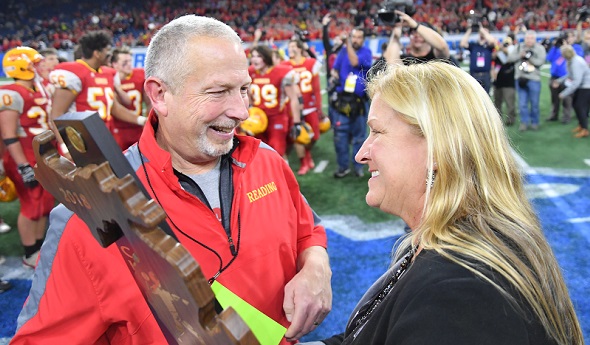
PHOTO: Adrian Madison athletic director Kris Isom, right, presents the Division 8 football championship trophy to Reading coach Rick Bailey in November at Ford Field.