

Using Heads in the Heat of Competition
December 20, 2013
By Rob Kaminski
MHSAA benchmarks editor
With so much recent attention to the risks and recognition of concussions in collision sports, athletic leaders have put their heads together to address far more common – but often overlooked – threats to the health of our student-athletes: heat and sudden cardiac arrest.
The No. 1 killer of young athletes is sudden cardiac arrest, while heat stroke victims can surpass that during the year’s hottest months. While the moment of impact leading to a concussion is totally unpredictable, athletic trainers, coaches and administrators have the ability to diminish the occurrences of cardiac arrest and heatstroke. Typically, there is a pre-existing condition, or family history suggesting probabilities for sudden cardiac arrest, which can be treated when detected. And, the perils associated with hot weather – heat stroke, prostration – are almost always completely preventable.
The MHSAA has addressed both issues recently. With assistance from numerous medical governing bodies, the annual pre-participation physical form was revamped and expanded prior to the 2011-12 school year to include comprehensive information regarding participants’ medical history.
In May, the Representative Council adopted a Model Policy for Managing Heat & Humidity (see below), a plan many schools have since adopted at the local level. The plan directs schools to monitor the heat index at an activity site once the air temperature reaches 80 degrees and provides recommendations when the heat index reaches certain levels, including ceasing activities when it rises above 104 degrees.
The topic of heat-related illnesses receives a lot of attention at the start of fall when deaths at the professional, collegiate and interscholastic levels of sport occur, especially since they are preventable in most cases with the proper precautions. In football, data from the National Federation of State High School Associations shows 41 high school players died from heat stroke between 1995 and 2012.
“We know now more than we ever have about when the risk is high and who is most at risk, and we’re now able to communicate that information better than ever before to administrators, coaches, athletes and parents," said Jack Roberts, executive director of the MHSAA. “Heat stroke is almost always preventable, and we encourage everyone to avail themselves of the information on our website.
“Schools need to be vigilant about providing water during practices, making sure that students are partaking of water and educating their teams about the need for good hydration practices.”
All of which is not to say concussions aren’t a serious matter; they are. In fact, leaders in sport safety can take advantage of the concussion spotlight to illuminate these additional health threats.
A recent New York Times story (May 2013) by Bill Pennington featured a February 2013 gathering in Washington organized by the National Athletic Trainers Association. In the article, Dr. Douglas J. Casa, professor of kinesiology at the University of Connecticut and Chief Operating Officer of the Korey Stringer Institute (founded in the late NFL offensive lineman’s name to promote prevention of sudden death in sport), suggests just that.
“All the talk about head injuries can be a gateway for telling people about the other things they need to know about, like cardiac events and heat illness,” said Casa in the article. “It doesn’t really matter how we get through to people as long as we continue to make sports safer.”
Education and prevention methods need to find a permanent place in school programs if those programs are to thrive and avoid becoming targets at which special interest groups can aim budgetary arrows.
Dr. Jonathan Drezner, the president of the American Medical Society for Sports Medicine, said in the New York Times piece that sudden cardiac arrest is “so incredibly tragic and stunning that people aren’t comfortable putting it into the everyday conversation. I do wish, to some extent, it was something people talked more about because we are getting to a place where we could prevent many of these deaths.”
When it comes to heat-related deaths or illnesses, the prevention efforts can be even more successful by educating the masses. And, these efforts can be done at minimal cost to schools.
“That’s the thing about curtailing exertional heat illness: it’s 100 percent preventable, and unlike other health threats to athletes, the solutions can be very low-tech and inexpensive,” said Dr. Michael F. Bergeron, the director of the National Institute for Athletic Health & Performance at the University of South Dakota’s Sanford Medical Center, in the New York Times story.
To assist with cost and data maintenance, the MHSAA has teamed with Sports Health to provide schools with psychrometers (heat measurement instruments) at a discounted rate, and has built online tools to track heat and humidity conditions.
Managing heat and humidity policy
- Thirty minutes prior to the start of an activity, and again 60 minutes after the start of that activity, take temperature and humidity readings at the site of the activity. Using a digital sling psychrometer is recommended. Record the readings in writing and maintain the information in files of school administration. Each school is to designate whose duties these are: generally the athletic director, head coach or certified athletic trainer.
- Factor the temperature and humidity into a Heat Index Calculator and Chart to determine the Heat Index. If a digital sling psychrometer is being used, the calculation is automatic.
If the Heat Index is below 95 degrees:
All Sports
- Provide ample amounts of water. This means that water should always be available and athletes should be able to take in as much water as they desire.
- Optional water breaks every 30 minutes for 10 minutes in duration.
- Ice-down towels for cooling.
- Watch/monitor athletes carefully for necessary action.
If the Heat Index is 95 degrees to 99 degrees:
All Sports
- Provide ample amounts of water. This means that water should always be available and athletes should be able to take in as much water as they desire.
- Optional water breaks every 30 minutes for 10 minutes in duration.
- Ice-down towels for cooling.
- Watch/monitor athletes carefully for necessary action.
Contact sports and activities with additional equipment:
- Helmets and other possible equipment removed while not involved in contact.
- Reduce time of outside activity. Consider postponing practice to later in the day.
- Recheck temperature and humidity every 30 minutes to monitor for increased Heat Index.
If the Heat Index is above 99 degrees to 104 degrees:
All Sports
- Provide ample amounts of water. This means that water should always be available and athletes should be able to take in as much water as they desire.
- Mandatory water breaks every 30 minutes for 10 minutes in duration.
- Ice-down towels for cooling.
- Watch/monitor athletes carefully for necessary action.
- Alter uniform by removing items if possible.
- Allow for changes to dry T-shirts and shorts.
- Reduce time of outside activity as well as indoor activity if air conditioning is unavailable.
- Postpone practice to later in the day.
Contact sports and activities with additional equipment
- Helmets and other possible equipment removed if not involved in contact or necessary for safety.
- If necessary for safety, suspend activity.
Recheck temperature and humidity every 30 minutes to monitor for increased Heat Index.
If the Heat Index is above 104 degrees:
All sports
- Stop all outside activity in practice and/or play, and stop all inside activity if air conditioning is unavailable.
Note: When the temperature is below 80 degrees there is no combination of heat and humidity that will result in need to curtail activity.
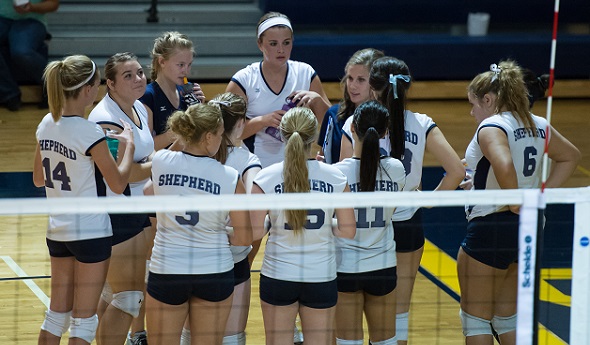
PHOTO: The Shepherd volleyball team includes hydration during a timeout in a match this fall.
AD Hardy Hands Off After Memorable Run
April 11, 2017
By Dennis Chase
Special for Second Half
TRAVERSE CITY – It all came into focus last Monday morning for Sophia Hardy.
 With school about to resume after spring break, the fifth-grader looked at her father and asked, “You’re done with all the night events, right?”
Tom Hardy had a ready response.
“Yep,” he said. “I’m ready for softball in the front yard, or whatever you want to do.”
Life is changing for the 46-year-old Hardy, who stepped down as athletic director/director of transportation at Traverse City St. Francis after the winter sports season.
Hardy, a St. Francis graduate, led one of the state’s most successful athletic programs for 17 years.
“It was a tough decision because of the relationships you build, the sense of family you have here,” he said. “It took a lot of thought, a lot of prayer. Ultimately, it boiled down to me putting my family first.”
Hardy and his wife, Betsy, have five children – Olivia, a junior at Michigan State; Julia, a freshman at Hope College; Thomas, a sophomore at St. Francis; Andrew, a sixth-grader; and Sophia.
“It was time for a change, time for something different that would allow me the flexibility to make sure I’m available for all my kids,” he said.
Hardy is now an information technology job recruiter for Genoa. He has an office near downtown Traverse City, but one of the perks of the job is that he’s able to work almost anywhere – as long as there’s wireless internet and phone service.
So in March, he was able to watch Julia, a softball player at Hope, and her teammates compete in Florida without taking time off and without the worry of preparing for spring sports.
Typically this week, Hardy would be in full throttle trying to cover all his bases for eight varsity teams plus more at lower levels.
“How many games do we have? Are the fields ready? Are they too wet? Do they need to be mowed? Can we even practice outside? If not, what about gym times? Do we have the concessions set up? Do we have ticket takers? It would be all the stress of walking back in and getting the season ready,” he said. “It’s definitely a different day today.”
Hardy was recognized for his efforts at a basketball game near the end of the season.
“The athletic director’s job is a very busy and often thankless one,” Superintendent Mike Buell told the crowd. “Nights and weekends are the norm. Changes are constant. Details are endless.
“For 17 years, Tom juggled a lot of things, big and small, on our behalf – game schedules, practice times, physicals, securing game day officials, transportation and logistics, concessions, athletes’ eligibility, special events, milestone celebrations, awards banquets. It’s a huge job at any school, and during Tom’s tenure, it became even bigger because since 2000 the variety of sports at our school has grown from 13 to 20 to include things like soccer, hockey, equestrian and sailing.
“He was the champion behind new sports even though a lot of people thought that was going to dilute the talent pool,” Buell added.
St. Francis, which has an enrollment of 341, just added lacrosse as a varsity sport this spring.
Despite the expansion, St. Francis continues to excel in nearly all sports. During Hardy’s tenure, the Gladiators won 17 MHSAA team championships and were runners-up 14 times. The success was across the board. The 2015-16 season was one for the ages. St. Francis won MHSAA Finals titles in girls cross country and girls skiing (a co-op); finished second in girls basketball, girls tennis and boys skiing (a co-op); third in boys tennis and girls track; and reached the Semifinals in football and volleyball.
“All the stars aligned – great kids, great parents, great coaches,” Hardy said. “It was awesome to be a part of it.”
The key to the success starts with the participation numbers.
“We’re at a plus 90 percent,” Buell said.
And most play more than one sport.
“I know one of the concerns of the MHSAA is that more and more kids are specializing today,” Hardy said. “I think that’s one of our successes – we’re pushing our kids to be multi-sport athletes. With specialization comes burnout, (an increased) injury rate. To me, it doesn’t make the well-rounded athlete college coaches want.
 “Take (senior) Juliana Phillips. She’s going (to St. Louis University) on a volleyball scholarship, but she could easily be going on a basketball scholarship. She’s a great athlete. More importantly, though, she’s a great kid. Her basketball team loses in the District and the next day she’s leading the student section for the boys game.
“Those kind of stories are there – parents and kids who understand what it means to be part of a team instead of (playing as) individuals, and coaches knowing that the athletes are going to be shared. Our coaches revel in the success the kids have in other sports because they know it’s going to help their teams.”
In addition to strong participation numbers, St. Francis has had its share of talented athletes come through the system, too, including Phillips.
One family, the Bulloughs, had four family members that starred for the Gladiators. Hardy said their success was no accident.
“I remember driving by Thirlby Field three years ago (during the summer) and I see a bunch of people on the field,” he said. “I turned around so I could find out why they were there. I go in and at the 50-yard line there’s Shane Bullough blowing a whistle while Holly, Byron, Riley, Max and Lee Ann (Shane’s wife) are all running 50-yard sprints. Max is in a full sweat suit trying to get ready for the Texas heat (as a member of the NFL Houston Texans). That’s an example of the work ethic and dedication they had to succeed, not only at the high school level but beyond. They have one in the NFL, one hoping to be drafted (later this month), one on the Michigan State football team, and one running cross country and track at Michigan State and doing very well. People don’t see those kind of things, what it takes to be a great athlete. And they were not just one-sport kids. They played other sports, too.”
When Hardy reflects back on the “oh, my!” moments during his tenure, one immediately comes to mind. It was Gabe Callery’s half-court shot at the buzzer that toppled previously-unbeaten East Jordan last January, a shot that made ESPN’s plays of the day segment.
“It was awesome to watch,” Hardy said. “The backstory is that (coach) Keith Haske ends every basketball practice with a game-winner half-court shot. That’s a practiced moment because you know it’s going to happen at some point. And when they make it, they celebrate. So to know that backstory and then to see Gabe nail that shot in a huge moment, in a packed gym, and then for it to make ESPN, that’s every player’s dream, right?”
On a more personal note, there was the day Hardy was able to hand daughters Olivia and Julia Regional medals in softball. It’s a day he will not forget.
“That’s a memory you can’t replace,” he said.
Then there’s Molly Maxbauer.
“She was trying out for the girls basketball team back when the season was in the fall,” Hardy recalled. “She was a junior and wasn’t sure where she fit. The basketball team went out to run a mile for conditioning and I happened to be standing in front of the gym when they were coming back. She was three blocks in front of all the other players. I said, ‘Have you ever thought about running cross country?’ Well, she made that transition. This was a girl who loved to play basketball, grew up playing basketball. She went on to run in college.”
Hardy took a tremendous amount of pride in that type of success, watching kids thrive.
“One of Tom’s strengths has been his enthusiasm for all sports and the lessons that they could teach beyond the classroom,” Buell said. “His sports teams were like his kids. He loved them all and experienced their joys and sorrows right along with them.
 “Tom also had a knack for diffusing contentious situations with humor and helping people find common ground in their disagreements.”
Football coach Josh Sellers agreed.
“First and foremost, as an AD you have to have a thick skin,” he said. “It’s a job where you don’t hear a lot of the good; you hear a lot of the bad. Tom had the right temperament for that gig.”
In football, Sellers was always appreciative that Hardy stressed safety.
“When it came to reconditioning helmets or buying safety equipment, he was like, ‘Josh, do what you need to do to keep our kids safe,’” Sellers said. “That’s all any parent or coach wants to hear. Player safety is a big part of his legacy.”
Buell said Hardy also did things behind the scenes to help people.
“Asked to describe Tom Hardy in one word, people say things like efficient, joyful, loyal, tireless, encouraging and crazy,” he said. “But I would add one word, and that is compassionate. When there was a tragedy in the athletics community – the Grayling golf team’s car accident is one example – Tom always found ways for us, as a school system, to provide meaningful support. On a personal level, he often went above and beyond to help our students, volunteers, coaches and teams.”
Hardy leaves in good company. The senior class that will be departing soon will be remembered for a long time, too.
The 84-member class includes four National Merit scholars, two students who posted perfect ACT scores and two who are bound for military academies (Air Force and Navy).
“And all those kids play sports,” Buell said. “That class got it done everywhere. They’re good role models for the classes behind them.”
Aaron Biggar, an elementary school principal and assistant football coach, has succeeded Hardy.
“I graduated with Aaron,” Sellers said. “We played on the offensive line next to one another in high school. The bad news is I lose a position coach. The good news is that he’ll be able to impact more people beyond the football program now. We’re in good hands.”
Biggar will take over an athletic program that’s a major player on the state level, thanks in part to Hardy.
As for the former athletic director, Hardy was looking to fill 10 IT job openings across the country Monday.
“It’s a fun thing,” he said, “to call people each day and say, ‘Hey, are you open to new opportunities?”
It was that type of call that Hardy received a few months ago.
“While we’re sad to see Tom leave,” Buell said, “we wish him the very best because we know he will always be a Gladiator at heart.”
 Dennis Chase worked 32 years as a sportswriter at the Traverse City Record-Eagle, including as sports editor from 2000-14. He can be reached at [email protected] with story ideas for Manistee, Wexford, Missaukee, Roscommon, Ogemaw, Iosco, Alcona, Oscoda, Crawford, Kalkaska, Grand Traverse, Benzie, Leelanau, Antrim, Otsego, Montmorency, Alpena, Presque Isle, Cheboygan, Charlevoix and Emmet counties.
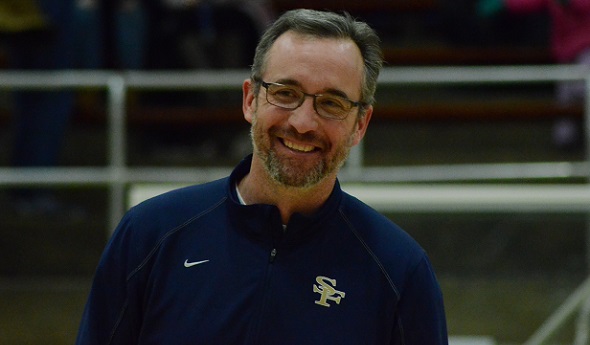
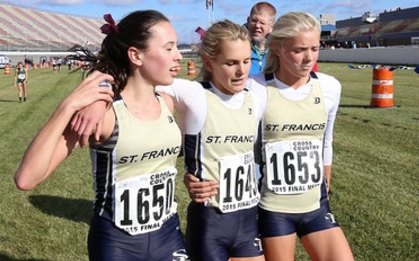
PHOTOS: (Top) Outgoing St. Francis athletic director Tom Hardy is honored during a halftime ceremony at a boys basketball game this season. (Middle) Gladiators Katelyn Duffing (1650), Holly Bullough (1649) and Emmalyne Tarsa leave the Michigan International Speedway chute together after leading their team to the 2015 Lower Peninsula Division 3 cross country title. (Below) Hardy, left, with wife Betsy and son Thomas. (Top and below photos by Julie English, middle photo by RunMichigan.com.)