

Using Heads in the Heat of Competition
December 20, 2013
By Rob Kaminski
MHSAA benchmarks editor
With so much recent attention to the risks and recognition of concussions in collision sports, athletic leaders have put their heads together to address far more common – but often overlooked – threats to the health of our student-athletes: heat and sudden cardiac arrest.
The No. 1 killer of young athletes is sudden cardiac arrest, while heat stroke victims can surpass that during the year’s hottest months. While the moment of impact leading to a concussion is totally unpredictable, athletic trainers, coaches and administrators have the ability to diminish the occurrences of cardiac arrest and heatstroke. Typically, there is a pre-existing condition, or family history suggesting probabilities for sudden cardiac arrest, which can be treated when detected. And, the perils associated with hot weather – heat stroke, prostration – are almost always completely preventable.
The MHSAA has addressed both issues recently. With assistance from numerous medical governing bodies, the annual pre-participation physical form was revamped and expanded prior to the 2011-12 school year to include comprehensive information regarding participants’ medical history.
In May, the Representative Council adopted a Model Policy for Managing Heat & Humidity (see below), a plan many schools have since adopted at the local level. The plan directs schools to monitor the heat index at an activity site once the air temperature reaches 80 degrees and provides recommendations when the heat index reaches certain levels, including ceasing activities when it rises above 104 degrees.
The topic of heat-related illnesses receives a lot of attention at the start of fall when deaths at the professional, collegiate and interscholastic levels of sport occur, especially since they are preventable in most cases with the proper precautions. In football, data from the National Federation of State High School Associations shows 41 high school players died from heat stroke between 1995 and 2012.
“We know now more than we ever have about when the risk is high and who is most at risk, and we’re now able to communicate that information better than ever before to administrators, coaches, athletes and parents," said Jack Roberts, executive director of the MHSAA. “Heat stroke is almost always preventable, and we encourage everyone to avail themselves of the information on our website.
“Schools need to be vigilant about providing water during practices, making sure that students are partaking of water and educating their teams about the need for good hydration practices.”
All of which is not to say concussions aren’t a serious matter; they are. In fact, leaders in sport safety can take advantage of the concussion spotlight to illuminate these additional health threats.
A recent New York Times story (May 2013) by Bill Pennington featured a February 2013 gathering in Washington organized by the National Athletic Trainers Association. In the article, Dr. Douglas J. Casa, professor of kinesiology at the University of Connecticut and Chief Operating Officer of the Korey Stringer Institute (founded in the late NFL offensive lineman’s name to promote prevention of sudden death in sport), suggests just that.
“All the talk about head injuries can be a gateway for telling people about the other things they need to know about, like cardiac events and heat illness,” said Casa in the article. “It doesn’t really matter how we get through to people as long as we continue to make sports safer.”
Education and prevention methods need to find a permanent place in school programs if those programs are to thrive and avoid becoming targets at which special interest groups can aim budgetary arrows.
Dr. Jonathan Drezner, the president of the American Medical Society for Sports Medicine, said in the New York Times piece that sudden cardiac arrest is “so incredibly tragic and stunning that people aren’t comfortable putting it into the everyday conversation. I do wish, to some extent, it was something people talked more about because we are getting to a place where we could prevent many of these deaths.”
When it comes to heat-related deaths or illnesses, the prevention efforts can be even more successful by educating the masses. And, these efforts can be done at minimal cost to schools.
“That’s the thing about curtailing exertional heat illness: it’s 100 percent preventable, and unlike other health threats to athletes, the solutions can be very low-tech and inexpensive,” said Dr. Michael F. Bergeron, the director of the National Institute for Athletic Health & Performance at the University of South Dakota’s Sanford Medical Center, in the New York Times story.
To assist with cost and data maintenance, the MHSAA has teamed with Sports Health to provide schools with psychrometers (heat measurement instruments) at a discounted rate, and has built online tools to track heat and humidity conditions.
Managing heat and humidity policy
- Thirty minutes prior to the start of an activity, and again 60 minutes after the start of that activity, take temperature and humidity readings at the site of the activity. Using a digital sling psychrometer is recommended. Record the readings in writing and maintain the information in files of school administration. Each school is to designate whose duties these are: generally the athletic director, head coach or certified athletic trainer.
- Factor the temperature and humidity into a Heat Index Calculator and Chart to determine the Heat Index. If a digital sling psychrometer is being used, the calculation is automatic.
If the Heat Index is below 95 degrees:
All Sports
- Provide ample amounts of water. This means that water should always be available and athletes should be able to take in as much water as they desire.
- Optional water breaks every 30 minutes for 10 minutes in duration.
- Ice-down towels for cooling.
- Watch/monitor athletes carefully for necessary action.
If the Heat Index is 95 degrees to 99 degrees:
All Sports
- Provide ample amounts of water. This means that water should always be available and athletes should be able to take in as much water as they desire.
- Optional water breaks every 30 minutes for 10 minutes in duration.
- Ice-down towels for cooling.
- Watch/monitor athletes carefully for necessary action.
Contact sports and activities with additional equipment:
- Helmets and other possible equipment removed while not involved in contact.
- Reduce time of outside activity. Consider postponing practice to later in the day.
- Recheck temperature and humidity every 30 minutes to monitor for increased Heat Index.
If the Heat Index is above 99 degrees to 104 degrees:
All Sports
- Provide ample amounts of water. This means that water should always be available and athletes should be able to take in as much water as they desire.
- Mandatory water breaks every 30 minutes for 10 minutes in duration.
- Ice-down towels for cooling.
- Watch/monitor athletes carefully for necessary action.
- Alter uniform by removing items if possible.
- Allow for changes to dry T-shirts and shorts.
- Reduce time of outside activity as well as indoor activity if air conditioning is unavailable.
- Postpone practice to later in the day.
Contact sports and activities with additional equipment
- Helmets and other possible equipment removed if not involved in contact or necessary for safety.
- If necessary for safety, suspend activity.
Recheck temperature and humidity every 30 minutes to monitor for increased Heat Index.
If the Heat Index is above 104 degrees:
All sports
- Stop all outside activity in practice and/or play, and stop all inside activity if air conditioning is unavailable.
Note: When the temperature is below 80 degrees there is no combination of heat and humidity that will result in need to curtail activity.
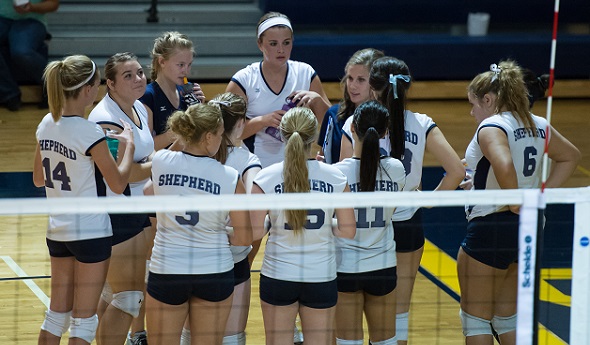
PHOTO: The Shepherd volleyball team includes hydration during a timeout in a match this fall.
Van Valkenburg Returns to Madison to Continue Dad's Pole Vaulting Program
By
Doug Donnelly
Special for MHSAA.com
April 8, 2026
Larry Van Valkenburg had two passions in retirement – coaching high school track & field and racing motorcycles.
 In September, only a few months after completing his 25th season as the pole vault coach at Adrian Madison, Van Valkenburg loaded up his motorcycle and headed to Harpster, Ohio, a tiny, unincorporated city of 160 residents in central Ohio.
“He loved racing motorcycles,” said his son, Trevor Van Valkenburg. “Seems like an odd hobby for someone in their 70s, but he loved it. He hadn’t done it for a couple of years and said he wanted to give it one more shot.”
While at a race in Harpster, Van Valkenburg, 78, was involved in a motorcycle crash, had trouble catching his breath and tragically died.
“He took a very hard fall,” Trevor said.
This spring, after months of deliberations, Trevor decided to end his nine-year run as track coach at nearby Onsted and take over for his father as an assistant at Madison. For all intents and purposes, he’s coming home.
“It really is like coming home,” Trevor said. “I have crazy Madison ties that go way back.”
Trevor was a big reason why his dad began coaching at Madison. He was a high school sophomore in the early 2000s when he switched from baseball to track.
“When Coach (Josh) Powers took over the program in 1999, Madison didn’t have pole vault,” Van Valkenburg said. “Most of the schools in the 1990s had gotten rid of it. As a sophomore, I said if you have pole vault, I’ll run track. That is how my dad got involved.”
Trevor knew his dad had some background in pole vault.
“He was a vaulter in high school,” he said. “He always told us he had the school record. He vaulted in the 1960s where he would land in a pit of saw dust. As a junior, he broke his arm vaulting. He had a scar he would show us from time to time. His proud accomplishment was he came back as a senior and set the school record.”
With Trevor a senior, the Van Valkenburgs were part of Madison’s run to a Michigan Interscholastic Track Coaches Association (MITCA) track & field team state championship.
“He ended up staying 25 years,” Trevor said, speaking of his dad. “He loved it.”
Pole vault is a tough event to learn – and teach.
 “In my opinion, it’s probably the most complicated high school sport,” Trevor said. “There are so many variables, how long your pole is, what the wind rating is, the flex rating and you have to set up your steps. You can move the bar so you have to know where to put it. It’s almost impossible to do well without a good coach. There are too many things an outside person needs to watch and give you feedback on.
“I always tell the kids every time you focus on one thing in pole vault about 30 other things go wrong – and that’s fine. It’s a very complicated high school thing to do. If you don’t have a good coach, it’s really hard to be successful.”
Last year, Trevor’s son Noah was on the Trojans middle school track & field team and chose the pole vault as one of his events. His grandfather was able to coach him.
“I am thankful for that,” Trevor said.
Over the years, the elder Van Valkenburg coached numerous league, county and Regional champs. Trevor joined his high school friend, Kyle Cessna, at Onsted, first coaching the pole vault but later coaching distance runners and the Wildcats cross country team. Madison and Onsted were in the same league, the Lenawee County Athletic Association, for the last several years.
“Over the years my dad and I had plenty of good pole vault coaching and team battles,” Trevor said. “We were really competitive at first. Over time, that relaxed a little bit.”
Returning to Madison to coach was an emotional decision for Trevor.
“I’ve coached Onsted for nine seasons,” Van Valkenburg said. “It was kind of always in the back of my head that if my dad was ever done, I’ll go back to Madison. I knew he would hold on as long as he could. It didn’t end up the way we thought it would, but it finally happened and I’m back home.”
Another reason it is home is because his wife, Kathryn, has taught at Madison schools for more than 20 years. His younger son, Dominque, also attends Madison schools.
“When I’m here after school, my whole family is here,” he said. “My wife is in the building. My one son is getting out of elementary at 3:30, my other son is on the middle school track team.”
Larry Van Valkenburg was an ex-Marine who retired as an air traffic controller in 2011. His legacy will remain at Madison, mainly because he teamed with Powers and the rest of the coaching staff to form a powerhouse track & field program that won numerous league championships and made an impact at MHSAA Finals.
“Larry was a great coach,” Powers said. “Trevor is a lot like him. We are really happy he came back to coach.”
Trevor Van Valkenburg is the director of the Lenawee District Library, a system that has six branches and a bookmobile. They circulate more than 150,000 items a year. Each spring, he adjusts his schedule to allow for coaching. He feels at home at Madison – and the track & field athletes can take comfort knowing a Van Valkenburg is still coaching them.
“We’re pretty similar,” Trevor said. “I learned a lot of it from (my dad), so it makes sense we would be similar. We both are pretty laid-back people. We’re not going to scream in kids’ faces. I might be a little more drill-heavy instead of just practicing jumping over the bar. I learned everything I know from him.”
 Doug Donnelly has served as a news and sports reporter at the Adrian Daily Telegram and the Monroe News for 30 years, including 10 years as city editor in Monroe. He's written a book on high school basketball in Monroe County and compiles record books for various schools in southeast Michigan. He is now publisher and editor of The Blissfield Advance, a weekly newspaper. E-mail him at [email protected] with story ideas for Jackson, Washtenaw, Hillsdale, Lenawee and Monroe counties.
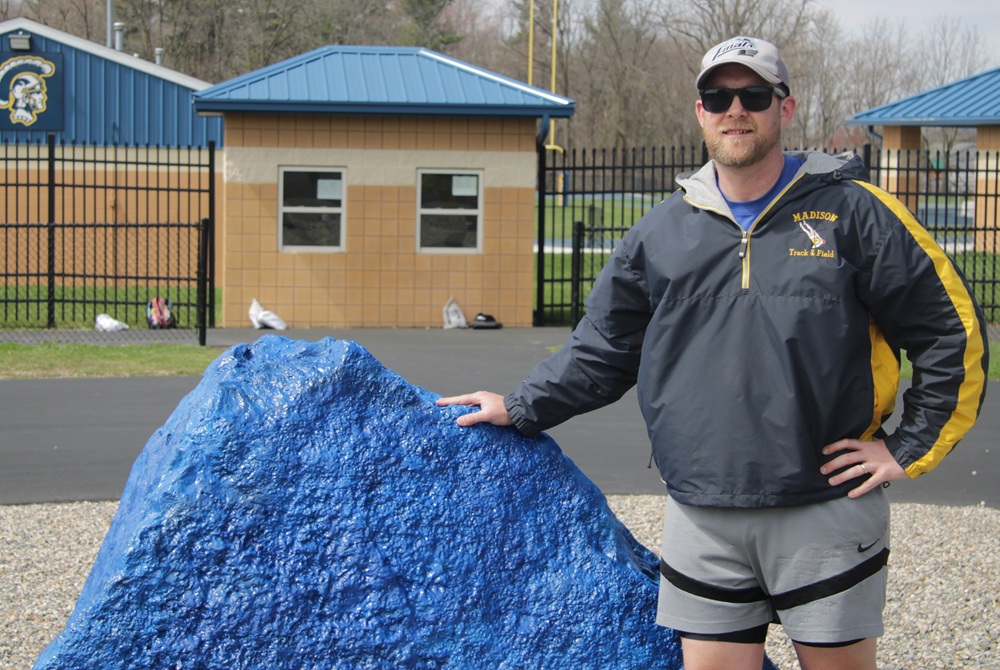
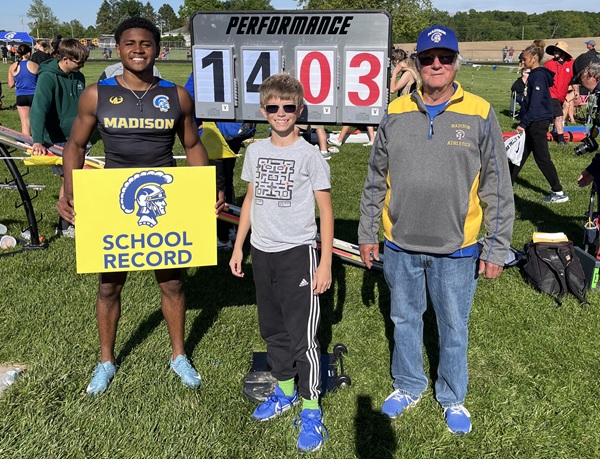
PHOTOS (Top) Adrian Madison track & field assistant coach Trevor Van Valkenburg stands at the entrance to the school’s track this spring. (Middle) At left, JaLonn Borders stands for a photo with Larry Van Valkenburg and Larry’s grandson Noah after breaking the school’s pole vault record during last season’s Lenawee County Championships. (Top photo by Doug Donnelly. Middle photo courtesy of Trevor Van Valkenburg.)