

Using Heads in the Heat of Competition
December 20, 2013
By Rob Kaminski
MHSAA benchmarks editor
With so much recent attention to the risks and recognition of concussions in collision sports, athletic leaders have put their heads together to address far more common – but often overlooked – threats to the health of our student-athletes: heat and sudden cardiac arrest.
The No. 1 killer of young athletes is sudden cardiac arrest, while heat stroke victims can surpass that during the year’s hottest months. While the moment of impact leading to a concussion is totally unpredictable, athletic trainers, coaches and administrators have the ability to diminish the occurrences of cardiac arrest and heatstroke. Typically, there is a pre-existing condition, or family history suggesting probabilities for sudden cardiac arrest, which can be treated when detected. And, the perils associated with hot weather – heat stroke, prostration – are almost always completely preventable.
The MHSAA has addressed both issues recently. With assistance from numerous medical governing bodies, the annual pre-participation physical form was revamped and expanded prior to the 2011-12 school year to include comprehensive information regarding participants’ medical history.
In May, the Representative Council adopted a Model Policy for Managing Heat & Humidity (see below), a plan many schools have since adopted at the local level. The plan directs schools to monitor the heat index at an activity site once the air temperature reaches 80 degrees and provides recommendations when the heat index reaches certain levels, including ceasing activities when it rises above 104 degrees.
The topic of heat-related illnesses receives a lot of attention at the start of fall when deaths at the professional, collegiate and interscholastic levels of sport occur, especially since they are preventable in most cases with the proper precautions. In football, data from the National Federation of State High School Associations shows 41 high school players died from heat stroke between 1995 and 2012.
“We know now more than we ever have about when the risk is high and who is most at risk, and we’re now able to communicate that information better than ever before to administrators, coaches, athletes and parents," said Jack Roberts, executive director of the MHSAA. “Heat stroke is almost always preventable, and we encourage everyone to avail themselves of the information on our website.
“Schools need to be vigilant about providing water during practices, making sure that students are partaking of water and educating their teams about the need for good hydration practices.”
All of which is not to say concussions aren’t a serious matter; they are. In fact, leaders in sport safety can take advantage of the concussion spotlight to illuminate these additional health threats.
A recent New York Times story (May 2013) by Bill Pennington featured a February 2013 gathering in Washington organized by the National Athletic Trainers Association. In the article, Dr. Douglas J. Casa, professor of kinesiology at the University of Connecticut and Chief Operating Officer of the Korey Stringer Institute (founded in the late NFL offensive lineman’s name to promote prevention of sudden death in sport), suggests just that.
“All the talk about head injuries can be a gateway for telling people about the other things they need to know about, like cardiac events and heat illness,” said Casa in the article. “It doesn’t really matter how we get through to people as long as we continue to make sports safer.”
Education and prevention methods need to find a permanent place in school programs if those programs are to thrive and avoid becoming targets at which special interest groups can aim budgetary arrows.
Dr. Jonathan Drezner, the president of the American Medical Society for Sports Medicine, said in the New York Times piece that sudden cardiac arrest is “so incredibly tragic and stunning that people aren’t comfortable putting it into the everyday conversation. I do wish, to some extent, it was something people talked more about because we are getting to a place where we could prevent many of these deaths.”
When it comes to heat-related deaths or illnesses, the prevention efforts can be even more successful by educating the masses. And, these efforts can be done at minimal cost to schools.
“That’s the thing about curtailing exertional heat illness: it’s 100 percent preventable, and unlike other health threats to athletes, the solutions can be very low-tech and inexpensive,” said Dr. Michael F. Bergeron, the director of the National Institute for Athletic Health & Performance at the University of South Dakota’s Sanford Medical Center, in the New York Times story.
To assist with cost and data maintenance, the MHSAA has teamed with Sports Health to provide schools with psychrometers (heat measurement instruments) at a discounted rate, and has built online tools to track heat and humidity conditions.
Managing heat and humidity policy
- Thirty minutes prior to the start of an activity, and again 60 minutes after the start of that activity, take temperature and humidity readings at the site of the activity. Using a digital sling psychrometer is recommended. Record the readings in writing and maintain the information in files of school administration. Each school is to designate whose duties these are: generally the athletic director, head coach or certified athletic trainer.
- Factor the temperature and humidity into a Heat Index Calculator and Chart to determine the Heat Index. If a digital sling psychrometer is being used, the calculation is automatic.
If the Heat Index is below 95 degrees:
All Sports
- Provide ample amounts of water. This means that water should always be available and athletes should be able to take in as much water as they desire.
- Optional water breaks every 30 minutes for 10 minutes in duration.
- Ice-down towels for cooling.
- Watch/monitor athletes carefully for necessary action.
If the Heat Index is 95 degrees to 99 degrees:
All Sports
- Provide ample amounts of water. This means that water should always be available and athletes should be able to take in as much water as they desire.
- Optional water breaks every 30 minutes for 10 minutes in duration.
- Ice-down towels for cooling.
- Watch/monitor athletes carefully for necessary action.
Contact sports and activities with additional equipment:
- Helmets and other possible equipment removed while not involved in contact.
- Reduce time of outside activity. Consider postponing practice to later in the day.
- Recheck temperature and humidity every 30 minutes to monitor for increased Heat Index.
If the Heat Index is above 99 degrees to 104 degrees:
All Sports
- Provide ample amounts of water. This means that water should always be available and athletes should be able to take in as much water as they desire.
- Mandatory water breaks every 30 minutes for 10 minutes in duration.
- Ice-down towels for cooling.
- Watch/monitor athletes carefully for necessary action.
- Alter uniform by removing items if possible.
- Allow for changes to dry T-shirts and shorts.
- Reduce time of outside activity as well as indoor activity if air conditioning is unavailable.
- Postpone practice to later in the day.
Contact sports and activities with additional equipment
- Helmets and other possible equipment removed if not involved in contact or necessary for safety.
- If necessary for safety, suspend activity.
Recheck temperature and humidity every 30 minutes to monitor for increased Heat Index.
If the Heat Index is above 104 degrees:
All sports
- Stop all outside activity in practice and/or play, and stop all inside activity if air conditioning is unavailable.
Note: When the temperature is below 80 degrees there is no combination of heat and humidity that will result in need to curtail activity.
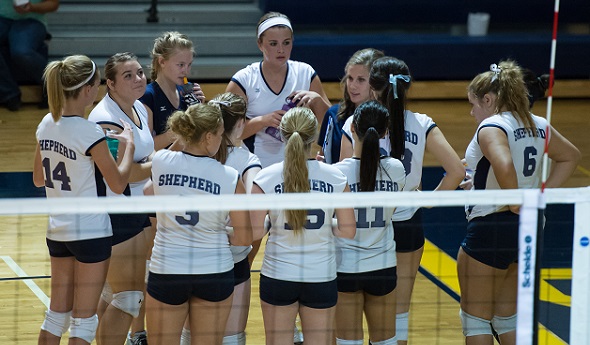
PHOTO: The Shepherd volleyball team includes hydration during a timeout in a match this fall.
Hackett Mentor's Care Sparked Lifetime in Hoops for BCAM President White
By
Pam Shebest
Special for MHSAA.com
July 24, 2026
KALAMAZOO — When Kevin White counsels an unruly student, he usually understands what’s going on.
 At one time, he was that student.
For the dean of students at Kalamazoo Hackett Catholic Prep, White’s life has come full circle.
He thrived while attending St. Monica Elementary School as a child, but after his father Damon passed away in 1989, the family moved to Portage and he changed schools.
“Eighth and ninth grades there was a change in behavior and grade point average,” White said. “Right about Christmas break, I had three gentlemen in my living room.
“Mike Smith, Shawn Potts and Nib Reisterer were having a conversation with my mom. They were worried about the direction I was headed and I think somehow those three came up with a plan to get me back (to Hackett).
He soon realized he needed the structure, discipline and smaller class sizes available there. But the worst part of transferring to Hackett was that he had to sit out the upcoming basketball season.
“I was not allowed to play right away because they decided my grades weren’t good enough to play, only to practice,” he recalled. “To sit on the bench as a high school kid with a bad GPA, and (bad attitude), it was like when I was little. If I wanted to do things, I had to do them the right way.”
At Hackett, he was reunited with Reisterer, his mentor who put him through some tough workouts.
“They were some of the hardest workouts I ever had because I had to go back to changing some bad habits, which changed pretty quickly,” White said.
He also had to face the players he idolized as a child when they asked why he wasn’t playing.
“That’s when I knew I had to kick it into gear because I didn’t want to let those guys down,” White said. “They said, ‘You wanted to wear that jersey since you were in fifth grade.’ My mom says peer pressure is the best pressure.”
Learning from the best
White first encountered Reisterer, who changed his life, during elementary school.
After losing his father, White would have to remain at school until his mother, Sheila, who was a police officer, picked him up.
“This gym teacher was, ‘Hey, do you want to hang out in the gym?’ Then he said he had basketball practice at 5 and did I want to come with him to practice? And he’s been stuck with me ever since,” White recalled. “It turned into ‘can I come to practice’ to ‘can I go to a couple games?’ Then I got to ride the bus. Then the Reisterer vacations at the lake became ‘Kevin’s coming too.’ There was a time when the Reisterers became my extended family, and within that came a basketball family.”
Reisterer, who was physical education teacher at St. Monica, said he knew White’s situation and wanted to help.
“My son Ryan was only a couple years younger than Kevin,” he said. “Ryan just adored him, and Kevin became my second son.”
 Reisterer, who was also Hackett’s head boys basketball coach, noted, “Kevin became my ball boy. He came to every practice and did all the drills with the kids. He led the team in warmups before the game and became quite a celebrity himself.”
The highlight of his younger years was riding the bus with the Irish players, White said.
“Doing my third-grade homework with them showing me how to do the math problems and arguing about giving me the answers or not giving me the answers,” White laughed.
“The reward was, if you behaved in school you got to go to the games. So it was real easy to behave because I wanted to hang out with the high school guys and be on the bench.”
That sparked his love of basketball.
White graduated from Hackett in 1998 and then played at Glen Oaks Community College. With thoughts of prolonging his career in basketball after college – he went on to graduate from Western Michigan University – White remembered words he heard in passing.
“The guy said, ‘You might be able to play for a long time, but you’ll coach a lot longer than you’ll play if you start coaching right away,’” White said. “As a young guy, you hear it but you don’t think about it.
“Then you get into coaching and start working camps and going to the Final Fours and start networking. I like playing, but I love teaching the game. It’s been fun doing it that way.”
Reisterer said White wasn’t going to “set the world on fire” as a basketball player, but he worked his way through the coaching ranks, from instructing young kids and contributing at summer camps to filling roles at the high school and college levels, learning at each stop.
“He has quite a network of coaches and a lot of experience,” Reisterer added.
Prioritizing family life
As an assistant coach at Kalamazoo College, White met athletic trainer Kathleen O’Farrell and was immediately smitten. He credits her with making him more detailed and organized.
They eventually married and have two children – Vincent, 7, and Riley, 3.
“Vincent is at the age where he wants to come to practice with dad,” White said. “People ask if he’s going to play basketball.
“Right now he loves to swim, loves to play soccer. I love that because I can just sit there and be Dad.”
Vincent not only goes to practice with his dad, but has his own whistle, his own spot in the locker room and his own practice plan.
“He’s in charge of the clock,” White added. “I make him sweep the floor because I had to sweep the floor when I was young. If he decides to coach, I wouldn’t be upset.”
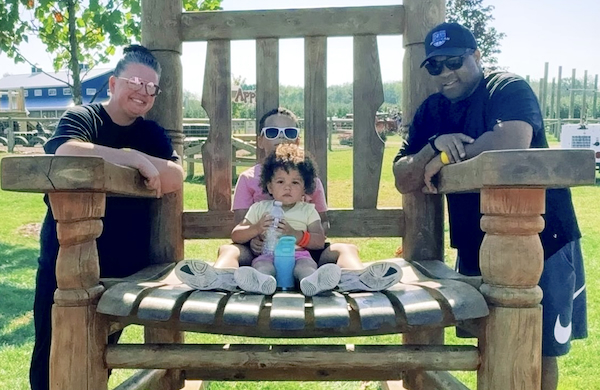 White called his daughter a “mini-me.”
“She will say hello to anyone,” he said. “She’s got confidence, she will speak up. If she doesn’t like something, she will tell you.”
White honed his coaching skills as an assistant to several college and high school coaches, including at Hackett last season, and discovered that working at the same school where he coaches is special.
“I will tell any young coach, if you can get a high school job in today’s age and work in the school, that’s a win-win,” White noted. “The relationship with players is an advantage of working in the school because you’re with them during the day and after school, a lot of times more than they’re with their parents.”
White is running the summer basketball program at Hackett, but that’s not all the gregarious coach is doing.
As the current president of the Basketball Coaches Association of Michigan (BCAM), “We run an event called Reaching Higher,” he said. “High school teams are selected from all over the state and they come for two days to play at Grand Valley University.
“It’s open to college coaches all over the country to watch the top high school players from the state.”
He was also involved in Midwest Live where 20-40 Michigan teams compete against teams from Ohio, West Virginia and Pennsylvania at Cedar Point.
But next month, White will be back at Hackett, working to keep students on task.
“I see a lot of my classmates and myself in students today,” White said. “Yes, times have changed, but kids still want to be taken care of and want to be treated well and have support. Yes, some discipline comes with my job, but it’s also built on relationship and trust.
“I want (alumni) to come back and tell current kids that yes, Mr. White was hard on me about x, y and z, but when I needed something, he was there for me and if I didn’t follow through, he made sure I did.”
2026 Made In Michigan
July 24: Mackey Leaving Court with 500+ College Hoops Wins, Many More Lessons Shared - Report
July 16: Country Day Two-Time Champ Moore Building Perennial Winner at Harvard - Report
July 9: Multi-Sport Career at TC West Helps Gillis Thrive as Pro in Game She Once Left Behind - Report
July 2: Inspired by Home, Eager to Give Back, Spencer Hosts Hoop City Alumni Games - Report
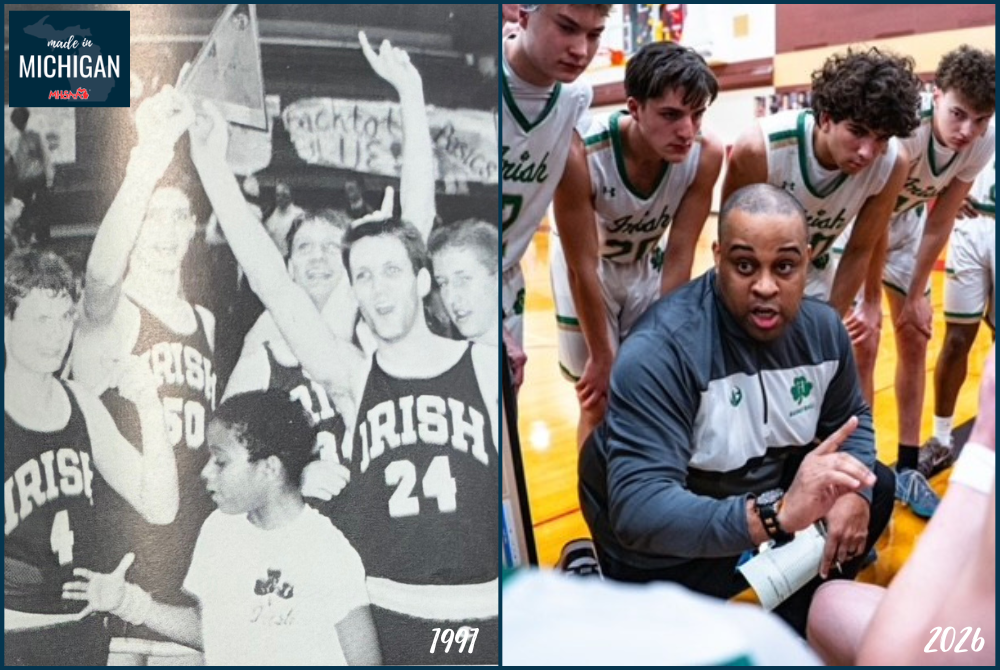
PHOTOS (Top) At left, fifth-grader Kevin White celebrates with the Hackett boys basketball team in 1991. At right, White huddles with his players this past season while serving as an assistant with the Irish varsity. (Middle) White stands for a photo with BCAM Executive Director Dan Young. (Below) White poses with wife Kathleen and children Vincent and Riley. (Photos provided by Kevin White.)