


Working Through Transfer Trends
December 2, 2015
By Jack Roberts
MHSAA Executive Director
One of the responsibilities that schools have asked organizations like the MHSAA to execute is the management of transfer student eligibility. Historically, many associations have linked eligibility to residence ... thus, for some the regulation has been called the “Residency Rule” or “Transfer/Residency Rule,” not merely the “Transfer Rule.”
Over the years, as society became more mobile and families less stable, these rules became more and more complicated; and now, for most state high school associations, this is the regulation that consumes the most (or second) most pages of their handbooks. Over the years, this has also been the regulation most frequently challenged in court.
Over the years, some states have relaxed their transfer rule and others have refined their transfer rule. In either case, the transfer rule remains an imperfect rule, an imperfect net. Sometimes this net snags students who should not be made ineligible, and for those situations all associations have arranged some kind of waiver or appeal process.
And sometimes, and much less easily solved, the net fails to catch the situations it really should ... the transfers that are not hardship related or the result of some very compelling educational need, but those that are obviously for athletic reasons. It is those that we have been most focused on in Michigan.
Our first effort to get at the most problematic transfers was the adoption for the 1997-98 school year of what we called the “Athletic-MOTIVATED Transfer Rule” ... Regulation I, Section 9(E). Examples of an athletic-motivated transfer are included in the rule. The rule only applies to transfer students who do NOT meet any of the stated exceptions for immediate eligibility and are ineligible for one semester under our basic transfer rule. They become ineligible for 180 scheduled school days if there is a finding that the transfer was more for athletics than any other compelling reason.
This effort has not been successful enough because it requires a school that loses a student to another school to promptly allege to the MHSAA office, with supporting documentation, that the transfer was more for athletic reasons than any other compelling reason. The receiving school then must respond to those allegations. Then the executive director makes the decision. The unfortunate result of applying this rule is that it usually causes hard feelings between the schools, and hard feelings toward the executive director by the school decided against. In 17 years, schools have invoked this rule only 45 times.
Our more recent effort to address the most egregious athletic transfers resulted from requests from the coaches associations for wrestling and basketball, which were watching too many students change schools for athletic reasons, usually related to an out-of-season coaching relationship. The new rule – the “Athletic-RELATED Transfer Rule” – is Regulation I, Section 9(F). The difference between Section 9(E) and the newer Section 9(F) is that in 9(F) one school does not have to make and document allegations before staff can act. If MHSAA staff discover or are informed of any of the circumstances listed in 9(F), we can act. Again, the rule only applies to those transfer students whose circumstances do NOT meet one of the automatic exceptions. It applies only to students who are ineligible for a semester under the basic transfer rule. If there is a finding that one of the athletic related “links” exists (usually an out-of-season coaching relationship), then this transfer student who would be ineligible for one semester is made ineligible for 180 scheduled school days.
So far, it appears that 9(F) may be a better deterrent than 9(E). It has been referenced when students are rumored to be transferring, and it has stopped many of those transfers before they occur. We expect 9(F) to be an even better deterrent in 2015-16 because the rule has been broadened to apply to administrators and parents (not just coaches) and to address directing and coordinating athletic activities (not just coaching).
We have said that if this latest effort does not succeed in slowing athletic transfers, then the next step is 180 days of ineligibility – at least in any sport the student played in high school previously – for all transfer students who do not qualify for an exception that permits immediate play. I fear that would catch far too many students who should not be withheld so long from competition and could lead to a period like the early 1980s when the MHSAA, at the request of the state principals association, adopted the core of the transfer rule we have today and which resulted in a period of busiest litigation for the MHSAA when, at one time, the association had more than a dozen cases in court simultaneously on transfer matters. We’ve got to make the current rules work – with tweaks, perhaps; but not with radical revision.
Fresh from Cancer Fight, Disbrow Returns to Coaching Ready to Continue 'Winning the Day'
By
Doug Donnelly
Special for MHSAA.com
September 16, 2026
Nikki Disbrow grabbed her keys and started to get into the family vehicle to pick up her son from a summer 7-on-7 practice. Her husband, Sand Creek football coach Sid Disbrow, told her he wanted to come, too.
 “What are you doing?” she asked. “You can barely walk.”
Sid, who had just returned home from surgery to have a tumor removed while battling colorectal cancer for the second time in three years, wasn’t having it. He got in the vehicle.
When Nikki arrived at the field, Sid opened the door.
“Where are you going?” she asked.
Sid, unrelenting, got out of the car and began making his way to the field.
“She was kind of my walker,” he said. “I couldn’t walk on my own, but I needed to address the kids. I needed to be out there. I needed to show them that it’s about winning the day, because you never know what might happen.”
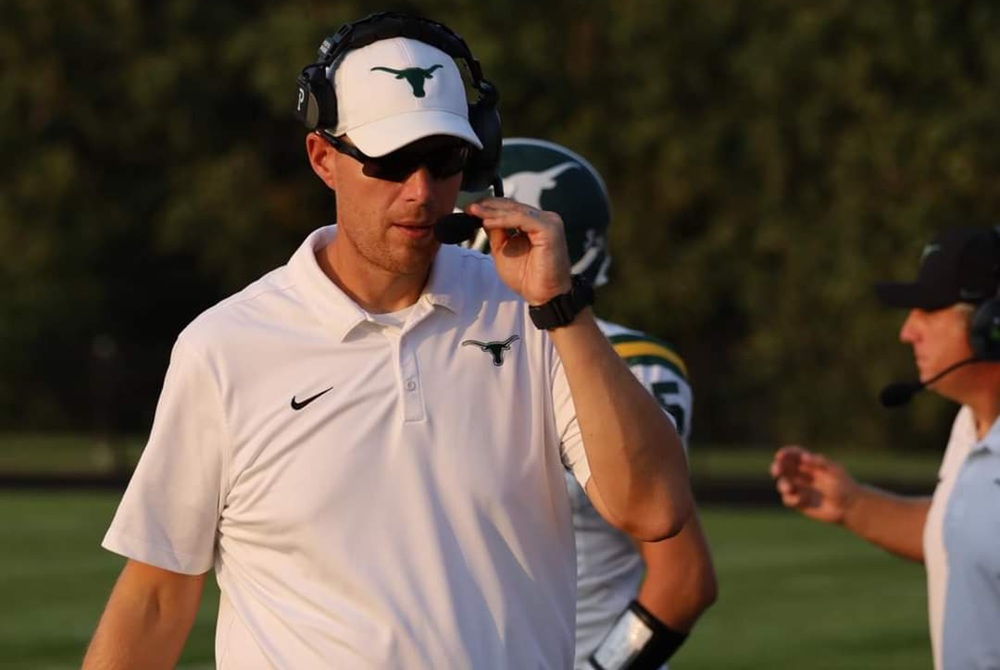
Disbrow, 49, has been coach for just about 30 years. It’s part of who he is in the Sand Creek school district and community. He’s been an assistant football coach, youth baseball and softball coach, varsity boys and middle school basketball coach. He’s detailed, organized, loves the competition and thrives on being around kids.
Last year around the eighth or ninth week of the football season, he began noticing the symptoms of the cancer he had chemotherapy and radiation to treat a couple years prior. He finished the season, knowing middle school basketball was getting ready to start.
Within a week of finding out the cancer had indeed returned, he was able to get everything scheduled and begin chemotherapy. He was getting treated at Flower Hospital in Sylvania, Ohio, about 45 minutes from Sand Creek.
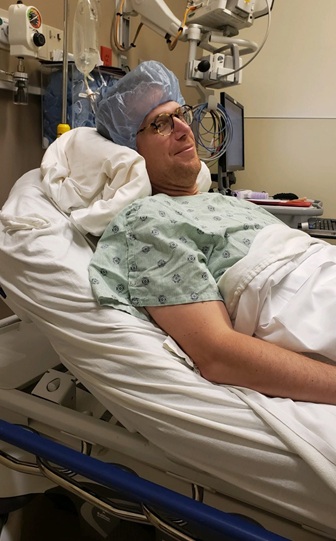 “They would give me the last appointment of the day so I could get there after school,” he said. “They were great to work with.”
It wasn’t easy trying to maintain a rigorous coaching schedule while fighting cancer.
“There are no rules in cancer. You don’t get to do as you wish. Chemotherapy is real,” Disbrow said.
He wasn’t deterred. He coached the entire middle school basketball season – which ended around Christmas. Some days, he was exhausted. Still, quitting wasn’t an option.
“I wanted to be out there for my son and all of the other kids that I’ve been coaching all the way through,” he said. “That was important to me. That was my driving force.”
Not long after basketball season ended, he began eight weeks of radiation. It ended just in time for him to coach his son’s baseball team.
After that season ended, something still wasn’t right. Doctors found a tumor, although they weren’t sure if it was shrinking or growing. They gave him an option – surgery to remove it or wait a few months, get tested again. At that point, if it returned, it meant starting chemotherapy and radiation all over again. He checked the calendar.
“I thought about football season,” he said. “My son is on JV this year. That’s not something I want to miss.”
He went in for surgery and had the tumor successfully removed. Doctors found out later it was indeed cancerous and growing.
“I made the right decision,” he said.
He was recovering from that round of surgery when he made it onto the football field to talk to the Aggies players. The football field is more than a place for Disbrow to forget all about cancer and focus on the lives of the young men on the field. It’s a place him and Nikki, a former varsity volleyball coach at Sand Creek herself, got married.
“It’s probably the first time there was a wedding on the football field, and probably the last time,” he said.
On Aug. 3 – one week before two-a-days started for Sand Creek – he found out the cancer was in remission. He was back with the team when practice began.
“I brought my lawn chair with me,” he said. “There were some days where I just didn’t have the strength.”
Through it all, he’s endured, never wavering.
“The credit goes to God,” he said. “I don’t see how people go through something like this without their faith. I owe it all to Him. He’s given me this chance to continue to teach and coach. I don’t take that lightly.”
 Sand Creek varsity football coach Derek Hewitt said seeing Disbrow come back to practice after all he went through was inspiring. Disbrow coaches special teams, the quarterbacks and helps Hewitt with the offense. On most Fridays he’s in the coach’s box.
“It’s great to have him back out there,” Hewitt said. “He’s not the scout team quarterback anymore, but he’s there, every day. It’s great for me to have him by my side.”
One thing Disbrow is not planning to do is stop coaching. In fact, he’s going to be even busier. He was recently named the school’s junior varsity boys basketball head coach.
“Coaching really kept me going through all of this,” he said. “The kids have been great through it all.”
The father of four is from Morenci, the neighboring town to the south and heated rival of Sand Creek, which he admits caused some angst when he moved from coaching football at his alma mater to Sand Creek.
He was part of the 1995 Morenci football team that played for a Class C championship in the Pontiac Silverdome, graduating in 1996. He was a sophomore at Adrian College when a Morenci coach asked him to join that coaching staff. A couple years later he began coaching at Sand Creek.
Now, he, his wife and four kids are engrained in the Aggies community.
“I wasn’t one of those people who got into teaching because I wanted to coach,” he said. “I wanted to be a teacher, to be around young people and help them. Coaching was something I loved once I started doing it. It’s who we are now as a family. It’s part of our lives.”
 Doug Donnelly has served as a news and sports reporter at the Adrian Daily Telegram and the Monroe News for 30 years, including 10 years as city editor in Monroe. He's written a book on high school basketball in Monroe County and compiles record books for various schools in southeast Michigan. He is now publisher and editor of The Blissfield Advance, a weekly newspaper. E-mail him at [email protected] with story ideas for Jackson, Washtenaw, Hillsdale, Lenawee and Monroe counties.
PHOTOS (Top) Sand Creek assistant football coach Sid Disbrow mans the headset while on the sideline during a game. (Middle) Disbrow lays in a hospital bed while receiving care in 2023. (Below) Disbrow stands for a photo with wife Nikki last fall. (Top photo by Becky Serin. Hospital and family photos courtesy of the Disbrow family.)