


Working Through Transfer Trends
December 2, 2015
By Jack Roberts
MHSAA Executive Director
One of the responsibilities that schools have asked organizations like the MHSAA to execute is the management of transfer student eligibility. Historically, many associations have linked eligibility to residence ... thus, for some the regulation has been called the “Residency Rule” or “Transfer/Residency Rule,” not merely the “Transfer Rule.”
Over the years, as society became more mobile and families less stable, these rules became more and more complicated; and now, for most state high school associations, this is the regulation that consumes the most (or second) most pages of their handbooks. Over the years, this has also been the regulation most frequently challenged in court.
Over the years, some states have relaxed their transfer rule and others have refined their transfer rule. In either case, the transfer rule remains an imperfect rule, an imperfect net. Sometimes this net snags students who should not be made ineligible, and for those situations all associations have arranged some kind of waiver or appeal process.
And sometimes, and much less easily solved, the net fails to catch the situations it really should ... the transfers that are not hardship related or the result of some very compelling educational need, but those that are obviously for athletic reasons. It is those that we have been most focused on in Michigan.
Our first effort to get at the most problematic transfers was the adoption for the 1997-98 school year of what we called the “Athletic-MOTIVATED Transfer Rule” ... Regulation I, Section 9(E). Examples of an athletic-motivated transfer are included in the rule. The rule only applies to transfer students who do NOT meet any of the stated exceptions for immediate eligibility and are ineligible for one semester under our basic transfer rule. They become ineligible for 180 scheduled school days if there is a finding that the transfer was more for athletics than any other compelling reason.
This effort has not been successful enough because it requires a school that loses a student to another school to promptly allege to the MHSAA office, with supporting documentation, that the transfer was more for athletic reasons than any other compelling reason. The receiving school then must respond to those allegations. Then the executive director makes the decision. The unfortunate result of applying this rule is that it usually causes hard feelings between the schools, and hard feelings toward the executive director by the school decided against. In 17 years, schools have invoked this rule only 45 times.
Our more recent effort to address the most egregious athletic transfers resulted from requests from the coaches associations for wrestling and basketball, which were watching too many students change schools for athletic reasons, usually related to an out-of-season coaching relationship. The new rule – the “Athletic-RELATED Transfer Rule” – is Regulation I, Section 9(F). The difference between Section 9(E) and the newer Section 9(F) is that in 9(F) one school does not have to make and document allegations before staff can act. If MHSAA staff discover or are informed of any of the circumstances listed in 9(F), we can act. Again, the rule only applies to those transfer students whose circumstances do NOT meet one of the automatic exceptions. It applies only to students who are ineligible for a semester under the basic transfer rule. If there is a finding that one of the athletic related “links” exists (usually an out-of-season coaching relationship), then this transfer student who would be ineligible for one semester is made ineligible for 180 scheduled school days.
So far, it appears that 9(F) may be a better deterrent than 9(E). It has been referenced when students are rumored to be transferring, and it has stopped many of those transfers before they occur. We expect 9(F) to be an even better deterrent in 2015-16 because the rule has been broadened to apply to administrators and parents (not just coaches) and to address directing and coordinating athletic activities (not just coaching).
We have said that if this latest effort does not succeed in slowing athletic transfers, then the next step is 180 days of ineligibility – at least in any sport the student played in high school previously – for all transfer students who do not qualify for an exception that permits immediate play. I fear that would catch far too many students who should not be withheld so long from competition and could lead to a period like the early 1980s when the MHSAA, at the request of the state principals association, adopted the core of the transfer rule we have today and which resulted in a period of busiest litigation for the MHSAA when, at one time, the association had more than a dozen cases in court simultaneously on transfer matters. We’ve got to make the current rules work – with tweaks, perhaps; but not with radical revision.
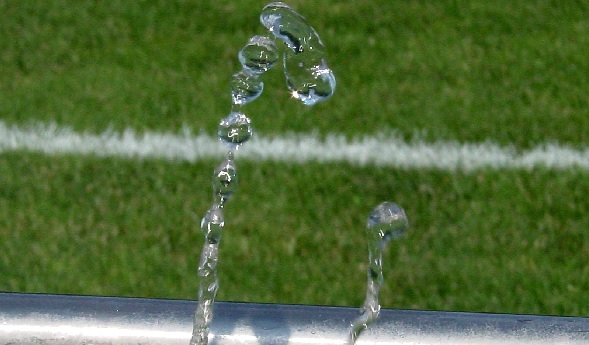
Athletes: Prepare to Beat the Heat
August 4, 2014
By Geoff Kimmerly
Second Half editor
Despite unseasonably cool temperatures this summer in Michigan, high school athletes should prepare for the heat that usually accompanies August and the beginning of Michigan High School Athletic Association fall practices as they kick off next week.
Each year, the MHSAA provides information to its member schools to help them prepare for hot weather practice and game conditions in the late summer and early fall. Football practice can begin August 11, followed by first practices for all other fall sports August 13.
The topic of heat-related injuries receives a lot of attention at this time of year, especially when deaths at the professional, collegiate and interscholastic levels of sport occur, and especially since they are preventable in most cases with the proper precautions. In football, data from the National Federation of State High School Associations shows that nationally 41 high school players died from heat stroke between 1995 and 2013.
Many MHSAA schools this fall are expected to again follow the MHSAA’s Model Policy for Managing Heat & Humidity that directs schools to monitor heat index prior to and during activity and recommends actions based on those readings.
Also this school year, for the first time, the MHSAA is requiring all assistant and subvarsity coaches at the high school level to complete the same rules and risk minimization meeting requirement as high school varsity head coaches, or, in the alternative, one of several online courses designated for this purpose on MHSAA.com.
“It’s not an accident that causes severe heat illness and death. It’s a lack of attention to what should’ve been taking place, a lack of preparation,” said John E. “Jack” Roberts, executive director of the MHSAA. “We’re trying to communicate to our constituents that if we make the precautions that we should, plan as we should, we will have none of these tragedies in school sports.”
The MHSAA Representative Council adopted in 2013 the Model Policy for Managing Heat & Humidity that, while not mandated for member schools, has been adopted by many at the local level. The plan directs schools to begin monitoring the heat index at the activity site once the air temperature reaches 80 degrees and provides recommendations when the heat index reaches certain points, including ceasing activities when it rises above 104 degrees.
The model policy is outlined in a number of places, including the publication Heat Ways, which is available for download from the MHSAA Website. Heat Ways not only provides the model policy, but addresses the need for proper acclimatization in hot weather.
Heat, hydration and acclimatization also are again focuses of the MHSAA’s required preseason rules meetings for coaches and officials. The online presentation discusses the need for good hydration in sports, regardless of the activity or time of year.
The Health & Safety Resources page of the MHSAA Website has a number of links to different publications and information and a free online presentation from the National Federation of State High School Associations. Visit MHSAA.com, click on “Schools” and then on “Health & Safety Resources” to find the information.
Roberts said the first days of formal practices in hot weather should be more for heat acclimatization than the conditioning of athletes, and that practices in such conditions need planning to become longer and more strenuous over a gradual progression of time.
He added schools also must consider moving practices to different times of day, different locations, or change practice plans to include different activities depending on the conditions.
“I think all schools need to prepare themselves in these ways,” Roberts said. “They need to educate participants, parents and coaches about proper hydration and the dangers of practicing and competing when the heat and humidity are too high.”