

Eventually, the sun will shine ...
April 25, 2013
By Geoff Kimmerly
Second Half editor
 We all believe that, right?
Rain – and snow for some – has been the buzzword of this spring sports season. Just about every newspaper is writing about it and every athletic director, coach, player and parent is dreading it on a now-daily basis.
But eventually, we expect the weather to clear up and teams to play catch-up. To that end, there are limitations teams in some sports face when attempting to make up their games – but also opportunities to take advantage of while trying to fill out their regular-season schedules.
- Girls soccer and girls and boys lacrosse teams may play only three games during a week, Monday through Sunday. A weekend tournament – which generally includes 2 to 3 shortened games – counts as only one in this equation.
- Baseball and softball teams can play as many games as they want in a week, but no more than two on a school day – and baseball pitchers must not pitch for two days following their 30th out in a week.
- For tennis, an individual may not play more than three matches in one day – unless she or he is playing in a league championship tournament featuring more than eight schools for which a fourth match would decide the championship. That player also could not have played more than six sets that day heading into that fourth and final match.
- Golf and Track and Field do not have weekly contest limitations. Track and field athletes can compete in only four events per day.
As expected, a number of teams – especially for baseball and softball – are scheduling to smash in as many contests as possible into the next four weeks. Postseason play for tennis and lacrosse begins May 16 – three weeks from today.
But teams do have options.
One rarely used but anticipated to be used more this spring is an opportunity to continue playing regular-season contests through the final day of the MHSAA tournament in that sport. For example, a baseball team can continue making up games through June 15, the day of the MHSAA Finals in Battle Creek. A tennis team can play regular-season matches through June 1, etc.
Also, the MHSAA Executive Committee approved Thursday to allow for this spring two additional multi-team tournament dates for soccer and lacrosse, which will give those teams an opportunity to get in a few more games. That means soccer teams will be allowed to play in four multi-team tournaments instead of two, boys lacrosse four instead of two and girls lacrosse five instead of three.
Teams will have to do some juggling, no doubt, and all other tournament stipulations still apply (games generally are shortened so more can be played, etc.). But with a little creativity, teams could at least get in a few of their make-up games in this way.
Also, the Executive Committee approved a motion to waive the four-contest MHSAA tournament entry requirement for all Upper Peninsula schools in all sports this spring. As of the weekend, snow still covered parts of the U.P.
Gaps shrinking
Much has been discussed about minimums for all four MHSAA classes for 2013-14, and how they are the lowest student totals in at least a decade.
It’s true. The floor in Class A is 893 (down from 911 this school year), Class B starts at 429 (down from 449), Class C at 207 (down from 217) and Class D at 206 (down from 216).
However, there is a better way to crunch the numbers: Consider the shrinking gaps between the largest and smallest schools in each class.
For 2013-14, the gap in Class A is 1,888 students – 261 students fewer than 2007-08 and nearly 900 students fewer than in 2005-06. The gaps between largest and smallest in Classes B, C and D also are trending smaller – which means each class actually includes schools more similar in size, instead of a perceived other way around.
SAC 2013-14 on the way
We’re thankful for a valuable group of students who help us throughout the school year – our 16-member Student Advisory Council, made up of eight seniors and eight juniors from all over the state who are charged with providing feedback on issues impacting educational athletics from a student’s perspective, while also assisting at MHSAA championships and with special projects like the “Battle of the Fans.”
Selecting the next class to join is a highlight of every spring – but hardly an easy process.
A six-member selection committee, myself included, considered 62 sophomore applicants today from all over the Lower and Upper Peninsulas, representing all four of our classes and nearly every sport we sponsor.
Every candidate is impressive for a variety of reasons. That’s what makes this difficult – we could pick any number of combinations to make up our new SAC class, and no doubt leaders galore will emerge from another impressive group.
But there are only eight spots on the council. And we’ll announce who received them later next week.
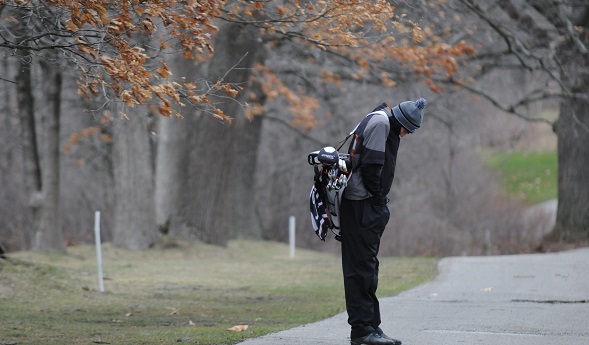
PHOTO: A golfer attempts to keep warm during a round on a dreary day earlier this season. (Click to see more at HighSchoolSportsScene.com.)
Future Becomes Now as Freshman Oliver Pulls Douglass Past Dollar Bay
By
Keith Dunlap
Special for MHSAA.com
March 12, 2026
EAST LANSING — Judging by the Detroit Douglass and Dollar Bay rosters Thursday, one thing is for certain:
The day’s first Division 4 Semifinal might not be the last time those two schools – located 553 miles apart on opposite ends of the state – hook up at the Breslin Center over the next few seasons.
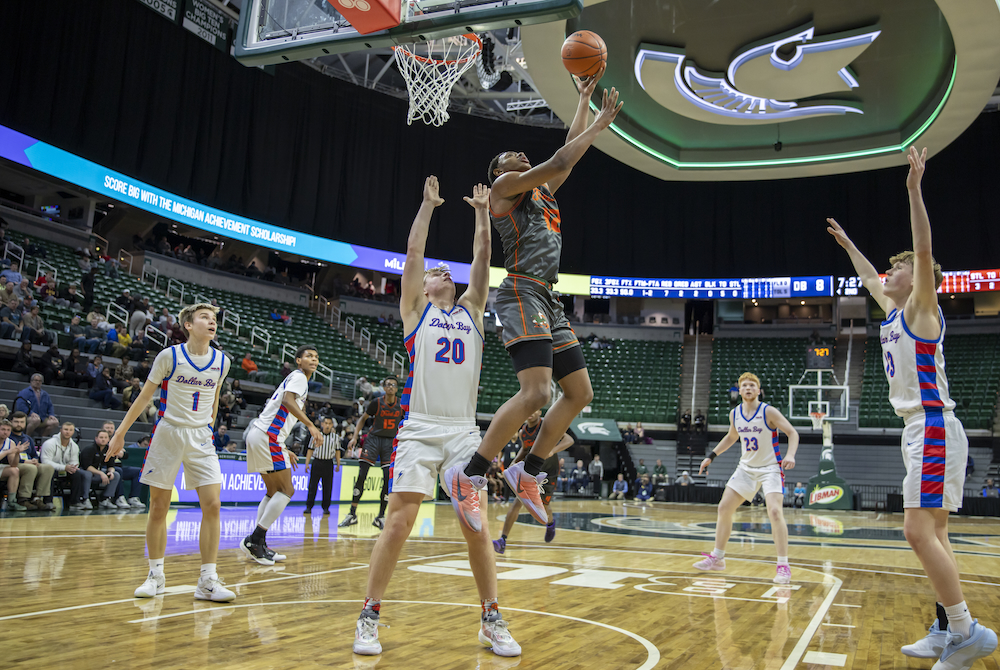
In a matchup between teams with rosters dominated by underclassmen, Douglass had a little too much on this occasion, advancing to the Division 4 championship game for the first time since winning it all in 2021 with a 58-47 win.
Douglass head coach Pierre Brooks had high praise after the game for Dollar Bay head coach Jesse Kentala and how he prepared his team, and knows the Hurricanes could be running into the Blue Bolts again.
“I heard about the young guys they have on their team,” Brooks said. “I think Coach told me they were here in 18 or 19. So hey, I wouldn’t mind seeing them again.”
One advantage Douglass had Thursday – and will if they meet again in the near future – is freshman Damani Oliver.
Entering the game leading his team in scoring at over 22 points a game, Oliver played like someone beyond his years, scoring 17 of his 21 points during the second half to help Douglass pull away.
 “I (didn’t) see too many (Detroit) Lions games this year because every Sunday, he’s calling me to get into the gym,” Brooks said. “He’s definitely put in the work and I’m glad in the second half he decided to really pick it up.”
Holding a 22-17 lead at halftime, Oliver started the third quarter with a four-point play and finished the third with 10 points to help Douglass take a 40-35 lead into the fourth.
The Hurricanes put the game away from there, going up 51-38 with 3:44 remaining on a basket by sophomore Quinn Davis.
He also scored 14 points for Douglass, which didn’t shoot the ball well from the perimeter. Douglass was just 4 of 20 from 3-point range, but made that up a bit with a 30-22 rebounding advantage.
Junior Baron Colbert scored a game-high 23 points for Dollar Bay (24-3), which was making its first Semifinal appearance since 2019. With just three seniors, three freshmen and two eighth graders on the roster, Dollar Bay should be heard from again.
Kentala just hopes that if his team returns next year or beyond, the weather will be a little better.
Many of the school and community’s fans couldn’t make it down to the game as expected because the Mackinac Bridge was closed due to a winter storm.
“It’s been a great ride,” Kentala said, talking about his team’s tournament run. “I thought our plan was right. I thought these guys executed it just beautifully. I thought we did everything in our power. I thought we kept them guessing. We mixed up our zone and man pressure. I thought we attacked, I thought we were fearless, I thought we were tough. Sometimes the shots don’t fall, and (Oliver) really stuck a few key shots. A really nice player.”
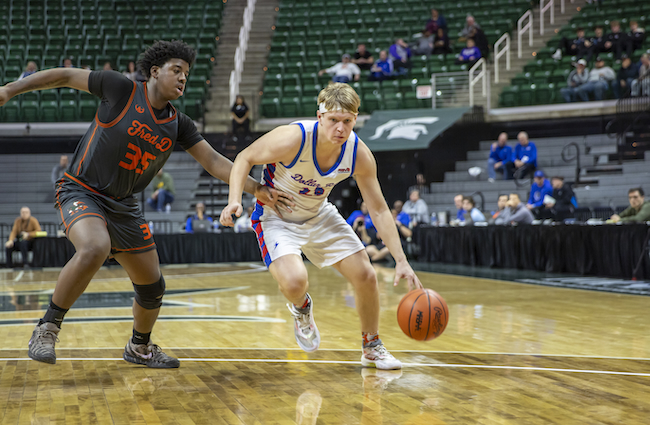
PHOTOS (Top) Detroit Douglass’ Kamari Howard (12) gets a shot up over Dollar Bay’s Liam Tourtillott (20) during Thursday’s first Division 4 Semifinal at Breslin Center. (Middle) Tourtillot makes a move into the lane while guarded by Douglass’ Dimauvion Smith-Powe (35). (Photos by Adam Sheehan/Hockey Weekly Action Photos.)