

Eventually, the sun will shine ...
April 25, 2013
By Geoff Kimmerly
Second Half editor
 We all believe that, right?
Rain – and snow for some – has been the buzzword of this spring sports season. Just about every newspaper is writing about it and every athletic director, coach, player and parent is dreading it on a now-daily basis.
But eventually, we expect the weather to clear up and teams to play catch-up. To that end, there are limitations teams in some sports face when attempting to make up their games – but also opportunities to take advantage of while trying to fill out their regular-season schedules.
- Girls soccer and girls and boys lacrosse teams may play only three games during a week, Monday through Sunday. A weekend tournament – which generally includes 2 to 3 shortened games – counts as only one in this equation.
- Baseball and softball teams can play as many games as they want in a week, but no more than two on a school day – and baseball pitchers must not pitch for two days following their 30th out in a week.
- For tennis, an individual may not play more than three matches in one day – unless she or he is playing in a league championship tournament featuring more than eight schools for which a fourth match would decide the championship. That player also could not have played more than six sets that day heading into that fourth and final match.
- Golf and Track and Field do not have weekly contest limitations. Track and field athletes can compete in only four events per day.
As expected, a number of teams – especially for baseball and softball – are scheduling to smash in as many contests as possible into the next four weeks. Postseason play for tennis and lacrosse begins May 16 – three weeks from today.
But teams do have options.
One rarely used but anticipated to be used more this spring is an opportunity to continue playing regular-season contests through the final day of the MHSAA tournament in that sport. For example, a baseball team can continue making up games through June 15, the day of the MHSAA Finals in Battle Creek. A tennis team can play regular-season matches through June 1, etc.
Also, the MHSAA Executive Committee approved Thursday to allow for this spring two additional multi-team tournament dates for soccer and lacrosse, which will give those teams an opportunity to get in a few more games. That means soccer teams will be allowed to play in four multi-team tournaments instead of two, boys lacrosse four instead of two and girls lacrosse five instead of three.
Teams will have to do some juggling, no doubt, and all other tournament stipulations still apply (games generally are shortened so more can be played, etc.). But with a little creativity, teams could at least get in a few of their make-up games in this way.
Also, the Executive Committee approved a motion to waive the four-contest MHSAA tournament entry requirement for all Upper Peninsula schools in all sports this spring. As of the weekend, snow still covered parts of the U.P.
Gaps shrinking
Much has been discussed about minimums for all four MHSAA classes for 2013-14, and how they are the lowest student totals in at least a decade.
It’s true. The floor in Class A is 893 (down from 911 this school year), Class B starts at 429 (down from 449), Class C at 207 (down from 217) and Class D at 206 (down from 216).
However, there is a better way to crunch the numbers: Consider the shrinking gaps between the largest and smallest schools in each class.
For 2013-14, the gap in Class A is 1,888 students – 261 students fewer than 2007-08 and nearly 900 students fewer than in 2005-06. The gaps between largest and smallest in Classes B, C and D also are trending smaller – which means each class actually includes schools more similar in size, instead of a perceived other way around.
SAC 2013-14 on the way
We’re thankful for a valuable group of students who help us throughout the school year – our 16-member Student Advisory Council, made up of eight seniors and eight juniors from all over the state who are charged with providing feedback on issues impacting educational athletics from a student’s perspective, while also assisting at MHSAA championships and with special projects like the “Battle of the Fans.”
Selecting the next class to join is a highlight of every spring – but hardly an easy process.
A six-member selection committee, myself included, considered 62 sophomore applicants today from all over the Lower and Upper Peninsulas, representing all four of our classes and nearly every sport we sponsor.
Every candidate is impressive for a variety of reasons. That’s what makes this difficult – we could pick any number of combinations to make up our new SAC class, and no doubt leaders galore will emerge from another impressive group.
But there are only eight spots on the council. And we’ll announce who received them later next week.
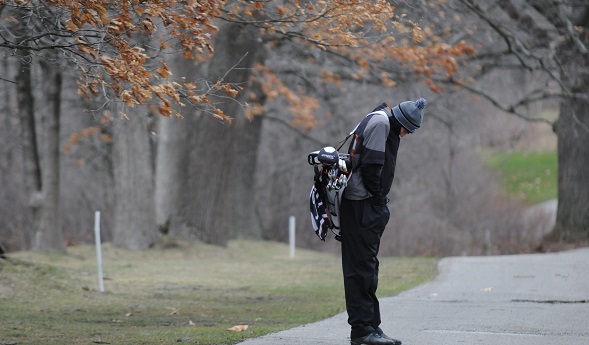
PHOTO: A golfer attempts to keep warm during a round on a dreary day earlier this season. (Click to see more at HighSchoolSportsScene.com.)
Significance of Historic Run, Relationships Formed Live On for 1973 Unity Champs
By
Dean Holzwarth
Special for MHSAA.com
August 7, 2026
It has been more than five decades, but Kim Hansen and Marcia (Visser) Beutel can still recall certain moments from a historic night in mid-December when their Hudsonville Unity Christian girls basketball team accomplished a tremendous feat.
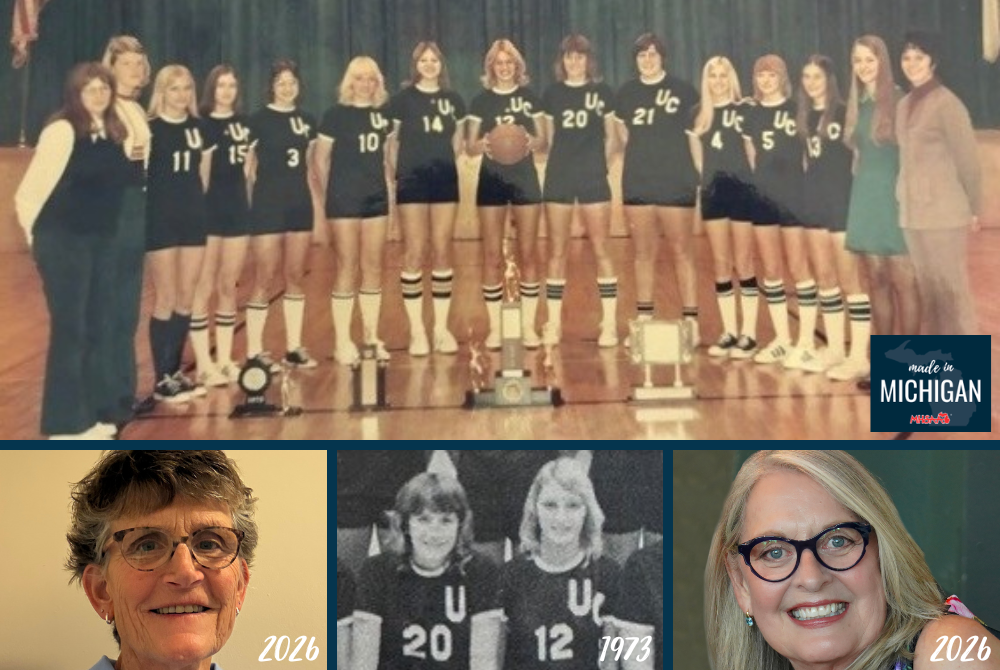
 On Dec. 15, 1973, at East Kentwood High School, the teammates helped the Crusaders win the first MHSAA Girls Basketball Finals championship in Class B.
Unity Christian defeated Saginaw MacArthur 49-45 before a crowd of 1,000.
“i just remember the team, the bus ride out there, and I remember just how excited we were to be together and what we had accomplished as a group,” Hansen said. “Our parents and friends were such big supporters through the whole process, and when I think back I see faces of pure joy.”
A total of 629 schools participated in that first tournament, which like now lasted three weeks and was divided into four classifications.
Cindy Masselink scored 17 points and Deb Aukeman added 16 points to lead the Crusaders to the championship win.
“For us, it was an excitingly significant day because we had been working hard throughout the season, and we, as women, could be the first winners of a state championship for our school and the state,” Beutel said. “A lot of us had been playing together since the sixth grade, and that camaraderie, that friendship, that teamwork and the work we had put in was going to end with a state championship.
“We were very blessed to be there, and we also knew that we were pioneers and trailblazers in the game.”
The Crusaders consisted of 11 girls, three managers and head coach Susan Contant.
An interesting sidenote from the Class B title game: As the home team, Unity Christian was to wear white uniforms. But the Crusaders didn’t own those.
“There were limited resources for women's sports back then so we had to wear the boys uniforms for the state championship,” Beutel said. “They didn't fit well so we had to wear T-shirts underneath them.”
One thing the 1973 squad possessed was size, which proved to be a benefit as the 3-point shot didn’t yet exist.
“We took each tournament game as it came to us and just kind of did our thing,” Hansen said. “I look back at our pictures, and we were huge. We had a starting five of 6-foot plus, and we were a big team. That definitely worked in our favor, and I really don't think that we were going to be denied.”
Beutel and Hansen, both 69, are organizing a night to recognize this special group of women.
 It will take place Dec. 11 during a Unity Christian girls and boys varsity game night.
“We are all much older and lives have happened and we are in different places, but I’m hoping that many of the teammates will come back for that,” Hasen said. “I know our head coach and her husband are going to come back for that, and I think that is just amazing. I haven't seen Sue since 1973.
“I got to see some of my teammates when we were recognized at Central Michigan for the 30-year anniversary, and I’m looking forward to seeing who is going to be able to make it and hoping that many do.”
Beutel lives in Toronto with her husband, Robert. She recently visited her old high school.
“They had a list of all the state championships on the wall, and the first one was us,” she said. “That was very emotional for me to see that, to see that recognition.”
Beutel met her husband at the University of Michigan, and they had three kids. One of their daughters, Sophie, played Division I basketball at Brown.
Beutel moved to Toronto in 1987 and coached basketball in a recreational league while helping grow the game. She was president of the Toronto Basketball Association, which has surged to 1,000 athletes.
The country needed to push for basketball representation and now has the NBA’s Toronto Raptors and the Toronto Tempo, currently playing its inaugural season in the WNBA.
“Back then it was a hockey country, so I had to search for basketball in Toronto,” Beutel said. “I got involved in it and expanded it on the girls side and always coached my kids.”
Now retired after a career as a health care executive, Beutel and her husband love adventures and have traveled to several countries. “There is so much more to experience in life,” she said.
While she stays active by playing tennis, cycling and kayaking, Beutel also plays clarinet in a band and volunteers at a cancer support group as a peer counselor after enduring two bouts of breast cancer.
After high school, Hansen played four years of basketball at Grand Valley State University before being drafted by the San Francisco Pioneers of the Women’s Professional Basketball League.
She played there one season before being traded to the Chicago Hustle. She also spent time with the Minnesota Fillies before the league went bankrupt and disbanded in 1981.
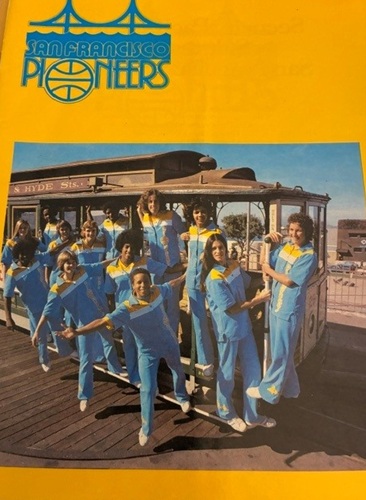 “I think I made $7,000 for my salary and the season was very short, but it was such an amazing experience and San Francisco was a very good franchise,” Hansen said. “They had good ownership and we flew all over the place and stayed in really nice hotels. They had a good practice facility, and we were treated really well.”
Prior to a game scheduled in Chicago on March 21, 1981, Hansen and her Fillies teammates walked off the court before the starting lineups were announced in a protest over unpaid salaries.
“We planned to do our warm-up, go back to the locker room and then get back in vans and drive back to Minnesota because we weren’t getting paid,” Hansen said. “That was our way of showing that we were not happy with ownership and the only way that we could make a stand.”
Despite the disbanding of the league, Hansen said lifelong relationships were formed.
“The beauty of playing sports is relationships, and even relationships that we developed at Unity are still so strong, and relationships I developed while playing pro ball are still very active and to me that is the beauty of playing sports,” she said.
After the WPBL, Hansen went to graduate school at Lamar University in Texas and eventually became an educator and coach at several colleges and high schools, including Wichita State and North Central College (Ill.).
Her final stop was Cleveland Heights High School, where she coached and taught physical education and health. She lives in Kirtland, Ohio, and retired from teaching and coaching in 2024 although she still works part-time in the transportation department.
“I love coaching and I always loved practice,” Hansen said. “I just finished working with four seventh-grade boys and helping them with fundamentals and skills. I just enjoy that part of it so much.”
2026 Made In Michigan
Aug. 4: Work Ethic Continues to Drive Van Dyk's Endeavors as Co-Owner of Family Farm - Report
July 24: Hackett Mentor's Care Sparked Lifetime in Hoops for BCAM President White - Report
July 24: Mackey Leaving Court with 500+ College Hoops Wins, Many More Lessons Shared - Report
July 16: Country Day Two-Time Champ Moore Building Perennial Winner at Harvard - Report
July 9: Multi-Sport Career at TC West Helps Gillis Thrive as Pro in Game She Once Left Behind - Report
July 2: Inspired by Home, Eager to Give Back, Spencer Hosts Hoop City Alumni Games - Report
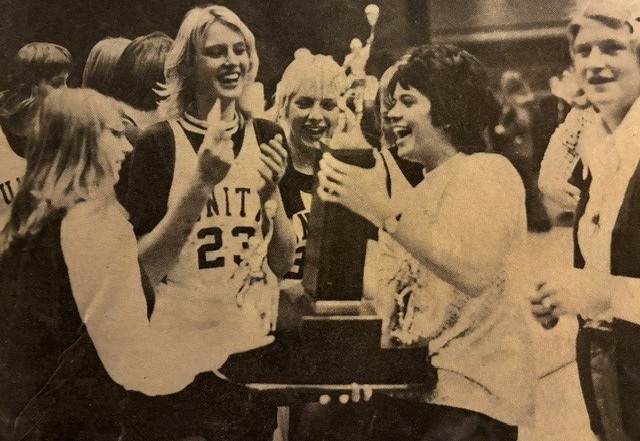
PHOTOS (Top) The 1973 Unity Christian girls basketball team poses for a team photo with its championship trophy; Kim Hansen (20) and Marcia Beutel (12) then and now. (Middle) Unity coach Susan Contant holds the championship trophy surrounded by her players after the clinching victory. (Below) Hansen stands for a photo with her San Francisco Pioneers teammates during the 1979-80 season. (Photos provided by Kim Hansen and Marcia Beutel.)