Eventually, the sun will shine ...
April 25, 2013
By Geoff Kimmerly
Second Half editor

We all believe that, right?
Rain – and snow for some – has been the buzzword of this spring sports season. Just about every newspaper is writing about it and every athletic director, coach, player and parent is dreading it on a now-daily basis.
But eventually, we expect the weather to clear up and teams to play catch-up. To that end, there are limitations teams in some sports face when attempting to make up their games – but also opportunities to take advantage of while trying to fill out their regular-season schedules.
- Girls soccer and girls and boys lacrosse teams may play only three games during a week, Monday through Sunday. A weekend tournament – which generally includes 2 to 3 shortened games – counts as only one in this equation.
- Baseball and softball teams can play as many games as they want in a week, but no more than two on a school day – and baseball pitchers must not pitch for two days following their 30th out in a week.
- For tennis, an individual may not play more than three matches in one day – unless she or he is playing in a league championship tournament featuring more than eight schools for which a fourth match would decide the championship. That player also could not have played more than six sets that day heading into that fourth and final match.
- Golf and Track and Field do not have weekly contest limitations. Track and field athletes can compete in only four events per day.
As expected, a number of teams – especially for baseball and softball – are scheduling to smash in as many contests as possible into the next four weeks. Postseason play for tennis and lacrosse begins May 16 – three weeks from today.
But teams do have options.
One rarely used but anticipated to be used more this spring is an opportunity to continue playing regular-season contests through the final day of the MHSAA tournament in that sport. For example, a baseball team can continue making up games through June 15, the day of the MHSAA Finals in Battle Creek. A tennis team can play regular-season matches through June 1, etc.
Also, the MHSAA Executive Committee approved Thursday to allow for this spring two additional multi-team tournament dates for soccer and lacrosse, which will give those teams an opportunity to get in a few more games. That means soccer teams will be allowed to play in four multi-team tournaments instead of two, boys lacrosse four instead of two and girls lacrosse five instead of three.
Teams will have to do some juggling, no doubt, and all other tournament stipulations still apply (games generally are shortened so more can be played, etc.). But with a little creativity, teams could at least get in a few of their make-up games in this way.
Also, the Executive Committee approved a motion to waive the four-contest MHSAA tournament entry requirement for all Upper Peninsula schools in all sports this spring. As of the weekend, snow still covered parts of the U.P.
Gaps shrinking
Much has been discussed about minimums for all four MHSAA classes for 2013-14, and how they are the lowest student totals in at least a decade.
It’s true. The floor in Class A is 893 (down from 911 this school year), Class B starts at 429 (down from 449), Class C at 207 (down from 217) and Class D at 206 (down from 216).
However, there is a better way to crunch the numbers: Consider the shrinking gaps between the largest and smallest schools in each class.
For 2013-14, the gap in Class A is 1,888 students – 261 students fewer than 2007-08 and nearly 900 students fewer than in 2005-06. The gaps between largest and smallest in Classes B, C and D also are trending smaller – which means each class actually includes schools more similar in size, instead of a perceived other way around.
SAC 2013-14 on the way
We’re thankful for a valuable group of students who help us throughout the school year – our 16-member Student Advisory Council, made up of eight seniors and eight juniors from all over the state who are charged with providing feedback on issues impacting educational athletics from a student’s perspective, while also assisting at MHSAA championships and with special projects like the “Battle of the Fans.”
Selecting the next class to join is a highlight of every spring – but hardly an easy process.
A six-member selection committee, myself included, considered 62 sophomore applicants today from all over the Lower and Upper Peninsulas, representing all four of our classes and nearly every sport we sponsor.
Every candidate is impressive for a variety of reasons. That’s what makes this difficult – we could pick any number of combinations to make up our new SAC class, and no doubt leaders galore will emerge from another impressive group.
But there are only eight spots on the council. And we’ll announce who received them later next week.
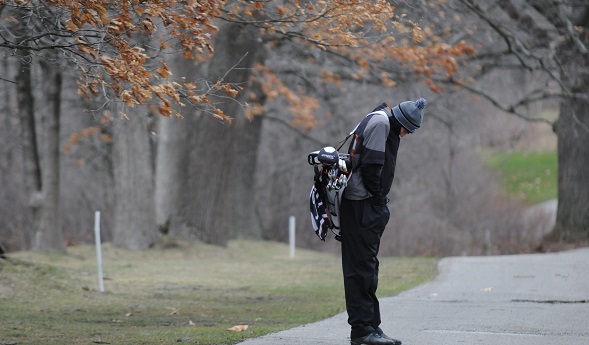
PHOTO: A golfer attempts to keep warm during a round on a dreary day earlier this season. (Click to see more at HighSchoolSportsScene.com.)
Century of School Sports: MHSAA's Move to TV, Now Internet, 60 Years Old & Growing
By
Jon Ross
MHSAA Director of Broadcast Properties
June 3, 2025
On any given day during a sports season, you can choose from nearly 100 high school sporting events in Michigan to watch online.
More than 600 high schools are partners with the NFHS Network, and their freshman, JV, and varsity games all air live on that platform. In fact, since the MHSAA joined the Network in 2013, more than 216,000 events from Michigan have aired, trailing only Georgia and California. During the 2023-24 school year alone, nearly 47,000 events from Michigan were on live.
The NFHS Network is also home to the Finals in boys & girls cross country, boys & girls soccer, boys & girls Lower and Upper Peninsula swimming & diving, girls volleyball, 8-player football, competitive cheer, gymnastics, ice hockey, skiing, wrestling, baseball, softball, boys & girls lacrosse, and track & field. And starting with the 2025-26 school year, Finals in field hockey, boys volleyball, 11-player football, and boys & girls basketball will also air on the Network.
But it wasn’t always this easy to have so much content on your phone, computer, or TV.
During the mid-1950s, the MHSAA Representative Council began to explore the possibilities of having the Boys Basketball Finals televised. The Council discussed ideas of having all four classes broadcast to statewide audiences, and creating a modest new revenue stream while protecting existing ticket sales, which was already happening in some states.
It wasn’t until 1961 that a proposal from WJIM-TV in Lansing was approved by the Council on a one-year “experimental” basis. All four title games would be shown, with WOOD-TV in Grand Rapids, WPBN-TV in Traverse City and WTOM-TV in Cheboygan joining the network. Since the games were already sold out, a rights fee to protect against lost ticket sales was waived.
No live television took place in 1962, but Michigan State University’s WMSB-TV recorded the games to be shown the following day.
In 1963, only the Class A Final was televised on six stations – WXYZ-TV, Detroit; WJRT-TV, Flint/Saginaw/Bay City; WJIM-TV, Lansing; WOOD-TV, Grand Rapids/Kalamazoo; WWTV, Cadillac; and WWUP-TV, Sault Ste. Marie. At least one station – WXYZ (the flagship station of the network) – could make only a two-hour time slot available, and when that window closed, the broadcast ended before the end of the contest.
From 1964 through 1974, Final games were televised on anywhere from two to four stations, with MHSAA BULLETIN accounts listing WZZM-TV in Grand Rapids as the originating party most years up to 1970, and WOTV-TV in Grand Rapids from 1971-74. The BULLETIN reported that 10 stations carried the Class A game in 1968, and the number of stations varied for the other three games. Flint, Detroit and Cadillac were other markets in which games were regularly shown.
In 1975, the MHSAA struck up a relationship with Public Broadcasting for the games for seven years, with WCMU-TV in Mount Pleasant coordinating the network that included affiliates in Allendale, Detroit and University Center the first year. Stations in Alpena, East Lansing and Marquette would later be involved. WFUM-TV in Flint would assume responsibility for the network in 1981, and also produced one year of the MHSAA Football Finals at the Pontiac Silverdome.
The games went back the commercial air waves in 1982, originated by WILX-TV in Lansing and carried by stations in Cadillac, Flint and Grand Rapids. The Grand Rapids affiliate, WXMI-TV, would assume control of network operations from 1986 to 1989, and included live telecasts of the Girls Basketball Finals in its market.
When the Boys Basketball Finals moved to The Palace of Auburn Hills in 1990, Palace Sports & Entertainment produced and distributed the games statewide with WKBD-Southfield as the flagship station. At the same time, the MHSAA began to produce Finals in girls basketball, volleyball, soccer, ice hockey and other sports to be shown live and delayed on Pro-Am Sports (PASS Sports). Football Finals and the Football Selection Sunday Show also aired for several years on PASS. (A large collection of those games are available to view on the MHSAA YouTube channel.)
In 1998, the MHSAA began a 28-year partnership with Fox Sports Detroit (which became Bally Sports Detroit in 2021 and FanDuel Sports Network Detroit in 2024). Fox Sports broadcast Boys and Girls Basketball Semifinals and Finals and Football Finals, and also produced the football playoffs selection show during this time.
Starting in 2007, the MHSAA created the School Broadcast Program – which allowed schools to provide content to Comcast, which aired the games throughout the state on a delayed basis.
Six years later, the NFHS Network was born – with Michigan one of the founding states. The Network has shared nearly $1.5 million dollars with partner schools since the Network’s start.
In 2017, the addition of the Pixellot camera – an automated unit equipped with multiple high-definition cameras that operates without human assistance by focusing on the ball and player movement – sped up the number of schools supplying content to the Network. Otisville LakeVille Memorial in 2017 became the first Michigan school – and one of the first nationally – to implement the technology that now broadcasts events from fields and gyms all over both peninsulas.
But perhaps the most rapid acceleration of digital broadcast presence occurred during the COVID-19 pandemic, which led to live audience limits during much of the 2020-21 school year and made putting events online a must so families and friends could follow the action. And following that rapid rise in live streaming, the number of broadcasts has only continued to grow.
For those unable to attend a game in person, it’s never been easier to watch the game from home or anywhere with an internet connection.
(Retired MHSAA Director of Broadcast Properties John Johnson contributed significant research to this report.)
Previous "Century of School Sports" Spotlights
May 27: Upper Peninsula Helps Make Michigan's School Sports Story Unique - Read
May 20: From Nearly A to Z, Schools Repped by 221 Nicknames - Read
May 13: These Record-Setters were Nearly Impossible to Defeat - Read
May 6: 200+ Representatives Fill All-Time Council Roster - Read
April 29: MHSAA Programs Prioritize Health & Safety - Read
April 23: Patches Signify Registered Officials' Role in MHSAA Story - Read
April 16: Student Advisory Council Gives Voice to Athletes - Read
April 9: State's Storytellers Share Spring Memories - Read
April 2: Sharp Leadership Synonymous with MHSAA Success - Read
March 25: Athletic Directors Indispensable to Mission of School Sports - Read
March 18: 2025 Finals Begin Next Half-Century of Girls Hoops Championships - Read
March 11: Boys Basketball's Best 1st to Earn MHSAA Finals Titles - Read
March 5: Everything We Do Begins with Participation - Read
Feb. 25: Slogans & Logos Remain Unforgettable Parts of MHSAA History - Read
Feb. 19: MHSAA Tickets Continue to Provide Fan-Friendly Value - Read
Feb. 11: We Recognize Those Who Make Our Games Go - Read
Feb. 4: WISL Conference Continues to Inspire Aspiring Leaders - Read
Jan. 28: Michigan's National Impact Begins at NFHS' Start - Read
Jan. 21: Awards Celebrate Well-Rounded Educational Experience - Read
Jan. 14: Predecessors Laid Foundation for MHSAA's Formation - Read
Jan. 9: MHSAA Blazes Trail Into Cyberspace - Read
Dec. 31: State's Storytellers Share Winter Memories - Read
Dec. 17: MHSAA Over Time - Read
Dec. 10: On This Day, December 13, We Will Celebrate - Read
Dec. 3: MHSAA Work Guided by Representative Council - Read
Nov. 26: Finals Provide Future Pros Early Ford Field Glory - Read
Nov. 19: Connection at Heart of Coaches Advancement Program - Read
Nov. 12: Good Sports are Winners Then, Now & Always - Read
Nov. 5: MHSAA's Home Sweet Home - Read
Oct. 29: MHSAA Summits Draw Thousands to Promote Sportsmanship - Read
Oct. 23: Cross Country Finals Among MHSAA's Longest Running - Read
Oct. 15: State's Storytellers Share Fall Memories - Read
Oct. 8: Guided by 4 S's of Educational Athletics - Read
Oct. 1: Michigan Sends 10 to National Hall of Fame - Read
Sept. 25: MHSAA Record Books Filled with 1000s of Achievements - Read
Sept. 18: Why Does the MHSAA Have These Rules? - Read
Sept. 10: Special Medals, Patches to Commemorate Special Year - Read
Sept. 4: Fall to Finish with 50th Football Championships - Read
Aug. 28: Let the Celebration Begin - Read
PHOTOS Clockwise from top left: (1) Mickey York and Matt Shepherd anchor the 2024 Football Selection Show on FanDuel Sports Network Detroit. (2) Fred McLeod and Stan Edwards call the 1998 Class AA Final on Fox Sports Detroit. (3) Natalie Kerwin reports from the sidelines at the 2023 MHSAA 11-Player Football Finals on Bally Sports Detroit. (4) Rick Berkey is on the microphone at Kellogg Arena in Battle Creek to call the 1992 Girls Basketball Class C Final. (5) Mark Crawford and Kim Kaye broadcast the 1999 Class C/D Competitive Cheer Finals from Grandville High School.