

Lee Takes Key Steps in Heart Safety with AED Purchase, CPR Training for All Athletes
By
Steve Vedder
Special for MHSAA.com
December 30, 2025
WYOMING – Tom DeGennaro never felt the typical dizziness, lightheadedness or nausea associated with the attack before he simply fell over in his Wyoming Lee classroom seven years ago.
His students moved quickly to help him, but within minutes, DeGennaro, one day past his 53rd birthday, was dead.
"Literally dead on the floor," DeGennaro said. "Just nothing there."
DeGennaro suffered an aneurysm, a bleeding of the brain which caused a subarachnoid hemorrhage or ventricular fibrillation which led to cardiac arrest. Fortunately, paramedics swiftly arrived at the school and with the help of an automated external defibrillator (AED), shocked DeGennaro back to life. Six months later DeGennaro, a former football and track coach at four West Michigan high schools, awoke from a coma.
"I was talking to the kids, then I just flopped over and started convulsing," DeGennaro said of his only recollection of the event.
It was an incident which stuck with Wyoming Lee cross country and track coach Greg Popma, who had coached under DeGennaro at Lee for many years. The more Popma saw overweight and obviously out-of-shape spectators huffing and puffing to make it to different points of a three-mile cross country course, the more it bothered him that real tragedy at a meet was only a heartbeat away.
So Popma did something about it.
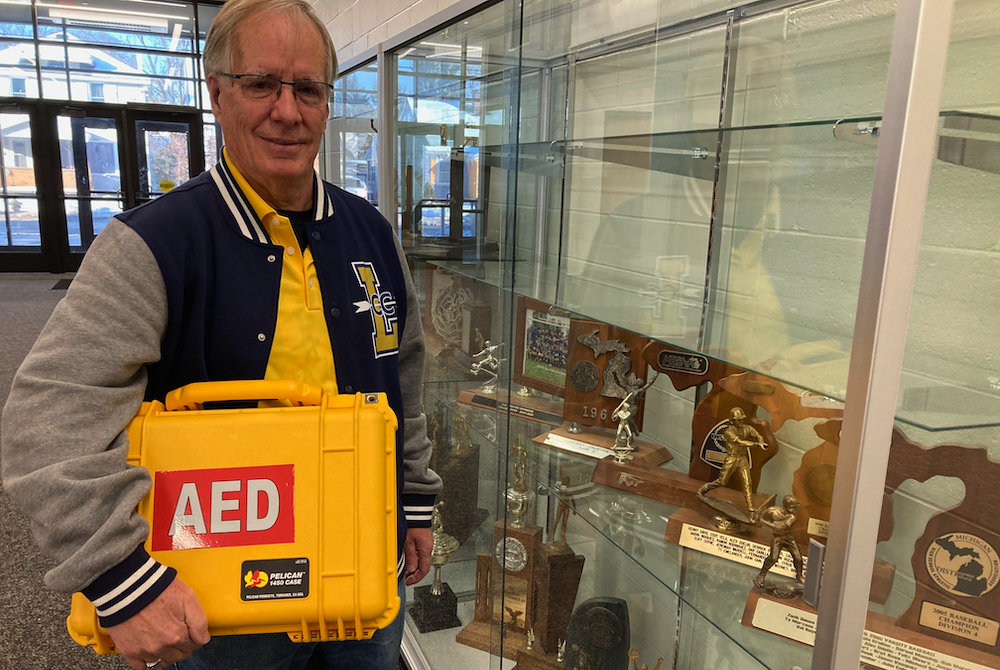
With the help of a grant from the American Heart Association, Popma organized the purchase of an AED to be kept at all Legends sporting events. Sure, all Wyoming Lee school buildings already had an AED, but Popma worried that in a medical emergency such as a heart attack, minutes counted. Popma wasn't completely sold on the idea that an AED could be rushed to a nearby cross country course, softball field or tennis court in time to fend off disaster. Now an AED is kept at the ready disposal of a Wyoming Lee trainer.
Popma admits the odds of ever needing an AED at a cross country meet or any other sporting event are low. But he isn't willing to just accept low odds.
Instead of letting a near-tragedy to his coaching partner and friend just slide into memory, Popma chose to act.
"It made me think a little that something like that could happen at any time," Popma said of DeGennaro's experience. "It's not only about the kids, but about parents and others who probably shouldn't be running or going from place to place at a cross country meet. We needed to have something there."
While MHSAA guidelines require all head coaches at member high schools and middle schools to be CPR certified (with that certification usually including AED training), Popma took the training a step farther. With the help of Wyoming Lee teacher Mike Donovan, all athletes from 15 Lee teams have been trained and certified in the usage of CPR.
Popma said he's seen AEDs at countless cross country and track meets over 25 years of coaching. Most are easily within reach at the organizational tent at meets. And while he's never witnessed a heart attack at an event, Popma knows of a father dying at a Legends baseball game, and he's also old enough to remember 28-year-old Detroit Lions receiver Chuck Hughes dying on the field at Tiger Stadium in 1971 due to a heart attack.
To do nothing and hope for the best is not a plan, Popma said.
"I hope people understand, what good is it if you don't have an AED?" he said. "Obviously you can't have 100 percent certainty if you don't make the attempt. The response has been positive. Coaches think it's a good idea. It's like, 'Oh, I never thought of that.'"
DeGennaro is recovered from his heart attack, but in the last seven years figures he's been shocked over 90 times by the implantable cardioverter defibrillator (ICD) in his chest. DeGennaro is honored that his experience sparked safety improvements at Wyoming Lee.
"Love it," he said. "Even at professional events these things can happen. AEDs need to be at every place, every sporting event and not just for the kids. For the adults, too.
"Nothing is 100 percent. You bring band-aids to games and never get cut, right? There needs to be preparation for something like a heart attack. I have two goals in life now. Spreading the word of Christ and getting people to learn about CPR."
PHOTO Wyoming Lee cross country/track coach Greg Popma carries his school’s portable AED that is brought to school sporting events. (Photo by Steve Vedder.)
The Inside Scoop On Ski Safety: 6 Tips
January 10, 2023
Injuries happen to skiers of all levels, even under pristine conditions and when using the best available equipment. “Beginners are more likely to get injured. But when experienced skiers go down, they tend to have more severe injuries,” says Michelle Gambino-Gorney, a certified athletic trainer at the Henry Ford Kutcher Clinic for Concussion and Sports Neurology.
 But you don’t have to let the risk of injury hold you back from having fun on the slopes. A few basic safety tips? Stay within your ability level and ensure your skis are in good condition. That said, going beyond ski safety basics and learning how to avoid injuries can help you stay safe on the slopes. Here are six expert tips:
Use caution when getting on and off the ski lift. Ski lifts make a lot of people anxious. Being high off the ground on your journey up the mountain can invoke a fear of falling. “But it’s getting on and off the ski lift where the vast majority of lift-related injuries occur,” Gambino-Gorney says. To lower your risk of injury, remove pole straps and backpacks before loading, look over your shoulder to make sure you sit squarely on the seat at the correct time, and don't try to retrieve items you lose hold of (including poles, gloves and phones). It’s best to let them go and ski back for them.
Keep it simple at terrain parks. Terrain parks include human-made features like ramps and rails that enable skiers to do jumps, flips and other maneuvers. Any time your skis leave the ground, injuries are possible. You can safely enjoy terrain parks by starting with smaller obstacles and maneuvers and mastering them before moving on to other challenges. Do not rely on online tutorials to learn new skills. Ski instructors can help you learn the correct technique and provide personalized tips for achieving your goals.
Beware of trees. Trees present multiple dangers. Colliding with a tree, especially at high speed, leads to some of the most severe ski injuries. A small number of skiers die each year from tree collisions. To avoid collisions, ski with control. Other concerns include tree wells and snow immersion suffocation. This type of injury occurs when a person falls head first into a pocket of loose snow near a tree trunk and gets trapped. Skiing with a partner on ungroomed paths, which typically run past tree wells, is essential. If you become immersed in a tree well, a partner can step in to help you break free.
Pay extra attention during your final run of the day. Injuries are more common during skiers’ last runs. “Skiing later in the day can be dangerous because small changes can affect your ability to maneuver and react to conditions,” Gambino-Gorney says. Fresh powder may get matted down. Groomed areas become bumpy. And fatigue can make you less aware of hazards and other skiers. While it may be tempting to give it your all on your last run, it’s better to ease up and take your time.
Follow the Skier Code of Responsibility. People of all ages, abilities and ski levels can safely share the slopes when everyone follows the National Ski Area Association™ Responsibility Code. Key points include: Giving right of way to people ahead of (downhill from) you, staying off closed trails, and looking uphill for other skiers when merging.
Expedite access to help in an emergency. Being prepared can help you quickly reach ski patrol in an emergency. Most ski areas list their ski patrol phone number near the lifts. While you are waiting in the ski lift line, program it into your phone. If you or someone nearby experiences an injury, being able to call for help will save precious time. Instead of waiting for someone to ski down the mountain and ask for help, you can stay with the injured person and call for help. Calling also makes it easier to share important details so that ski patrol arrives with the appropriate people and equipment.
“Skiing is like any sport in that there’s a risk of injury. But many people hit the slopes without incident. Some skiers go decades without a single fall,” Gambino-Gorney says. Follow these insider tips and don't forget to wear a helmet so you can relish your next powder day and get the most out of the season.
To find a sports medicine provider at Henry Ford, visit henryford.com/sports or call 313-651-1969.
Michelle Gambino-Gorney is a certified athletic trainer at the Henry Ford Kutcher Clinic for Concussion and Sports Neurology.