

Lee Takes Key Steps in Heart Safety with AED Purchase, CPR Training for All Athletes
By
Steve Vedder
Special for MHSAA.com
December 30, 2025
WYOMING – Tom DeGennaro never felt the typical dizziness, lightheadedness or nausea associated with the attack before he simply fell over in his Wyoming Lee classroom seven years ago.
His students moved quickly to help him, but within minutes, DeGennaro, one day past his 53rd birthday, was dead.
"Literally dead on the floor," DeGennaro said. "Just nothing there."
DeGennaro suffered an aneurysm, a bleeding of the brain which caused a subarachnoid hemorrhage or ventricular fibrillation which led to cardiac arrest. Fortunately, paramedics swiftly arrived at the school and with the help of an automated external defibrillator (AED), shocked DeGennaro back to life. Six months later DeGennaro, a former football and track coach at four West Michigan high schools, awoke from a coma.
"I was talking to the kids, then I just flopped over and started convulsing," DeGennaro said of his only recollection of the event.
It was an incident which stuck with Wyoming Lee cross country and track coach Greg Popma, who had coached under DeGennaro at Lee for many years. The more Popma saw overweight and obviously out-of-shape spectators huffing and puffing to make it to different points of a three-mile cross country course, the more it bothered him that real tragedy at a meet was only a heartbeat away.
So Popma did something about it.
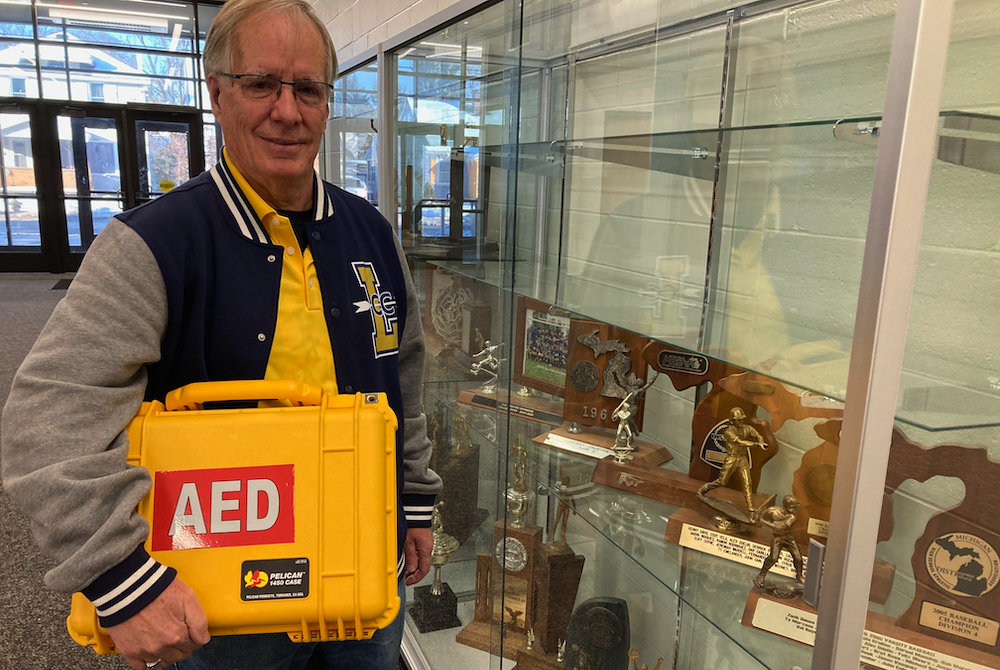
With the help of a grant from the American Heart Association, Popma organized the purchase of an AED to be kept at all Legends sporting events. Sure, all Wyoming Lee school buildings already had an AED, but Popma worried that in a medical emergency such as a heart attack, minutes counted. Popma wasn't completely sold on the idea that an AED could be rushed to a nearby cross country course, softball field or tennis court in time to fend off disaster. Now an AED is kept at the ready disposal of a Wyoming Lee trainer.
Popma admits the odds of ever needing an AED at a cross country meet or any other sporting event are low. But he isn't willing to just accept low odds.
Instead of letting a near-tragedy to his coaching partner and friend just slide into memory, Popma chose to act.
"It made me think a little that something like that could happen at any time," Popma said of DeGennaro's experience. "It's not only about the kids, but about parents and others who probably shouldn't be running or going from place to place at a cross country meet. We needed to have something there."
While MHSAA guidelines require all head coaches at member high schools and middle schools to be CPR certified (with that certification usually including AED training), Popma took the training a step farther. With the help of Wyoming Lee teacher Mike Donovan, all athletes from 15 Lee teams have been trained and certified in the usage of CPR.
Popma said he's seen AEDs at countless cross country and track meets over 25 years of coaching. Most are easily within reach at the organizational tent at meets. And while he's never witnessed a heart attack at an event, Popma knows of a father dying at a Legends baseball game, and he's also old enough to remember 28-year-old Detroit Lions receiver Chuck Hughes dying on the field at Tiger Stadium in 1971 due to a heart attack.
To do nothing and hope for the best is not a plan, Popma said.
"I hope people understand, what good is it if you don't have an AED?" he said. "Obviously you can't have 100 percent certainty if you don't make the attempt. The response has been positive. Coaches think it's a good idea. It's like, 'Oh, I never thought of that.'"
DeGennaro is recovered from his heart attack, but in the last seven years figures he's been shocked over 90 times by the implantable cardioverter defibrillator (ICD) in his chest. DeGennaro is honored that his experience sparked safety improvements at Wyoming Lee.
"Love it," he said. "Even at professional events these things can happen. AEDs need to be at every place, every sporting event and not just for the kids. For the adults, too.
"Nothing is 100 percent. You bring band-aids to games and never get cut, right? There needs to be preparation for something like a heart attack. I have two goals in life now. Spreading the word of Christ and getting people to learn about CPR."
PHOTO Wyoming Lee cross country/track coach Greg Popma carries his school’s portable AED that is brought to school sporting events. (Photo by Steve Vedder.)
Bloomingdale Trainer Performing Invaluable Role in Keeping Athletes Playing
By
Pam Shebest
Special for MHSAA.com
November 22, 2022
BLOOMINGDALE — If Scott Allison looks bored during one of Bloomingdale’s sporting events, that is a good thing.
 “Trainers like to be behind the scenes and in the shadows,” the certified athletic trainer said. “We’re only needed in emergencies.
“It’s one of those jobs that if we’re sitting around looking bored, then things are going well.”
But if an athlete goes down with an injury, Allison is quick to run onto the court or field.
In his first year at Bloomingdale, he has found that working with middle and high school students is a lot different than his previous work with the minor-league hockey Kalamazoo Wings.
Treating the hockey team, with whom he spent much of his 22 years, “There was a lot of traumatic stuff like lacerations or deep contusions, overuse injuries like hip flexors or core injuries or broken bones.
“Everything’s acute and fast. It’s a different animal. In hockey, they’re all pro athletes so they know their bodies really well.”
However, high school and middle school athletes are still in a growing phase.
“These kids don’t really know what’s going on a lot of times, so it’s a lot more education on what’s happening,” Allison said.
“Is it an injury, or is it just soreness? You get a lot of kids that don’t understand the difference between aches and pains or an injury. We see a lot of ankle sprains or shin splints because they’re just developing. They’re in that awkward range where their bodies try to grow too fast.”
 Allison is the Cardinals’ first certified athletic trainer, a new position for which athletic director Jason Hayes campaigned.
“What we notice is that if a kid’s injured, they’re out a lot less if you have a trainer because it speeds up recovery time,” said Hayes, who also coaches varsity football and is an assistant wrestling coach. “It’s like having a built-in physical therapist on your staff, too.”
Studies support Hayes’ statements.
According to information from The Sports Institute at University of Washington, “‘The athletic trainers know the athletes,” says Stan Herring, M.D., cofounder of The Sports Institute at (University of Washington) Medicine and a team physician for the Seattle Seahawks and Seattle Mariners. “They see the athletes frequently, if not every day. They know when something is wrong. They are medical professionals who evaluate, treat and rehabilitate athletes.’”
The article continued: “Three recent studies suggest that athletic trainers are linked to significant improvements in the diagnosis of concussion in young athletes and significant reductions in ‘time-loss’ injuries that require athletes to take time away from sports.”
Allison sees himself as a teacher as well as a trainer.
“We see a lot more strains or growth issues,” he said. “A lot of it is maintenance and teaching kids what’s going on with their bodies or what they need to do to change things.”
He also meets with parents and coaches to talk about the best way to prevent injuries.
Allison’s day begins about 1:30 or 2 p.m., giving athletes a chance to talk with him before practices or games.
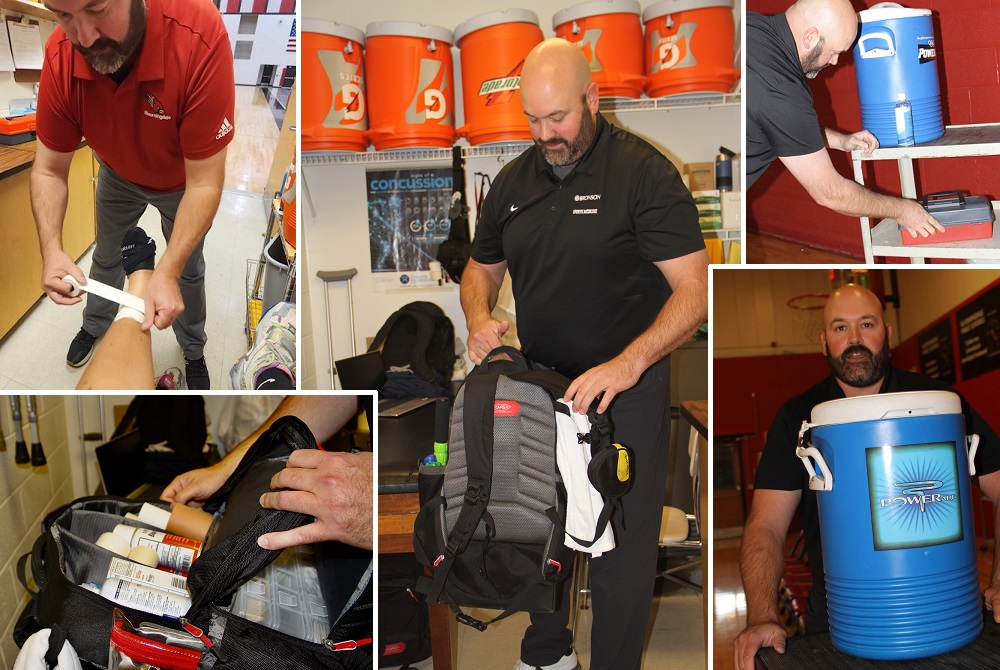
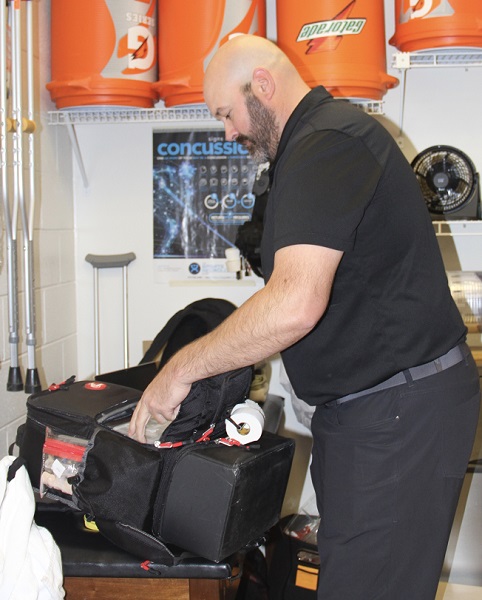
During the action, he always has his first aid backpack filled with the basics: air splints for fractures or dislocations, AED, EpiPens, and bench kits (with taping and bandaging supplies, splints, gauze, ACE wraps, ice bags, latex gloves and other basic first aid supplies.)
He travels with the teams when they are involved in high-impact sports, such as football, and many times he is also called to treat an opposing player if that team has no trainer.
 Allison is a perfect fit with Bloomingdale, Hayes said.
His wife, Kirsten, coached the Cardinals girls basketball team for seven years. His daughter Emma, now at Glen Oaks Community College, graduated from there, and his daughter Bailey is an eighth grader.
“We are a very lucky town,” Hayes said. “We had Doc (Robert) Stevens, who had been volunteering as our athletic trainer for 15 years. He’s just aging out.
“About a year ago, he came to me and said that it was his last year. Scott has 22 years experience, and he has relationships here. To me, it was a no-brainer.”
Assistant varsity football coach Lance Flynn, who also coaches the middle school football team, saw Allison in action during competition in the fall.
“First quarter in a middle school football game, a kid broke his arm,” Flynn said. “My own son, Ryder, was on the varsity team and he sprained his AC socket and Scott took care of him.
“If something happens during a game, they can go see him and I don’t have to worry much because I know they’re in good hands.”
Allison’s affiliation with Bronson Sports Medicine is also a plus, the trainer said.
“With Bronson, we can offer a lot more and expedite getting in to see doctors or specialists if we need to,” he said. “We’re on the same system as the doctors, so we can diagnose and send notes to the doctors and they can send notes back to us.
“If there’s anybody we need to keep track of with the doctors, I can talk with the doctors and figure out how that’s going. If anybody needs to see me, they know I’m here early if they just want to come down to talk.”
Bronson also provides certified athletic trainers at 21 other southwest Michigan high schools: Brooke Vandepolder (Battle Creek Central), Lindsay Aarseth-Lindhorst (Climax-Scotts), Amanda Monsivaes (Comstock), Makenzie Hodgson (Delton Kellogg), Salvador Robles-Soriano (Gobles), Holly Ives (Richland Gull Lake), Katelyn Baker-Contreras (Kalamazoo Hackett Catholic Prep), Lizzy Smith (Kalamazoo Central), Emma Beener (Kalamazoo Christian), Holly Sisson (Kalamazoo Loy Norrix), Nico Talentino (Mattawan), Aaron Eickhoff (Otsego), Quincey Powell (Parchment), Malorie Most (Paw Paw), Jessica Bakhuyzen (Plainwell), Lance LeTourneau (Portage Central), Janelle Currie (Portage Northern), Carrie Calhoun (Schoolcraft), Chelsea Harrison (South Haven), Alexis Walters (Three Rivers) and Natalie McClish (Vicksburg).
 Pam Shebest served as a sportswriter at the Kalamazoo Gazette from 1985-2009 after 11 years part-time with the Gazette while teaching French and English at White Pigeon High School. She can be reached at [email protected] with story ideas for Calhoun, Kalamazoo and Van Buren counties.
PHOTOS (Top) Bloomingdale trainer Scott Allison has several tasks as he works to keep the school’s student-athletes healthy and pain-free. (Middle) Bloomingdale athletic director Jason Hayes, left, and assistant varsity football coach Lance Flynn. (Below) Allison packs his bag for another full afternoon. (Ankle-taping photo by Andreya Robinson; all other photos by Pam Shebest.)