


Keep on Coaching
February 1, 2013
By Geoff Kimmerly
Second Half editor
A few weeks ago, I finally got my first chance this season to watch a friend coach his basketball team. After guiding some others at the lower levels, this is his first time running the varsity – something he wasn't sure he wanted to do with a 1-year-old just learning to walk, but a challenge he ended up taking on to the benefit of all those involved.
Simply put, he’s good. I've seen a lot of teams and a lot of coaches over the past 15 years, and although I wouldn't know much of what to do if I were walking the sideline, I felt pretty qualified in telling him I was impressed – even if he didn't buy that I was offering an unbiased opinion. The best news is he’s gone from not sure about this a few months ago to talking about next season.
We know, at least anecdotally, that coaching continues to get more challenging. The time commitment has grown substantially to make running a program a year-round endeavor in a lot of sports at a lot of schools.
That commitment – especially for coaches with children of their own – was a main reason referred to in a New Haven Post-Chronicle story Saturday that noted 23 football coaching openings in Connecticut at one point this offseason. That state has 146 football teams – meaning roughly 15 percent will have new leaders this fall.
And that got me thinking about my friend, about how glad I am he’s given this a shot, and how I've seen so many others either not do so, or not stick around long despite having some pretty nice success.
A study published last winter in Interscholastic Athletic Administration magazine – a product of the National Interscholastic Athletic Administrators Association – noted some predictable results of a study that sought to determine the biggest challenges faced by first-year high school coaches.
The toughest according to the study was balancing the demands of coaching and teaching, experienced by nearly half the respondents – 98 percent of which coached high school teams and 81 percent of which are teachers.
The next six reasons all were noted by at least 30 percent of those in the study – personal fatigue, securing community support, securing and caring for facilities and equipment, parental contact, keeping non-starting players motivated, dealing with schedule interruptions and motivating athletes to achieve consistent, peak performance.
Nothing there is earth-shaking, and most if not all of these challenges are faced by high school coaches regardless of how long they've been in the field. But I got a little more perspective from some of the 32 items that ranked as least challenging to the first-year leaders – keeping in compliance with state and league regulations, dealing with substance abuse issues, teaching sport skills and creating a positive team atmosphere – things that seem most important, and yet appear to be easiest to do. I’m not sure what that tells us – but I think it tells us something.
Click to check out the entire three-page breakdown of the study, plus the researchers’ recommendations to remedy some of what first-year coaches face.
Giving back to Saginaw
I love reading about high-level athletes – like a star-studded group of alums from Saginaw – giving back to where they got their starts.
Pittsburgh Steelers star LaMarr Woodley made a big impact before the start of this school year by donating $60,000 to cover all participation fees for athletes in his former school district. The Saginaw News’ Hugh Bernreuter writes today about how Woodley (Saginaw High), the Philadelphia 76ers’ Jason Richardson (Saginaw Arthur Hill) and former Oakland Raiders standout Stu Schweigert (Saginaw Heritage) have combined to give more than $865,000 back to their home communities.
Bernreuter also mentions the non-monetary contributions of the Golden State Warriors’ Draymond Green (Saginaw High) and former Indianapolis Colts receiver Blair White (Saginaw Nouvel).
Click to read more about it.
Quote(s) of the Week
While rifling through more papers on my desk, I found an article from the Washington Post from Sept. 2011 titled “How high school sports save our schools.” I was drawn to it in part because I spent more than a decade in a newsroom, and it was a piece by a reporter covering education who instead of reporting on school boards and the like, delved into the importance of interscholastic athletics to education as a whole.
He spoke of how participation continues to grow even as resources dwindle, and of data supporting that extracurriculars like sports are more effective than academic classes in teaching leadership, teamwork, time management and “other skills crucial for success in the workplace.” Later, he mentioned a study noting that those who participate in extracurriculars earned more a decade later.
Click here to read the entre piece. These passages struck me most.
“Coaches might be the only faculty members still allowed by our culture and educational practice to get tough with students not making the proper effort. They have the advantage of teaching what are essentially elective non-credit courses. They can insist on standards of behavior that classroom teachers often cannot enforce because the stakes of dismissing or letting students drop their courses are too high. …
“Students do better in activities they choose. If we provide more of them, led by committed adults … that can make a difference. We know the bad news about education. Dropout rates are high. Achievement scores are stagnant. But sports participation is going up, despite pressure to cut it back. Let’s cheer about that and look for a way to draw in more students.”

Piggee Leans on Big Reds After Dad's Death, Lifts Team with Dazzling Play
By
Tom Kendra
Special for MHSAA.com
November 3, 2021
Watching Destin Piggee do his thing on the football field – drawing collective gasps from the crowd with an array of moves, bursts of amazing speed and dramatic stops and starts – is nothing short of pure joy.
 What a contrast from the tragedy the quiet, humble, 15-year-old Muskegon High School sophomore suffered two months ago.
Muskegon coach Shane Fairfield said his young sensation has the heart of a lion, but that heart was ripped out of his chest on the afternoon of Sept. 3 – just hours before the Big Reds hosted Detroit Cass Tech in the biggest game in the state that weekend.
Piggee learned that his previously healthy father, 43-year-old Dereko Piggee, had died from complications after a short bout with COVID-19.
He then did what his dad would have wanted that night and played for the Big Reds, ripping off a 43-yard run (appropriately, one yard for every year of his dad’s life), giving a packed house at Hackley Stadium a preview of what was to come over the next eight games.
“I played that game, but I wasn’t in my right mind,” admitted Piggee, a 5-foot-6, 160-pound slot back and return man.
“My teammates and my coaches have helped me like you wouldn’t believe. If I didn’t have football, I probably would have gone out and done something stupid.”
The next game at Zeeland West was even more challenging, as earlier that day was his father’s funeral service – and then the young man who is too young to drive a car had to lay his father and best friend to rest at the cemetery.
He responded once again, scoring the winning touchdown on a 32-yard run in the fourth quarter.
Piggee hasn’t slowed down since, rolling up 705 rushing yards on a mere 30 carries, for a staggering 24 yards per attempt, with nine touchdowns. He also has caught nine passes for 201 yards and a touchdown, giving him 17 plays of 20-plus yards on only 39 offensive touches.
 “He is a gifted natural athlete, but you should see the way this young man works,” said Muskegon coach Shane Fairfield, who has led his team to nine straight wins after the humbling Week 2 loss to Cass Tech. “His love for the game and for his teammates is contagious.”
Muskegon (9-1) hopes to win its 10th-straight District championship at 1 p.m. Saturday when it hosts Cedar Springs (8-2).
The Big Reds, who have also won five straight Regional titles, are aspiring to make it to Ford Field for the eighth time in the past 10 years. Muskegon has won a state-best 878 games and 18 state titles, including six in the playoff era, with the latest coming in 2017.
It has been the emergence of super sophomore “smurfs” Piggee and his good friend, running back Jakob Price (5-7, 165), which has keyed this team’s resurgence.
Exhibit A was Muskegon’s 49-28 win over crosstown rival and two-time reigning Division 2 champion Muskegon Mona Shores on Oct. 8. With the Sailors keying on senior quarterback Myles Walton, the sophomores stole the show – Price with six carries for 217 yards and TD runs of 70 yards and 99 yards and Piggee with six carries for 123 yards and two TDs, along with two catches for 71 yards and another score.
Against Wyoming earlier this year, Piggee touched the ball twice all game and scored touchdowns both times, on an 82-yard run and an electrifying 50-yard punt return.
Although he makes it look easy on the field, it’s been a daily, hourly, minute-by-minute battle off of it for Piggee and his family, especially his mother, stepmother, grandparents and siblings.
“One day after school, I just started crying and I couldn’t stop,” said Piggee, who is the youngest of his father’s five children.
That was when his Big Red family stepped in.
 Senior Damari Foster hugged him and held him for a long time, before passing him off to freshman coach Corey Bibbs, who then handed him to Fairfield.
“Coach Fairfield finally got me to stop crying,” said Piggee, who wants to study electrical engineering in college. “He told me about some of the hard things he dealt with growing up, and I learned some things from him.”
Piggee said he draws motivation from his friend Dametrius “Meechie” Walker, a towering, 6-5 senior defensive lineman who was diagnosed last fall with osteosarcoma in his left leg, a rare bone cancer most often seen in teenage boys. The cancer has ended the playing career for Walker – who already had six Division I scholarship offers including from Michigan State, Minnesota and Kentucky – but he remains a positive, smiling force on the Muskegon sideline.
While Piggee is motivated to play hard for Walker, he is also determined to follow in the footsteps of his father, a 1996 grad who was a three-year varsity player and all-area defensive back for the Big Reds. He played running back, but was better known as a dangerous return man and lockdown cover man in the secondary.
“I remember Dereko was a nice, nice kid,” said Dave Taylor, Dereko’s head coach at Muskegon, who led the Big Reds to Class A championships in 1986 and 1989. “He did what I told him to do, and he was one of my favorites.”
This year’s Muskegon team is the youngest in Fairfield’s 12 years as head coach, with as many as eight freshmen and sophomores starting in some games.
The turning point in the season came after the 49-14 defeat at the hands of Cass Tech, when Fairfield challenged Piggee and his underclassmen teammates to rise above their youth and start playing “big boy football.”
“Big boy football means being confident and being in control of yourself at all times,” said Piggee. “We got on a group text and talked about that after our loss.
“We support our brothers here even when no one else does. These guys have helped me to get through every single day since my dad passed; you have no idea. I just want to go out and play as hard as I can for them.”
 Tom Kendra worked 23 years at The Muskegon Chronicle, including five as assistant sports editor and the final six as sports editor through 2011. E-mail him at [email protected] with story ideas for Muskegon, Oceana, Mason, Lake, Oceola, Mecosta and Newaygo counties.
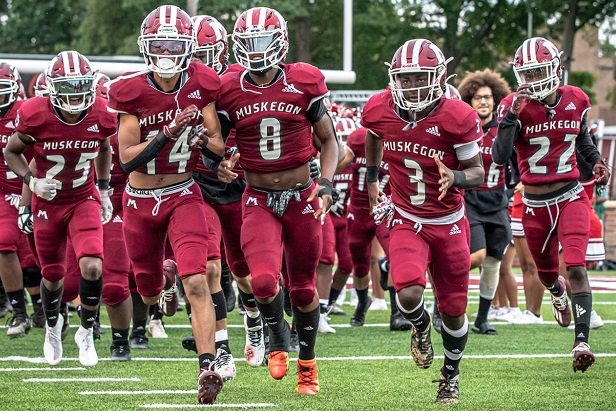
PHOTOS (Top) Muskegon’s Destin Piggee (3) eludes the grasp of a Lowell defender during the Big Reds’ District Semifinal win Saturday. (Middle) Piggee takes the field with his teammates before the Sept. 3 game against Detroit Cass Tech. (Below) Piggee makes his move upfield against East Kentwood. (Top and below photos courtesy of Local Sports Journal. Middle photo by Tim Reilly.)