


Keep on Coaching
February 1, 2013
By Geoff Kimmerly
Second Half editor
A few weeks ago, I finally got my first chance this season to watch a friend coach his basketball team. After guiding some others at the lower levels, this is his first time running the varsity – something he wasn't sure he wanted to do with a 1-year-old just learning to walk, but a challenge he ended up taking on to the benefit of all those involved.
Simply put, he’s good. I've seen a lot of teams and a lot of coaches over the past 15 years, and although I wouldn't know much of what to do if I were walking the sideline, I felt pretty qualified in telling him I was impressed – even if he didn't buy that I was offering an unbiased opinion. The best news is he’s gone from not sure about this a few months ago to talking about next season.
We know, at least anecdotally, that coaching continues to get more challenging. The time commitment has grown substantially to make running a program a year-round endeavor in a lot of sports at a lot of schools.
That commitment – especially for coaches with children of their own – was a main reason referred to in a New Haven Post-Chronicle story Saturday that noted 23 football coaching openings in Connecticut at one point this offseason. That state has 146 football teams – meaning roughly 15 percent will have new leaders this fall.
And that got me thinking about my friend, about how glad I am he’s given this a shot, and how I've seen so many others either not do so, or not stick around long despite having some pretty nice success.
A study published last winter in Interscholastic Athletic Administration magazine – a product of the National Interscholastic Athletic Administrators Association – noted some predictable results of a study that sought to determine the biggest challenges faced by first-year high school coaches.
The toughest according to the study was balancing the demands of coaching and teaching, experienced by nearly half the respondents – 98 percent of which coached high school teams and 81 percent of which are teachers.
The next six reasons all were noted by at least 30 percent of those in the study – personal fatigue, securing community support, securing and caring for facilities and equipment, parental contact, keeping non-starting players motivated, dealing with schedule interruptions and motivating athletes to achieve consistent, peak performance.
Nothing there is earth-shaking, and most if not all of these challenges are faced by high school coaches regardless of how long they've been in the field. But I got a little more perspective from some of the 32 items that ranked as least challenging to the first-year leaders – keeping in compliance with state and league regulations, dealing with substance abuse issues, teaching sport skills and creating a positive team atmosphere – things that seem most important, and yet appear to be easiest to do. I’m not sure what that tells us – but I think it tells us something.
Click to check out the entire three-page breakdown of the study, plus the researchers’ recommendations to remedy some of what first-year coaches face.
Giving back to Saginaw
I love reading about high-level athletes – like a star-studded group of alums from Saginaw – giving back to where they got their starts.
Pittsburgh Steelers star LaMarr Woodley made a big impact before the start of this school year by donating $60,000 to cover all participation fees for athletes in his former school district. The Saginaw News’ Hugh Bernreuter writes today about how Woodley (Saginaw High), the Philadelphia 76ers’ Jason Richardson (Saginaw Arthur Hill) and former Oakland Raiders standout Stu Schweigert (Saginaw Heritage) have combined to give more than $865,000 back to their home communities.
Bernreuter also mentions the non-monetary contributions of the Golden State Warriors’ Draymond Green (Saginaw High) and former Indianapolis Colts receiver Blair White (Saginaw Nouvel).
Click to read more about it.
Quote(s) of the Week
While rifling through more papers on my desk, I found an article from the Washington Post from Sept. 2011 titled “How high school sports save our schools.” I was drawn to it in part because I spent more than a decade in a newsroom, and it was a piece by a reporter covering education who instead of reporting on school boards and the like, delved into the importance of interscholastic athletics to education as a whole.
He spoke of how participation continues to grow even as resources dwindle, and of data supporting that extracurriculars like sports are more effective than academic classes in teaching leadership, teamwork, time management and “other skills crucial for success in the workplace.” Later, he mentioned a study noting that those who participate in extracurriculars earned more a decade later.
Click here to read the entre piece. These passages struck me most.
“Coaches might be the only faculty members still allowed by our culture and educational practice to get tough with students not making the proper effort. They have the advantage of teaching what are essentially elective non-credit courses. They can insist on standards of behavior that classroom teachers often cannot enforce because the stakes of dismissing or letting students drop their courses are too high. …
“Students do better in activities they choose. If we provide more of them, led by committed adults … that can make a difference. We know the bad news about education. Dropout rates are high. Achievement scores are stagnant. But sports participation is going up, despite pressure to cut it back. Let’s cheer about that and look for a way to draw in more students.”
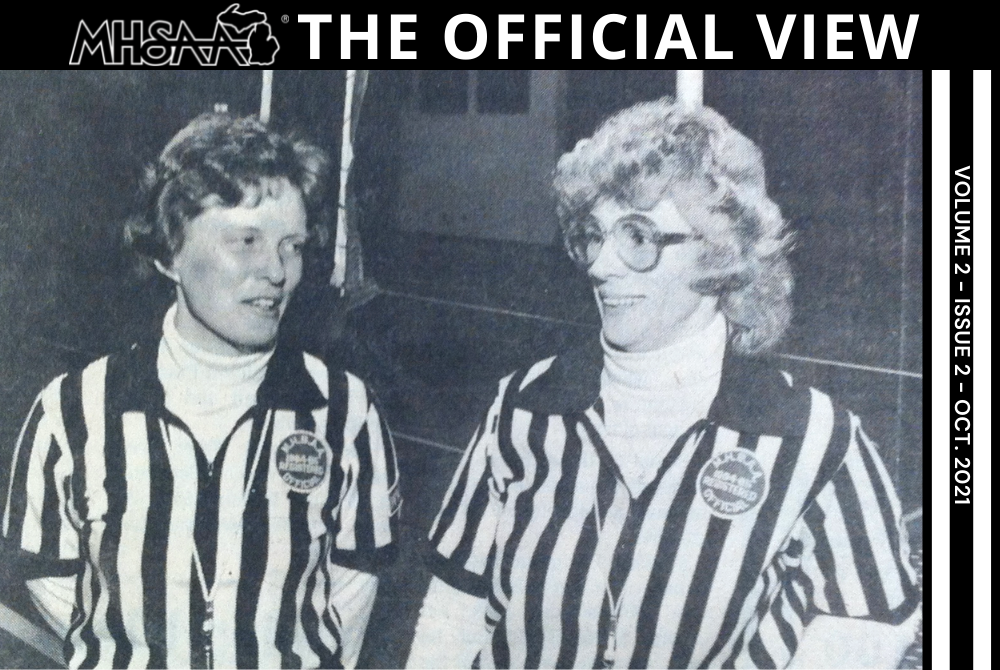
The Official View: Title IX – Door Opens for Female Officials
By
Brent Rice
MHSAA Assistant Director
October 29, 2021
In the 50 years since Congress passed Title IX legislation in order to create equal educational opportunities, huge strides have been made for female students to participate in athletics.
But the advancement of opportunities wasn’t just for the athletes. It also opened a door which ushered in a generation of female sports officials.
Betty Near is one of those officials whose long and distinguished career as a high school and collegiate volleyball official is a direct result of the opportunities provided through Title IX. Unlike many today who entered officiating after having played the sport, Betty didn’t have those opportunities before first climbing the ladder (literally) in 1971. She was encouraged to take up the sport by Macia Tiesenga (a nationally-ranked collegiate official) who told Betty – who had been involved in athletics recreationally – that athletes make the best officials because of their understanding of competition.
“I’m frequently asked whether I got into officiating because I played volleyball. I tell them I didn’t play because girls volleyball didn’t exist when I was in school," Near said. "I try to share the story of Title IX every chance I get, to show them that they now have opportunities to both play and officiate because of those that came before them.”
Near has spent more than 45 years as a registered MHSAA official and is still going strong. That run has included six appearances as a Finals official. She recalls how at one of those Finals, an injury to her knee created a change in mechanics for the entire state.
“When I first began officiating in the 70s, the MHSAA had the umpires (R2s today) kneel underneath the net to look at blockers," she said. "This was quite dangerous and pretty ineffective.
"Officiating at the collegiate level, I had been trained to stand at the pole and look down the net. With this background, and seeing as my knee was still hurting from an earlier injury, I decided to use this mechanic.”
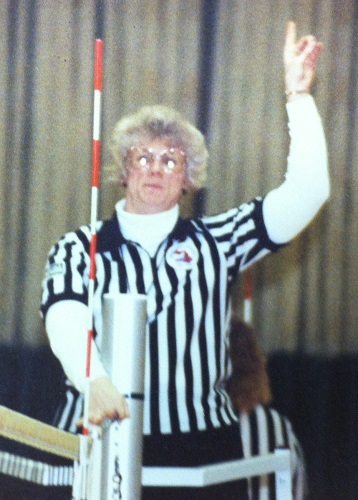 Sue Martin, the MHSAA director for volleyball at the time, approached Betty following her match. Near was certain that she was going to receive an earful. Instead, Martin asked the justification for using the mechanic, and they discussed the pros and cons of each. It was ultimately decided moving forward the umpire would take a position standing at the pole.
Mechanics changes aren’t the only effect Near has had on the sport. She was instrumental in the start of the West Michigan Volleyball Officials Association in 1984 and continues to help lead and grow that organization (now with more than 125 members). This has allowed her to work with the community, raising nearly $125,000 for scholarships for graduating high school seniors. And one of her biggest contributions remains her role in recruiting and mentoring new officials – especially helping to develop the next generation of female officials.
“Mentoring is a gratifying thing,” said Near, “especially when I receive emails or calls thanking me for helping them understand specific rules or situations and improving their skill sets. Watching someone I have mentored over 20 years work her way up to officiate multiple state tournaments (pleases me).”
Now officiating primarily at the college level, Betty still reserves Thursdays during the season to officiate MHSAA contests. She does this for the purpose of staying connected to high school students and officials and to build on the growth of female registered officials, though she also recognizes that challenges remain for female officials advancing through the system.
One of the natural barriers that apply to women more often than men is that women who begin families sometimes find difficulties continuing to officiate with their other responsibilities. While home lives can be difficult to navigate (for both women and men), officiating school sports provides a flexible alternative to stay active, remain involved in athletics, give back to the community, develop camaraderie and earn some extra cash.
Another hurdle that Near identifies for female officials, unfortunately, is a continuation of the “good ol' boy network.” She is reminded of a not-so-distant-past example when she and another female official had been selected to officiate the Regional round of the MHSAA Tournament; and even though both were well-established collegiate officials the host athletic director insisted that less-experienced male officials work as the R1 and R2 and the women work as line judges because the men would have better control of the tough matchup.
Of course, that kind of mindset isn’t based in fact, and many of the MHSAA’s best officials in all sports are women. Especially in girls sports, it is important that the student athletes see officials who represent them; but the MHSAA seeks female officials in all sports, including those dominated by male participants. This year will once again include a female officiating in the MHSAA Football Finals. Female officials also have worked Finals in baseball, boys basketball, ice hockey and wrestling.
The door that was opened for women and girls with the passing of Title IX a half-century ago only provides the opportunity. Capitalizing still requires stepping through the door to take full advantage of the opportunities provided. Near wants to encourage anyone to join the avocation of officiating, but especially young women.
“My hook is that the officiating is fun, and it is an activity that can be an avocation that can pay (in many ways) throughout their lifetimes," she said.
It’s Official!
Postseason Assignments: Officials assignments for fall sports tournaments have been released. Congratulations to all selected to officiate this year.
Speaking of tournament assignments, a change will be made this year that allows basketball officials to submit their availability to work together as a crew. Crews can be set for the boys and girls tournaments separately. The hope is that this will encourage more officials to seek postseason consideration, knowing they can choose with whom they will officiate. Eligible individuals not included with a crew will be assigned a crew by MHSAA staff.
For all winter sports officials, make sure to complete all requirements for postseason consideration. Please remember that officials in basketball, competitive cheer, gymnastics, ice hockey and wrestling must opt-in to the tournament by indicating their tournament availability dates HERE. All additional requirements such as completion of tournament exams and submission of regular-season schedule also remain in place.
Officials Review Committee: The Officials Review Committee, consisting of school administrators, officials and assigners from around the state, convened in early October to discuss issues and concerns involving officiating. A number of proposals were made to the MHSAA Representative Council. You can find these and other discussion items by reviewing the minutes HERE.
Know Your Rules
SOCCER A player (#7) is injured and must leave the field. His team elects to play short-handed. If #7 heals up, when can he return to the field? What if they wish to replace him with #12?
RULING If #7 comes back into the game, he only needs to wait until the next stoppage of play. If he will be replaced by #12 though, #12 can enter the game only at the next legal substitution opportunity.
It’s Your Call
REVIEW Last month’s play involved a suspect block by a defensive player (found here). The block by B17 is correctly flagged for an illegal block below the waist. While not widely known by spectators, blocks below the waist (except for linemen immediately at the snap) are illegal for players on both sides of the ball. In this case, since the block was by the defense, the penalty is enforced 15 yards from the end of the run.
VOLLEYBALL Officiating ball handling is the topic of this month’s "It’s Your Call." This rally ends following the pass of a back-row player. What’s the call?