


Let's Play 2 (or 3, or 4)
February 16, 2012
A few conversations I had at last week's Women In Sports Leadership conference further affirmed a point I've been making for years -- high school athletes, if they'd like, shouldn't hesitate to play multiple sports.
Doing so does not hurt, but might just help their chances at landing that prized college scholarship -- on top of adding another layer to the high school sports experience.
Reaffirming this for me last week was Michigan State softball coach Jacquie Joseph, who spoke on that subject at the WISL conference. She's heading into her 24th season as a head coach at the Division I college level -- so she's been around for some of the evolution of both high school sports specialization and college recruiting. Plus, she coaches a sport that sees its share of athletes playing just that one.
Later, I spoke with a high school coach who leads teams in three sports and also played one at the Division I college level. She's a believer in this as well.
Some of the things I've been told over the years about playing more than one sport:
- It allows an athlete to learn more skills and hone more parts of his or her athleticism.
- Using another range of movement further helps condition an athlete's body and make it more resistant to injury.
- It's hardly rare to see a college football coach watching a prospect's basketball game -- coaches like to see how athleticism transfers across sports, and sometimes will see something from an athlete playing basketball that he didn't show on the football field. (Football and basketball are used in this example, but the same applies to a number of similar situations.)
- Athletes get an opportunity to play whatever they'd like only this once (unless they turn out to be that rare college athlete who takes on more than one sport at that level).
These are hardly new arguments. But they are always worth repeating -- especially when the people frequently making them (college coaches) are the ones single-sport athletes often are trying to impress.
Same Score, New Champion: Country Day Takes Back D3 Title by Single Point
October 17, 2026
MIDLAND – Detroit Country Day sophomore Samuel Kole-James didn’t know what was on the line as he navigated a three-set match to complete Saturday’s No. 2 singles bracket at Midland Tennis Center.
But he knew what he had to do to get the job done – and his repeat championship at that flight did a whole lot more for the Yellowjackets.
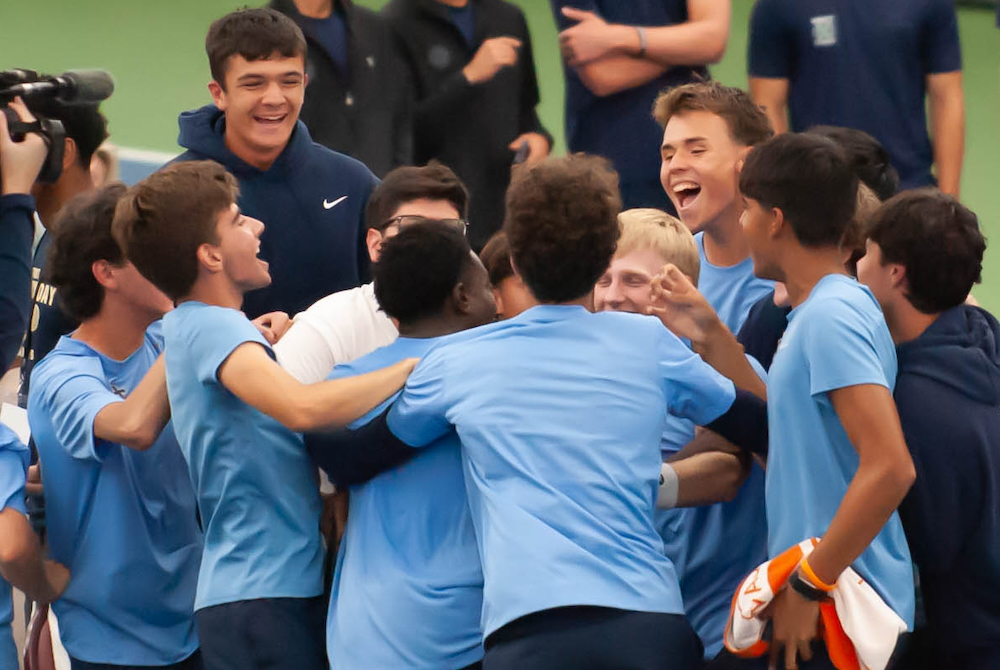
Kole-James claimed a second-straight title at No. 2 singles – coming back after losing the first set 6-2 to take the next two 7-5 and 7-6(4) – and in doing so scored the clinching point as Country Day pushed past rival Bloomfield Hills Cranbrook Kingswood 34-33 at the top of the standings to retake the Lower Peninsula Division 3 Finals championship.
A year ago, Cranbrook unseated then-reigning co-champion Country Day by the same score.
“I was telling myself to stay positive and just keep in the match,” Kole-James said of his comeback. “But really, I was just hanging in there, just a few more points.
“Nothing (was working) in the first set, and everything after 6-2, 5-2, was working. I’m not going to lie. I could feel the ball. I could feel my game.”
With the exception of Ann Arbor Greenhills entering the mix the last several seasons by sharing the Division 3 title in 2024 and winning it outright in 2022 and 2019, Country Day and Cranbrook have otherwise finished first or second in some order every other season over the last 13.
The Yellowjackets this weekend also secured flight championships from freshman Nicholas Nadjarian at No. 4 singles and sophomore Sasha Kebl and junior Sebastian Shah at No. 4 doubles. Cranbrook won three flights as well.
“I know every time with them it’s a battle, it’s a war, it’s a 50-50,” Country Day coach Nicholas Fiaschetti said. “I feel like our minds today were just on it, and I think that’s the difference for us – our minds were able to focus up when we needed it the most.”
Cranbrook’s flight championships came at No. 1 singles from freshman Jacob Yang, No. 3 singles from junior Eli Rosen, and No. 1 doubles from seniors Ryan VanDyke and Josh Day.
Yang’s clincher admittedly was a stunner, as he held on to defeat 2025 No. 1 singles champ Ricky Jeong 7-6, 3-6, 6-1. The Yellowjackets’ junior had defeated Yang “badly” the first three times they’d faced each other.
“I can’t believe it. I didn’t think I’d get to this position,” Yang said. “It’s just my team – thank you to my teammates over there. They really supported me through everything. They cheered for every point I won. It’s super helpful. … I’m super grateful for them.”
Ann Arbor Greenhills senior Deven Pimputkar and junior Evan Chung won No. 2 doubles, and Holland Christian seniors Jonathan Haig and Carter Leep emerged as fourth seeds to win No. 3 doubles.
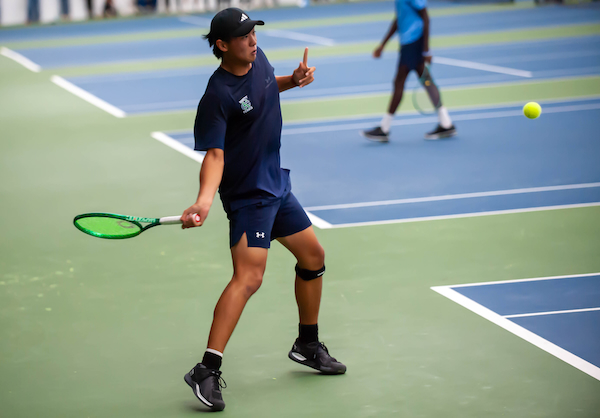
PHOTOS (Top) Detroit Country Day’s tennis team celebrates clinching the Division 3 championship Saturday at Midland Tennis Center. (Middle) Cranbrook’s Jacob Yang sends a forehand at No. 1 singles. (Click for more from High School Sports Scene.)