


105 Schools Recognized As HEARTSafe
October 19, 2016
The Michigan Departments of Health and Human Services (MDHHS), and Education (MDE); American Heart Association (AHA); Michigan High School Athletic Association (MHSAA); and Michigan Alliance for Prevention of Sudden Cardiac Death of the Young (MAP-SCDY) have awarded 105 schools in Michigan with the MI HEARTSafe School designation which recognizes schools that are prepared to respond to cardiac emergencies.
“Many sudden cardiac deaths that claim the lives of children and young adults could be prevented through screening, detection, and treatment,” said Dr. Eden Wells, chief medical executive of MDHHS. “Appropriate medical response within three to five minutes is crucial for increasing the chance of survival, which is why I’m pleased to see so many of our schools taking vital measures to prepare and address this health issue.”
In order for a school to receive a MI HEARTSafe School designation, it must perform at least one cardiac emergency response drill per year, have a written medical emergency response plan and team, have current CPR/AED certification of at least 10 percent of staff, 100 percent of head varsity coaches, and 50 percent of P.E. staff; have accessible, properly maintained and inspected AEDs with signs identifying their location; and ensure pre-participation sports screening of all student athletes using the current physical and history form endorsed by the Michigan High School Athletic Association.
“We are so proud to support Michigan’s HEARTSafe schools,” said State Superintendent Brian Whiston. “Ensuring schools are prepared for sudden cardiac emergencies through planning, training, and life-saving AEDs is an important part of having safer learning environments for students, staff, and the community.”
Between 2003 and 2012 in Michigan, there were 2,590 young individuals between 1 and 39 years of age who died of sudden cardiac death. Of those, 214 were between 5 and 19 years of age. This is the third year of the MI HEARTSafe Schools program in Michigan. In the first two years of the initiative, 162 schools were previously designated as MI HEARTSafe Schools and prepared to help reduce the number of sudden cardiac deaths in our youth.
Public Act 12 of 2014 requires all schools (grades kindergarten to 12) to have a cardiac emergency response plan in place. This MI HEARTSafe School designation recognizes the 267 school buildings that have taken steps above and beyond to prepare to respond in the event of a cardiac emergency, and is awarded for a period of three years. Click for the list of designated schools.
Schools that meet all of the requirements will be able to apply for the MI HEARTSafe School designation each year. Click for information about the MI HEARTSafe Schools program.
MHSAA Opposes Big Ten Friday Football
November 2, 2016
By Geoff Kimmerly
Second Half editor
The executive director of the Michigan High School Athletic Association said today that he is “disappointed and disheartened” by the Big Ten Conference announcement that it will play and televise football games on Friday nights beginning with the 2017 season.
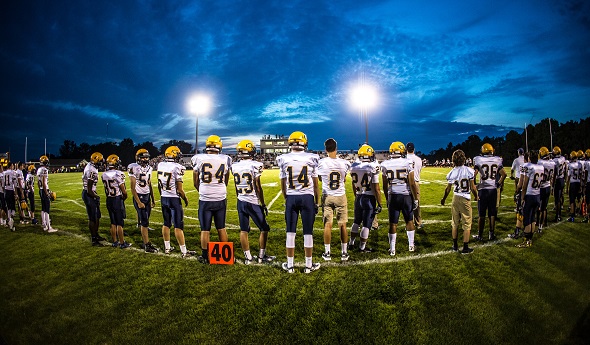
Friday night football remains one of the strongest and longest-standing traditions in high school athletics, and the MHSAA has fought since the start of this century to keep Friday nights sacred against the overstepping of college football and the damage televised Big Ten games are now expected to cause to attendance and media coverage of the sport at the high school level.
MHSAA Executive Director John E. “Jack” Roberts was contacted by both Big Ten Conference commissioner Jim Delany and Michigan State University athletic director Mark Hollis before the decision was announced. Roberts said he is appreciative of Michigan State and University of Michigan’s low tolerance to be included in this venture – at most, both will host a Thursday or Friday night game during Labor Day weekend and play one Friday night away game during the remainder of a season – but remains frustrated that similar respect for high school football was not shown by the conference as a whole.
Michigan State has played Friday night games during Labor Day weekend the last six seasons, hosting five and playing at Western Michigan University in 2015. However, most Michigan high school games continue to be scheduled and played on the Thursday before Labor Day, relieving holiday travel conflicts in most communities. University of Michigan did play on the Thursday before Labor Day at University of Utah in 2015, but has not played on a Friday night of Labor Day weekend this decade. The Wolverines are one of five Big Ten schools without a Friday night game in 2017.
“We are saddened by this decision. We had hoped that the Big Ten Conference would stay above this. We think this cheapens the Big Ten brand,” Roberts said. “Fans won’t like this. Recruits won’t like this. And high school football coaches won’t like this.
“We are grateful that Michigan State University and the University of Michigan are trying to minimize the effects of this decision by the Big Ten. But overall, this is just the latest step by major college athletics in the pursuit of cash that is just crushing high school sports.”
The MHSAA has shown its opposition to the use of Friday nights for televised collegiate football games for more than 15 years, dating back to 2001 when the NCAA lifted its restrictions on Friday night telecasts, which at first led to the broadcasting of “mid-major conference” games on the same night traditionally reserved for high school athletes.
The MHSAA launched in 2001 its “Save Our Friday Nights” campaign to emphasize the role that Friday night high school athletic events play in communities and to rally MHSAA member schools to contact NCAA member school football coaches, athletic directors and conference commissioners to voice their concerns.
In addition to causing lower attendance at events going up against Big Ten football games, Roberts anticipates that Friday night college games also will leave high school football as a secondary priority in many media markets. More than 80 radio stations statewide cover high school games regularly, but many also carry Michigan State or University of Michigan football. High school football could lose significant time on local TV highlights shows and in print and online coverage as well, as resources are diverted to cover a college game – potentially quieting significantly the positive buzz that comes from the typical high school football Friday night.
“Everyone knows that football is struggling right now,” Roberts said. “It’s getting a lot of bad publicity. Participation is declining. And now this; there couldn’t be worse timing.”
PHOTO: Grand Ledge takes on Okemos under the Friday night lights this season. (Click to see more from HighSchoolSportsScene.com.)