


Clipping Clipped as 2016-17 Begins
August 5, 2016
By Geoff Kimmerly
Second Half editor
Clipping has been eliminated in high school football, the biggest playing rules change on the horizon for member schools of the Michigan High School Athletic Association, which formally begin practice for 2016-17 fall sports next week.
Practice in football must begin on Aug. 8 for all schools wishing to begin regular-season games the weekend of Aug. 25-27. Schools must have 12 days of preseason practice at all levels before their first game, and those 12 days of practice may not occur before 16 calendar days.
Practice sessions for all other sports begin Wednesday (Aug. 10). In golf and tennis, competition may commence no earlier than after three separate days of team practice, and not before seven calendar days. The first day competition may take place in golf and tennis is Aug. 17. In all other fall sports, contests can take place after seven days of practice for the team and not before nine calendar days. The first day competition may take place in cross country, tennis, soccer, swimming and diving, and volleyball is Aug. 19.
This fall, two football dates again precede Labor Day, and a number of MHSAA schools will play their first varsity games on Thursday, Aug. 25. In Week 1, 131 varsity games will be played on Thursday, 169 contests will be played on Friday, and 17 games will be played on Saturday. In the second week, 245 games will take place on Thursday, 62 will be played on Friday and 6 contests are on Saturday.
Eliminating clipping from the high school game is the latest step in the national playing rules promulgated by the National Federation of State High School Associations. Clipping previously was permitted in the free-blocking zone when it met three conditions; however, clipping is now illegal anywhere on the field at any time. According to the rule, the free-blocking zone is defined as a rectangular area extending laterally 4 yards either side of the spot of the snap and 3 yards behind each line of scrimmage.
A few notable changes will go into effect for other fall sports:
• In cross country, a participant who assists an injured or ill competitor when the appropriate health care professional is not available no longer will be disqualified from the race; only the runner receiving assistance will be disqualified for not finishing the race unassisted.
• In soccer, changes were made to the offside rule that makes it match offside rules for the NCAA and FIFA/USSF. The most notable change states that a player in an offside position receiving the ball from an opponent who deliberately plays the ball (except from a deliberate save) is not considered to have gained an advantage and can move ahead toward attempting to score a goal. A player who does receive the ball while in offside position after a deliberate save remains offside, and the result is an indirect kick for the defending team.
• Also in soccer, eliminating of rough play will be a point of emphasis this school year. Rough play including contact above the shoulder often results in player injury.
• In volleyball, a change to rules on uniforms aims to make the libero more recognizable from all angles. Beginning this fall, the libero, her teammates, or both will be required to wear a solid-colored uniform top; the libero’s top must clearly contract the predominant color(s) of her teammates’ uniform tops. Also related the uniforms, soft hair devices, formerly no more than two inches in width, may now be up to three inches in width.
• Also in volleyball, a service toss that contacts a basketball backboard or its supports in a vertical position over the serving area is a service fault and not eligible for a re-serve. The opponent receives a point and the next serve.
The 2016 Fall campaign culminates with postseason tournaments beginning with the Upper Peninsula Girls Tennis Finals the week of Sept. 26, and wraps up with the 11-Player Football Playoff Finals on Nov. 25 and 26. Here is a complete list of fall tournament dates:
Cross Country:
U.P. Finals – Oct. 22
L.P. Regionals – Oct. 28 or 29
L.P. Finals – Nov. 5
11-Player Football:
Selection Sunday – Oct. 23
Pre-Districts – Oct. 28 or Oct. 29
District Finals – Nov. 4 or 5
Regional Finals – Nov. 11 or 12
Semifinals – Nov. 19
Finals – Nov. 25-26
8-Player Football:
Selection Sunday – Oct. 23
Regional Semifinals – Oct. 28 or Oct. 29
Regional Finals – Nov. 4 or 5
Semifinals – Nov. 12
Final – Nov. 18
L.P. Girls Golf:
Regionals – Oct. 5 or 6 or 7 or 8
Finals – Oct. 14-15
Soccer:
Boys L.P. Districts – Oct. 17-22
Boys L.P. Regionals – Oct. 25-29
Boys L.P. Semifinals – Nov. 2
Boys L.P. Finals – Nov. 5
L.P. Girls Swimming & Diving
Diving Regionals – Nov. 10
Swimming/Diving Finals – Nov. 18-19
Tennis:
U.P. Girls Finals – Sept. 28-Oct. 1
L.P. Boys Regionals – Oct. 6 or 7 or 8
L.P. Finals – Oct. 14-15
Girls Volleyball:
Districts – Oct. 31-Nov. 5
Regionals – Nov. 8 & 10
Quarterfinals – Nov. 15
Semifinals – Nov. 17-18
Finals – Nov. 19
The MHSAA is a private, not-for-profit corporation of voluntary membership by more than 1,400 public and private senior high schools and junior high/middle schools which exists to develop common rules for athletic eligibility and competition. No government funds or tax dollars support the MHSAA, which was the first such association nationally to not accept membership dues or tournament entry fees from schools. Member schools which enforce these rules are permitted to participate in MHSAA tournaments, which attract more than 1.4 million spectators each year.
'Mailloux Management' Goes Global
By
Geoff Kimmerly
MHSAA.com senior editor
December 17, 2013
By Geoff Kimmerly
Second Half editor
Leslie (Barnhart) Mailloux graduated from Ogemaw Heights High School in 1999 and since has lived in New Mexico, Texas and Ohio twice.
She’s traveled to parts of Africa and Europe multiple times, plus Haiti, with a voyage to Switzerland planned for next month.
She’s served as a supervisor in a foreign exchange program, mentoring students as they make adjustments to living in the U.S.
 Needless to say, Mailloux has gained plenty of worldly knowledge since becoming an MHSAA Scholar-Athlete Award winner as a high school senior in 1999.
“It was good to get out of the small-town America, meeting people of all walks of life,” Mailloux said. “People are different, but we’re all doing the same things: having families, working. We just do it differently.
“We’re all different, but we’re all the same. We’re on this planet for a reason ... and we can learn from each other.”
 A three-sport athlete – who played volleyball, basketball and soccer – Mailloux (pronounced May-you) was one of 24 scholar-athletes recognized during the winter of 1999 by the MHSAA and Farm Bureau Insurance, which continues to sponsor the Scholar-Athlete Award program that has grown to 32 recipients. In advance of this March’s 25th celebration, Second Half is catching up with some of the hundreds who have been recognized.
Leaving home
Mailloux, now 32, met her husband Logan while earning a degree in architecture at Southfield’s Lawrence Technological University.
Logan grew up in Farmington Hills and when they met told Leslie he never wanted to leave Michigan. But that was before he joined the Air Force and ascended to the rank of major, which led to the family's moving to the southwest and now back to the Dayton, Ohio, area for the second time.
When Leslie and Logan moved to New Mexico, she had initial thoughts they’d landed in a ugly desert. But they fell in love with their new home: “You learn to appreciate different kinds of beauty. Fountains, blue skies, you appreciate the creation,” she said. “You really have to keep your eyes open.”
While in New Mexico, Mailloux found a way to mix working abroad with an opportunity to become involved in that community. Through a posting on Craig’s List she landed with the Council of International Education Exchange, a program that specializes in study abroad. As a coordinator for the CIEE, she helped foreign students “make the jump” to living here while providing them support and mentoring.
She also has managed to stay active athletically, playing volleyball competitively including on two teams that have advanced to USAV national tournaments. And she has passed on the lessons she's learned on the court and field during two high school coaching stops, including as the varsity head coach at Dayton Christian High School during the couple's first stop in Ohio.
“Hard work does pay off,” Mailloux said of her coaching focus. “Obviously (my players) had some God-given talent; some had a lot of talent and some a little. But with hard work they could be good, whether it’s in a sport, career or school. If you work hard, you’ll succeed.”
Traveling abroad
Mailloux no doubt has seen plenty as well during her international travels, including the mission trip she took to Haiti while in college. But her favorite excursion surely came a little more than three years ago, when Mailloux and her husband journeyed to Ethiopia to bring home their adopted twin sons.
Leslie had hoped to adopt siblings and was drawn to Ethiopia with a sister living there at the time. After some prayerful consideration, she and Logan began a two-year process that led to then 6-month-old boys Nathan and Issac becoming part of Mailloux family.
“Finally having the babies in our arms that God wanted us to have, it was a beautiful moment,” Mailloux said.
Her sons “are all boys, 250 percent," and keep her running around most of the day – Mailloux calls that fulltime job “Mailloux Management.” But she also does contract residential design work for Archetype Designs, a firm based in Texas.
She wasn’t alone among family members who journeyed far from home. In addition to her sister who lived in Ethiopia for three years, another sister plus her brother both moved to Seattle.
The sister in Seattle has moved back to Michigan, and the Maillouxs now are only six hours from West Branch. It could be only a matter of time before Leslie and Logan consider making good on his original desire to stay close to home now that they've experienced so much in this country and abroad.
“When it’s your roots, it’s still in your blood,” Leslie said. “We still love Michigan.”
Click to read the series' first installments:
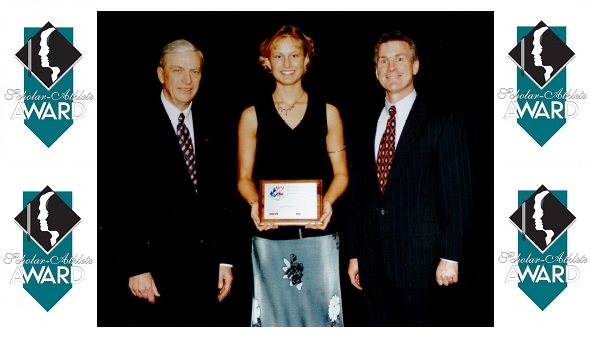
PHOTO: Ogemaw Heights' Leslie Barnhart (middle) poses with her Scholar-Athlete Award next to Larry Thomas (left), the then-executive vice president of Farm Bureau Insurance, and MHSAA Executive Director Jack Roberts.