


Council Approves Tennis Finals Pilot Program, Girls Wrestling Titles at Districts, Regionals
By
Geoff Kimmerly
MHSAA.com senior editor
May 8, 2025
The approval of a pilot program assigning all four Lower Peninsula Tennis Finals to be played at one site and the addition of girls wrestling team championships for District and Regional rounds were among actions taken by the Representative Council of the Michigan High School Athletic Association during its Spring Meeting, May 4-5 in Gaylord.
The Spring Meeting of the 19-member legislative body of the Association’s more than 1,500 member schools is generally the busiest of its sessions each year. The Council considered 22 committee proposals and dealt with a variety of eligibility rule, postseason tournament and operational issues.
The tennis pilot program was an MHSAA Tennis Committee recommendation and will be conducted during the 2025-26 and 2026-27 schools years. All four Lower Peninsula Finals for girls and boys seasons will be played at the Midland Tennis Center, which in addition to substantial outdoor courts includes up to 16 available indoor courts in case matches must be played inside due to inclement weather. Each season’s four Finals will take place over two successive days during a two-week period – one division on a Wednesday and Thursday and the next on a Friday and Saturday, to be repeated the following week.
In girls wrestling, District and Regional team champions will be awarded during the upcoming 2025-26 season for the first time, after a Finals champion was awarded for the first time this past season. Champions for all rounds will be determined by results from individual brackets as the sport continues to grow toward the possibility of a head-to-head team tournament.
A pair of football changes will be noticeable this fall. The Council approved a Football Committee recommendation to not award playoff points to a team that forfeits a football game; previously, a team that forfeited would still receive the bonus points for scheduling that opponent, although a game was never played. The Council also approved a Football Committee recommendation to assign neutral sites with artificial turf for the four 8-Player Semifinals near the end of each season. Previously that round of the MHSAA Playoffs, like the first two of the 8-Player Tournament, was hosted by the participating team with the highest playoff-point average.
Anticipating the first MHSAA-sponsored boys volleyball season to be played in Spring 2026, the Council approved a pair of Volleyball Committee recommendations regarding tournament classification and structure. The first establishes a tournament with two divisions, with classification determined by enrollment and delayed until September prior to this inaugural season only as to allow for a more accurate count of how many schools will have teams. The first MHSAA Boys Volleyball Semifinals and Finals will be played June 5-6, 2026, at Kellogg Arena in Battle Creek.
The Council also approved the recommendation to include boys volleyball among sports for which cooperatives are permitted when the combined enrollment of schools involved is fewer than 3,500 students.
Here is a summary of other notable actions taken by the Representative Council at the Spring Meeting, which will take effect during the 2025-26 school year:
Regulations
• The Council approved a pair of changes to the sport-specific transfer regulation regarding the full-and-complete residential move exception that allows students to gain immediate eligibility. The first increases the number of school days to 180 that a student who has changed residences and attends a new school must complete at that new school before returning to a previous school district and potentially having athletic eligibility in that former district. The 180 days also applies to all persons with whom the student moved to the new school district; if those other persons move back to the former school district before 180 school days, the student loses eligibility in all sports at all schools until approved by the two school districts and the MHSAA.
The second change increased the amount of time an athlete’s former residence must be signed into a long-term rental or lease agreement to a minimum of 12 months.
• The Council approved multiple clarifications to the definition of a scrimmage. A clarification was added to note that win-loss records, team and individual statistics and records may not be accrued or achieved during a scrimmage. A statement was added as well explaining that in sports that do not use a timing device – for example, baseball and softball – at least one rule must be altered to indicate it is a scrimmage.
Junior High/Middle School
• The Council approved a change to allow junior high/middle school teams to begin fall practice on the first day of classes at that school if it’s before the otherwise first allowable practice date on the 14th Monday before Thanksgiving. Ninth-grade football teams from junior high/middle schools may begin practice on the same date as the grade 10-12 football teams of that school district if the ninth-grade team is comprised only of ninth-grade students who have been approved for eligibility advancement.
• Also concerning junior high/middle school athletes, the Council approved a Junior High/Middle School Committee recommendation to make seventh and eighth-grade students who are eligible for high school competition due to their high school’s small enrollments also subject to high school transfer rules while in middle school and competing at the high school level.
Sport Matters
• BASEBALL: The Council approved a Baseball Committee recommendation to allow baseball players to play on multiple levels on the same day, with the 38-game season and daily limits still applying to all students.
• BOWLING: The Council approved a Bowling Committee recommendation to establish the official start of bowling practice as the third Monday before Thanksgiving.
The Council also approved a Bowling Committee recommendation to allow students to participate in no more than eight games on a school day (Monday-Thursday).
• COMPETITIVE CHEER: The Council approved the incorporation of a series of Competitive Cheer Committee-proposed technical high school and middle school rules recommendations into the 2024-26 Girls Competitive Cheer manual.
• GOLF: The Council approved a Golf Committee recommendation to allow Regional Tournament host schools to receive reimbursement for the expense of two referees.
• TENNIS: The Council approved two more Tennis Committee recommendations. The first will allow for all teams that tie for third place at their Regional to advance to Finals, but only in Lower Peninsula divisions where there are six Regionals.
The other approved change will allow continuous coaching between points and between non-changeover games, at all levels, if that coaching does not hinder the current pace of play.
• VOLLEYBALL: The Council also approved a Volleyball Committee recommendation to allow students to play in no more than 18 sets (games) per day.
The Council also reviewed reports on membership, with 754 senior high schools and 777 junior high/middle schools in 2024-25 plus 63 elementary schools with 6th-grader participation; cooperative programs, with 409 high school programs for 750 teams during 2024-25; eligibility advancement applications, which totaled four; the use of Educational Transfer Forms, of which there were 142; travel forms for out-of-state practice, school violations, attendance at athletic director in-service workshops and Coaches Advancement Program sessions; officials’ registrations (which were up nearly two percent from 2023-24 as the total rose for the fourth-consecutive school year), and officials reports submitted for the past three sports seasons. The Association’s $15.7 million budget for the 2025-26 school year also was approved.
The Representative Council is the 19-member legislative body of the MHSAA. All but five are elected by member schools. Four members are appointed by the Council to facilitate representation of females and minorities, and the 19th position is occupied by the Superintendent of Public Instruction or designee.
The MHSAA is a private, not-for-profit corporation of voluntary membership by more than 1,500 public and private senior high schools and junior high/middle schools which exists to develop common rules for athletic eligibility and competition. No government funds or tax dollars support the MHSAA, which was the first such association nationally to not accept membership dues or tournament entry fees from schools. Member schools which enforce these rules are permitted to participate in MHSAA tournaments, which attract more than 1.4 million spectators each year.
Rice Brings Officials Expertise to MHSAA
August 2, 2018
By Geoff Kimmerly
Second Half editor
Before starting down the path toward becoming one of the nation’s most respected trainers of baseball umpires, Brent Rice was a student at small-town Concord High School who didn’t have to put much effort into succeeding academically.
But he received a challenge that has continued serving him along the way.
 It came from one of his high school coaches, who said he’d go to bat for the then-senior leaving school early to begin attending the prestigious Harry Wendelstedt Umpire School in Ormond Beach, Florida. But first, Rice would have to show the higher level of effort and commitment it would take to succeed on his quest to become a professional official.
That nudge from high school sports drove Rice’s surge into officiating, and also remained with him as he decided to come home and serve Michigan’s high schools – with nearly two decades of teaching and training experience to guide him as an assistant director for the Michigan High School Athletic Association.
Rice, who went on to umpire minor league baseball for 12 years and become administrative director and chief of instruction for the Wendelstedt school, has been named to an MHSAA assistant director’s position, effective August 13. He will be charged with supervising the nearly 10,000 registered officials in all sports and also serve as the MHSAA’s director of baseball and assist with softball.
“I went to a small school, and I learned a lot of life lessons through that and I want to be able to give back,” Rice said. “It’s where I got my start, and where I want to finish up.”
The Wendelstedt school is the most highly-attended professional umpire school in the world, and Rice has served as chief of instruction since Sept. 2000 while adding responsibilities as administrative director in Jan. 2005. Rice also umpired at various levels of minor league baseball from 2000-12, including as a crew chief, and has directed or contributed to training publications referred to by thousands of professional umpires worldwide.
Rice, 36, graduated from Concord High School in 2000 and has a bachelor’s degree from Western Michigan University. He began attending Wendelstedt as a student while a senior at Concord and currently umpires at the Division I college level in the Big Ten and Atlantic Coast Conference. He moved to Battle Creek from New Orleans four years ago, and since returning to this state has been registered as an MHSAA official for baseball, volleyball and 11 and 8-player football, working as part of a regular football crew.
He was selected for the assistant director position from a pool of nearly 70 applicants.
"Brent Rice has devoted his career to preparing the next generations of officials, and he will provide great expertise in growing our efforts to recruit, retain and train officials in all of our sports," said newly-appointed MHSAA Executive Director Mark Uyl, who formerly served as assistant director and the association's coordinator of officials. "He is a national leader in teaching and training and has been a much sought-after speaker and clinician for many years, yet brings knowledge and passion for Michigan and educational athletics.
“His experience, work ethic and relationship-building skills will make him a valuable addition to the MHSAA staff."
Rice will draw on nearly two decades of experience in administration and rules interpretation in addition to his on-field umpiring experience.
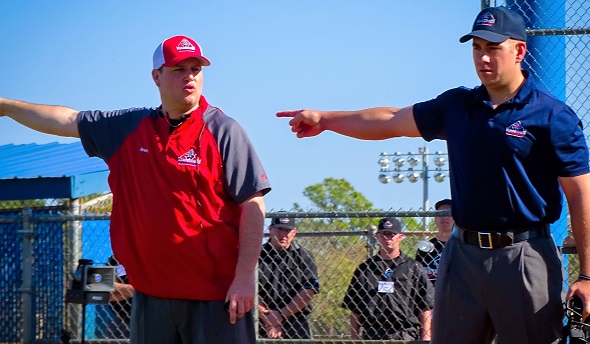
While at Wendelstedt, Rice supervised 30 Minor and Major League Baseball instructors and developed the curriculum for training future professional umpires. He led the day-to-day operations of the program, and also presented daily classroom lectures on rules and directed staff demonstrations of field mechanics.
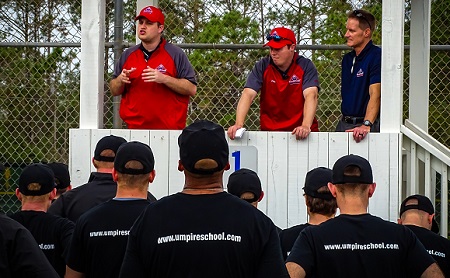 As the school’s administrative director, Rice was responsible for maintaining registration and enrollment records and developing programs to increase enrollment. Among his successful initiatives were recruiting programs that focused on engaging college student-athletes and military veterans.
He has directed the design, composition and annual revision of the school’s Official Baseball Rules and Interpretation Manual, the go-to source for umpires at all levels across the country and internationally. Rice also is a regular contributor to officiating publications and in the production of video training packages, and has been commissioned to rewrite the Official Baseball Rules manual used at all levels of the professional game.
Additionally, Rice has worked with both Minor League and Major League Baseball to develop various protocols and has served as a consultant for the Chinese Professional Baseball League, Korean Baseball Organization and the summer collegiate Northwoods League, as well as USA Fencing.
One area Rice would like to start work on immediately at the MHSAA revolves around tackling poor sportsmanship – a main factor driving officials away from the avocation.
Rice doesn’t see recruiting officials as the most difficult part of bolstering the MHSAA’s ranks; it’s retaining them.
“For me, the challenge is to try to find incentives outside of the box in some way … find other things to bring them along, make them feel supported and ultimately stay with you,” Rice said.
Rice played football and baseball as a student at Concord. He is working toward a master’s degree in public administration to go with his bachelor’s from WMU in political science and sociology. He and his wife Jenna have two daughters.
PHOTOS: (Top) Brent Rice, left, instructs an umpire during a drill at the Wendelstedt Umpire School. (Middle) Rice, far left, speaks to a group of students under his supervision. (Photos courtesy of Wendelstedt Umpire School.)