

From the Director: Back to School
August 7, 2020
By Mark Uyl
MHSAA Executive Director
Since March 12, our world has been anything but normal. These times have tested most everything in life, and as summer turns toward fall, we find ourselves still with far more questions than answers. It has been said that an abnormal reaction to an abnormal situation is normal behavior.
Let me start with these abnormal times. I’ve had many conversations with administrators over the past month about the start of school and school sports. The one constant theme is these are anything but normal times. Many of these conversations have moved to the issue of schools starting the academic year virtually while considering whether or not to offer school sports opportunities this fall. Let me share the things that have been part of almost all conversations on this topic.
The loudest message I hear is kids are going to be playing sports this fall someplace. Period. If we believe that kids are going to take the fall off if school sports aren’t offered, we haven’t been paying much attention since May. Since that time, athletic activity has taken place in the club, travel, AAU and non-school space nearly every day. From first-hand experience, many of these events have implemented ZERO of the safety standards and protocols that businesses and schools have adopted for their plans of return. The non-school world generally has plowed ahead this summer with few-to-no rules, regulations, enforcement, oversight and accountability to anyone. If kids are going to be playing sports, our member schools are telling us that activity needs to be in the safest environment possible – which is with professional educators and trained coaches in our school sports world.
Schools are quick to point out that kids have been conditioning and training with school coaches in school-sponsored workouts most of the summer. We believe that the absence of virus outbreaks among our 749 high schools’ summer activities, involving thousands of kids, has been because schools have been following the return-to-activity plans. Districts have told us they can continue doing what they’ve been doing safely since June by following all COVID guidance and regulations we have put in place with government’s leadership and partnership.
Schools starting the year virtually are telling us they will use the lessons learned from the start of sports for when students return to campus later in the fall. School administrators have shared this view privately as this has become a highly-charged topic among various groups within our school communities. Sports allow schools to bring students back to campus in small, consistent and defined groups with the same adults working with those students each day. In school sports, there is little mixing of students from one sport with those students in another – making it much easier to monitor, track and trace kids when needed than if all students were in the buildings, hallways and classrooms all day. We hear from administrators that valuable lessons can be learned with athletics in August and September for a successful school start-up with students back on campus in October.
All of us share the fundamental belief that we must protect the health and safety of individuals first. This doesn’t include only COVID prevention measures, but also the mental health of teenage students and adults as well. In districts that are starting the school year online, they see athletics being the one shred of normalcy students, and staff members who choose to coach, will have during the fall. It’s a chance to safely interact with peers and get needed physical activity that hasn’t been happening for some kids since March. Health and safety has to include all facets of the individual, and more research is being shared each day about how mental health is becoming a critical issue. For many at-risk kids, sports is the one motivating factor to keep them in school and progressing toward graduation. Given the challenges of all online education for these at-risk kids, sports and the daily routine they bring perhaps would be more important for this group of students than ever before.
With no school sports, the affluent communities and families can navigate online learning during the day and then afford the non-school athletic opportunities that kids and families in less-affluent areas simply cannot. In many communities, school sports can provide opportunities and open doors that would not appear if kids become priced-out from participating and competing.
The past five months have been the most abnormal in a century. School sports being the one pathway back to school for students in our state – the one norm for this fall – run by professional educators who put kids first, would be an incredible boost to the physical and mental health of all of us. We believe that school sports can be done safely and smartly, and the MHSAA has developed plans that do just that. While the optics of sports taking place while waiting for in-person education is not what any of us prefer, we believe we must react to these abnormal times by thinking differently and looking at these unique times through a unique lens.
Trying to find one normal for our kids in these abnormal school days might just be the best thing we can do.
MHSAA Provides Heat & Hydration Reminders with 2026 Fall Practices Soon to Begin
By
Geoff Kimmerly
MHSAA.com senior editor
August 3, 2026
Multiple regions across Michigan approached record-high temperatures this summer, just another reminder of the importance of adhering to hot-weather precautions as schools and families prepare for the start of fall sports practices and competitions this month at Michigan High School Athletic Association member schools.
Each year, the MHSAA provides information to its member schools to help them prepare for hot-weather practice and game conditions during the late summer and early fall. Practices for all Fall 2026 sports – cross country, field hockey, football, Lower Peninsula girls golf, boys soccer, Lower Peninsula girls swimming & diving, Lower Peninsula boys and Upper Peninsula girls tennis, and girls volleyball – may begin Monday, Aug. 10.
The “Health & Safety” page of MHSAA.com has links to several information sources, including the MHSAA preseason publication Heat Ways, which is available for download and includes valuable information on heat management in addition to requirements and resources regarding head injuries, sudden cardiac arrest and emergency action plans.
Heat Ways also again includes a statement on air quality and its potential effects on activity, given conditions across the state especially over the last month resulting from wildfires and smoke they have created.
The first days of formal practices in hot weather should be more for heat acclimatization and instruction than the conditioning of athletes, and practices in such conditions need planning to become longer and more strenuous over a gradual progression of time. Schools also must consider moving practices to different locations or different times of day, or changing practice plans to include different activities depending on the conditions. Furthermore, football practice rules allow for only helmets to be worn during the first two days, only shoulder pads to be added on the third and fourth days, and full pads to not be worn until the fifth day of team practice.
The MHSAA advises student-athletes to make sure to hydrate all day long – beginning before practice, continuing during and also after practice is done. Water and properly-formulated sports drinks are the best choices for hydration. The National Federation of State High School Associations (NFHS) advises that a 6-to-8 percent carbohydrate formulation is the maximum that should be utilized in a sports drink, while fruit juices with greater than 8-percent carbohydrate content and carbonated soda can both result in a bloated feeling and abdominal cramping.
A number of member schools follow the MHSAA’s Model Policy for Managing Heat & Humidity, which while not mandated for member schools was adopted as a rule for MHSAA postseason competition in 2013. The plan directs schools to begin monitoring the heat index at the activity site once the air temperature reaches 80 degrees and provides recommendations when the heat index reaches certain points, including ceasing activities when it rises above 104 degrees. (When the temperature is below 80 degrees, there is no combination of heat and humidity that will result in a need to curtail activity.)
The model heat & humidity policy is outlined in a number of places on the MHSAA Website, including as part of Heat Ways and the football-focused Safety Blitz preseason guide.
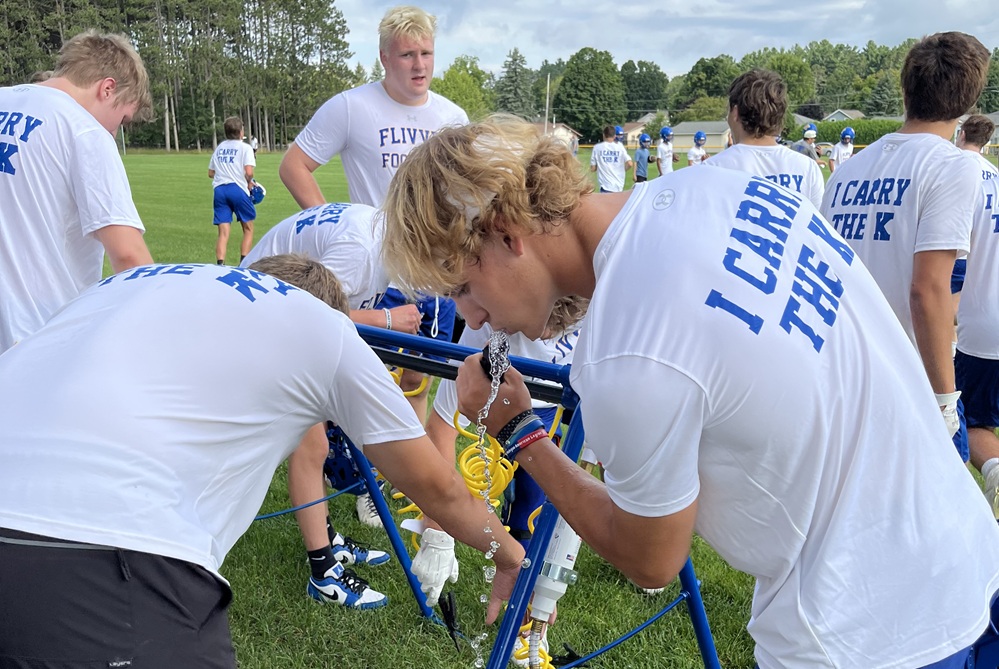
PHOTO Kingsford football players hydrate during last season's first day of practice. (Photo by Keith Dunlap.)