


Hoops, Hockey Prep for Playoff Changes
December 12, 2019
By Geoff Kimmerly
Second Half editor
The introduction of limited seeding at the District level for girls and boys basketball, and a shift in the postseason schedule for ice hockey, are among changes that will be noticed most this season by those who compete in and follow the 12 winter sports for which the Michigan High School Athletic Association sponsors postseason tournaments.
Girls basketball’s first games tipped off Dec. 2, followed by boys basketball openers Dec. 9. This winter, for the first time, the top two teams in every basketball District will be seeded and placed on the opposite sides of their bracket, making the District Final the earliest round they could play each other. Those top-seeded teams will be determined using the Michigan Power Ratings (MPR) computer formula based on regular-season results against other MHSAA Tournament-eligible teams and opponents’ strength of schedule. (Games against out-of-state or non-MHSAA opponents will not count in the MPR formula.)
The MHSAA will draw all brackets 15 days before the start of District play. After the top seeds are determined and separated to opposite sides of the bracket, the draw process will place the remaining teams on the bracket based on a randomly-selected order determined earlier in the season. MPR also was used to similarly seed Districts for boys soccer for the first time this past fall and in the spring for boys lacrosse.
Also undergoing a change this winter, the MHSAA Ice Hockey Tournament will be played over three weeks rather than two as in previous seasons. The traditional dates for the start of the regular season and Finals will remain the same, as will the total number of regular-season games allowed. However, the MHSAA Tournament will begin on the third Monday before the Finals instead of two weeks before, and the extended postseason schedule places the maximum of six games that may be played from the start of Regionals through Finals over 20 days instead of the previous 13.
While those changes will affect tournament structures, a handful of others affecting daily competition will be particularly noticeable as well this winter:
• As with Lower Peninsula girls swimming & diving season in the fall, a pair of changes for LP boys and Upper Peninsula girls will take effect this winter. For swimmers, the definition of a legal finish has changed to include a competitor touching any part of the finish end of the lane, not just the touch pad. In diving, the degree of difficulty was adjusted for back and reverse somersaults to provide consistency with difficulty of other dives.
• In hockey, the allowed stick length for a non-goaltender has been extended to 65 inches with a blade no more than 12.5 inches long and between 2-3 inches high. The allowances for a goaltender’s stick also were adjusted – the widened portion up to 28 inches from the heel and to 3.5 inches in width, with a blade at maximum 15.5 inches in length. These changes were made to accommodate the greater average height of today’s athletes.
• In girls competitive cheer, non-braced static inversions will be allowed only with the following stipulations: the original base or spotter maintains constant contact with the flyer, prior to the static inverted position the flyer must originate from below shoulder level, and the inversion must dismount to the cheering surface, cradle, any waist-level position or a non-inverted stunt at shoulder level. Also, twists from inversions and inversions released to extended level are illegal.
• A new rule in wrestling will allow for additional time to evaluate head and neck injuries. If an injury occurs involving the head, neck, cervical column and/or nervous system and an appropriate health care professional is present, that caregiver may request the traditional 90 seconds of injury time be extended up to a maximum of five minutes to evaluate the injury. Before that time expires, the wrestler must be ready and able to continue the match or it will be defaulted.
• Also for wrestling, a new criteria has been added to the tie-breaking system used when a dual meet finishes in a tied score. The new sixth criteria “f” states that the team giving up the fewest forfeits during a match shall be declared the winner.
The 2019-20 Winter campaign culminates with postseason tournaments beginning with Girls & Boys Skiing Regionals on Feb. 10, and wraps up with the Boys Basketball Finals on March 28. Here is a complete list of winter tournament dates:
Girls Basketball
Districts – March 2, 4 & 6
Regionals – March 10 & 12
Quarterfinals – March 17
Semifinals – March 19-20
Finals – March 21
Boys Basketball
Districts – March 9, 11 & 13
Regionals – March 16 & 18
Quarterfinals – March 24
Semifinals – March 26-27
Finals – March 28
Girls & Boys Bowling
Team Regionals – Feb. 28
Singles Regionals – Feb. 29
Team Finals – March 6
Singles Finals – March 7
Girls Competitive Cheer
Districts – Feb. 21-22
Regionals – Feb. 29
Finals: March 6-7
Girls Gymnastics
Regionals – March 7
Team Finals – March 13
Individual Finals – March 14
Ice Hockey
Regionals – Feb. 24-March 4
Quarterfinals – March 7
Semifinals – March 12-13
Finals – March 14
Girls and Boys Skiing
Regionals – Feb. 10-14
Finals – Feb. 24
Girls & Boys Swimming & Diving
U.P. Girls & Boys Finals – Feb. 15
L.P. Boys Diving Qualification Meets – March 5
L.P. Boys Finals – March 13-14
Wrestling
Team Districts – Feb. 12-13
Individual Districts – Feb. 15
Team Regionals – Feb. 19
Individual Regionals – Feb. 22
Team Quarterfinals – Feb. 28
Team Semifinals & Finals – Feb. 29
Individual Finals – March 6-7
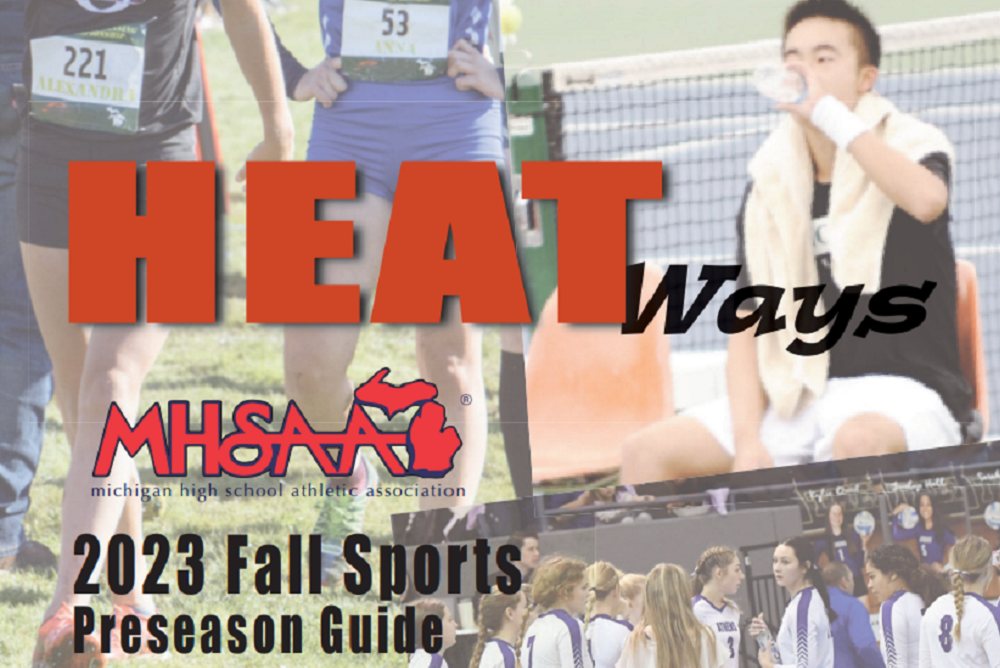
MHSAA Provides Heat Management Reminders in Advance of 2023 Fall Practices
By
Geoff Kimmerly
MHSAA.com senior editor
August 1, 2023
Temperatures reached record highs in some parts of Michigan at the start of this summer, and heat waves have made headlines nationally over the last month. Although the state didn’t experience similar extremes during July, the beginning of August always is a pertinent time for reminders that more hot weather is likely in many areas and should be prepared for as Michigan High School Athletic Association practices are set to begin Monday, Aug. 7.
Each year, the MHSAA provides information to its member schools to help them prepare for hot weather practice and game conditions during the late summer and early fall. Practices for all Fall 2023 sports – cross country, football, Lower Peninsula girls golf, boys soccer, Lower Peninsula girls swimming & diving, Lower Peninsula boys and Upper Peninsula girls tennis, and volleyball – may begin Monday, Aug. 7.
The “Health & Safety” page of the MHSAA Website has links to several information sources, including the MHSAA preseason publication Heat Ways, which is available for download and includes valuable information on heat management in addition to requirements and resources regarding head injuries and sudden cardiac arrest.
The first days of formal practices in hot weather should be more for heat acclimatization than the conditioning of athletes, and practices in such conditions need planning to become longer and more strenuous over a gradual progression of time. Schools also must consider moving practices to different locations or different times of day, or change practice plans to include different activities depending on the conditions. Furthermore, football practice rules allow for only helmets to be worn during the first two days, only shoulder pads to be added on the third and fourth days, and full pads to not be worn until the fifth day of team practice.
The MHSAA advises student-athletes to make sure to hydrate all day long – beginning before practice, continuing during and also after practice is done. Water and properly-formulated sports drinks are the best choices for hydration.
A number of member schools follow the MHSAA’s Model Policy for Managing Heat & Humidity, which while not mandated for member schools was adopted as a rule for MHSAA postseason competition in 2013. The plan directs schools to begin monitoring the heat index at the activity site once the air temperature reaches 80 degrees, and provides recommendations when the heat index reaches certain points, including ceasing activities when it rises above 104 degrees. (When the temperature is below 80 degrees, there is no combination of heat and humidity that will result in a need to curtail activity.) The model heat & humidity policy is outlined in a number of places on the MHSAA Website, including as part of Heat Ways.