

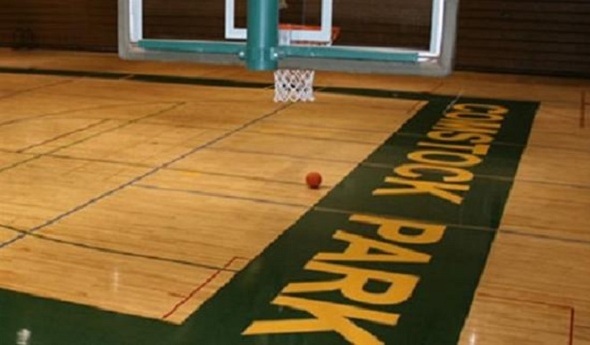
The House Gillette Helped Build
February 1, 2012
Maribeth Johnston’s description made it easy to imagine the bustling activity that was Janet Gillette’s Comstock Park athletic office for 20 years.
Gillette and her secretary’s desks, piled with shelves of labeled and color-coded binders. A wall-sized white board calendar marked with sports activities for the next two months. Floor to ceiling shelf units, labeled cubbies and a copy machine loaded with paper of various colors. Trophies on shelves awaiting their turn in the school’s display case.
And then there were the two most telling images of Gillette’s legacy during four decades as a part of Comstock Park schools. On other walls were hundreds of pictures of students, athletes, coaches and staff. And in the center of the athletic office were two large work tables, usually occupied by student volunteers stuffing envelopes, organizing and counting uniforms or taking any on other task to help out.
“Her attention to detail, service for others and devotion to make every event ‘special’ is what endears her to the people in our school system,” wrote Johnston, who recently finished her 24th season as the school’s volleyball coach, in a letter of recommendation for the MHSAA’s Women in Sports Leadership Award. “The athletic office is a wonderful place. But the person who makes it all happen is Jan Gillette.”
Gillette attended Comstock Park, came back as a teacher and coach, and retired in 2010 after spending her final 19 school years as athletic director. She is the 25th woman to be recognized with the WISL Award for exemplary leadership capabilities and positive contributions to athletics. The award will be presented during Sunday’s Women In Sports Leadership Conference banquet at the Lexington Lansing Hotel.
“One of my quotes that people always hear is there’s no greater privilege in life than to have an impact on a young person. I got to do that every day,” Gillette said. “And they impacted my life as well."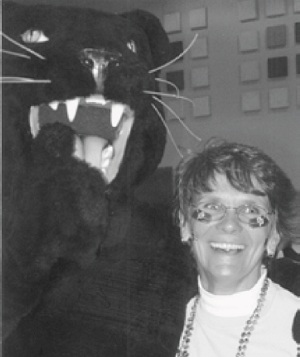
A 1973 graduate of Comstock Park, Gillette began coaching at the school just a year later. A four-sport athlete in high school, she eventually coached girls tennis, softball, volleyball and middle school basketball while also joining the district’s teaching staff in 1977 after attending Grand Rapids Community College and Grand Valley State (playing two sports at the former). Gillette then served as the high school athletic director beginning in 1990.
Under her leadership, Comstock Park served host to numerous MHSAA postseason tournaments, including 15 Lower Peninsula Track and Field Finals and multiple Girls Competitive Cheer Finals. Gillette also was active with the Michigan Interscholastic Athletic Administrators Association, serving as a presenter at numerous conferences and developing a coaches handbook.
“Few administrators have such a long record of hosting MHSAA Finals, evidence again of Janet Gillette’s drive to contribute not only at Comstock Park, but to high school sports on a larger scale,” said John E. “Jack” Roberts, executive director of the MHSAA. “Her involvement with female athletics dates back nearly to their inception. Jan’s impact will continue to be felt for years to come, and her contributions set a high standard for administrators in the future. We’re proud to honor her with the Women In Sports Leadership Award.”
Girls sports have evolved the most since Gillette first joined the athletic scene. Back then, seasons were only eight weeks, and volleyball, bowling and softball were not yet sponsored by the MHSAA. “To see what we have now, it’s just awesome,” Gillette said.
She is a member of the Comstock Park Athletic Hall of Fame, and has been recognized as Regional Athletic Director of the Year by the MIAAA, Athletic Director of the Year by the Michigan Competitive Cheer Coaches Association and the West Michigan Basketball-Football Association, and Comstock Park Employee of the Year in 2004. She also received the MHSAA’s Allen W. Bush Award in 2006 for her service to high school athletics.
In the community, Gillette has served as a coach in the Northwest Little League and been active with the Alpine Baptist Church as an AWANA Director and a Sunday School teacher.
“Mrs. G” hardly has disappeared from the school scene. She still manages the school’s volleyball tournaments and cheer invitationals, and the 250-person effort that makes the Division 3 Track and Field Final happen each spring.
She’s the first to credit all of those helpers, as well as the school boards, principals and superintendents who led the district during her career.
“I love Comstock Park. I love the community. I grew up there, and my dream was always to become a coach and a teacher,” Gillette said. “I didn’t want to do anything else because of the impact my teachers and the staff had on me, and the coaches.
“To go back to your own home town, what better could there be?”
Past Women In Sports Leadership Award recipients
1990 – Carol Seavoy, L’Anse
1991 – Diane Laffey, Harper Woods
1992 – Patricia Ashby, Scotts
1993 – Jo Lake, Grosse Pointe
1994 – Brenda Gatlin, Detroit
1995 – Jane Bennett, Ann Arbor
1996 – Cheryl Amos-Helmicki, Huntington Woods
1997 – Delores L. Elswick, Detroit
1998 – Karen S. Leinaar, Delton
1999 – Kathy McGee, Flint
2000 – Pat Richardson, Grass Lake
2001 – Suzanne Martin, East Lansing
2002 – Susan Barthold, Kentwood
2003 – Nancy Clark, Flint
2004 – Kathy Vruggink Westdorp, Grand Rapids
2005 – Barbara Redding, Capac
2006 – Melanie Miller, Lansing
2007 – Jan Sander, Warren Woods
2008 – Jane Bos, Grand Rapids
2009 – Gail Ganakas, Flint; Deb VanKuiken, Holly
2010 – Gina Mazzolini, Lansing
2011 – Ellen Pugh, West Branch; Patti Tibaldi, Traverse City
PHOTOS courtesy of Comstock Park High School.
Former Siena Heights Coach Kohn Excited for Next Phase as Lenawee Christian AD
By
Doug Donnelly
Special for MHSAA.com
June 3, 2026
When Matt Kohn found out that Siena Heights University was closing its doors at the end of the 2025-26 school year, he was on vacation at a southern Indiana campground with his family.
 He got out of the water, answered a call from one of the Siena Heights assistant coaches and was given the shocking news. Within minutes, he dried off and was packed and in his car, making the four-hour drive back to Adrian to meet with his coaching staff and players.
“I did it for my coaches,” Kohn said. “It was important for us to be on the same page and get together a game plan.”
Kohn, 44, is putting together a new game plan these days. The Adrian native began his new job this week as the athletic director at Adrian Lenawee Christian schools.
It’s a significant change from being head coach of the NAIA Saints, a position he held for the past decade. At Siena Heights, his football team typically had 120-130 players. Lenawee Christian, a Class D-size school, will have an enrollment of 114 this fall.
“It’s all relative,” Kohn said.
Instead of overseeing a team with 14 assistant coaches, he will lead an athletic program that has had incredible success over the years. Over the past decade, the Cougars have won two Division 4 girls basketball championships and three 8-Player football title. LCS won two Girls Volleyball Finals in the early 2000s, and the boys basketball program has 11 Regional titles and a Finals appearance since 1998.
The school takes tremendous pride in its athletic program and Kohn, who lives just minutes from campus, is excited to be a part of the LCS family.
“This is a great opportunity for myself and my family, and truly is done by God,” Kohn said. “Being able to stay home and continue into the next phase of my professional career is really all I could have asked for.”
Kohn finished out the school year at Siena Heights, helping find new schools for his remaining football players and new homes for his coaching staff.
“They made a commitment to me by coming to Siena Heights,” he said. “I felt it was important that I remained committed to them.”
As the end of the school year became closer and closer, however, he started searching for his next career move. He didn’t want to move out of the Adrian area but also knew he needed to find a job. When previous LCS athletic director Craig Anderson was promoted to principal, Kohn applied for the administrator position.
 “I have so many connections to LCS,” he said. “I couldn’t be more excited.”
While growing up in Adrian, his dad, Bill Kohn, was a head football coach at multiple schools in Lenawee County, including Morenci, Adrian – and Lenawee Christian.
On its campus on the west side of Adrian off US-223, LCS has what it calls The Centre, which offers fitness and training facilities, youth and adult sports leagues, an indoor pool and outdoor water recreation area. The Centre opened in 1988. Kohn said his parents would drop him off at The Centre when he was a kid to play sports. It’s where he developed his love for athletes.
Eventually he became a record-setting quarterback at Adrian High School and played in the Michigan High School Coaches Association East-West All-Star game. He went on to play quarterback at the University of Indianapolis and spent time with the Ohio Valley Greyhounds of the United Indoor Football Association and two seasons in the Arena Football League with the Nashville Kats and Kansas City Brigade.
He returned to the University of Indianapolis to coach for three seasons before returning to Adrian to join the fledgling Siena Heights football program. In 2016 he was named the interim head coach and took over the job full-time in 2017. Over 10 seasons overall, the Saints won 50 games and had just one sub-.500 finish. They were often ranked nationally and nearly made the NAIA playoffs a couple of times.
“I can honestly say I showed up to work every single day for 15 years, and I gave it everything I had,” Kohn said of being a college head football coach. “There's not a drop of me left that I did not spend in investing in my coaches and investing in my players and getting our guys ready for games and training them and recruiting. That program got every last drop of Matt Kohn. So, I don't have any regrets in that regard.”
Kohn is part of a bit of a transition at Lenawee Christian. The Cougars named a new varsity football coach this week, and with Anderson becoming principal, the school has also hired Noah Beaudrie, an Erie Mason graduate and former quarterback at Adrian College, as the assistant athletic director. Beaudrie comes from a family of athletes. His father is the football head coach at Monroe Jefferson, which had its best season in years last fall, and his sister won a Finals championship in track & field last weekend.
“I’m blessed to have someone like Noah by my side,” Kohn said.
Kohn said in his new role, he will bring his passion for developing student-athletes to the high school level.
“I'm coming into an incredible situation with incredibly strong team members,” he said. “That definitely motivates me every morning, to come to work and just get a little better every day because of the team I have around me.”
 Doug Donnelly has served as a news and sports reporter at the Adrian Daily Telegram and the Monroe News for 30 years, including 10 years as city editor in Monroe. He's written a book on high school basketball in Monroe County and compiles record books for various schools in southeast Michigan. He is now publisher and editor of The Blissfield Advance, a weekly newspaper. E-mail him at [email protected] with story ideas for Jackson, Washtenaw, Hillsdale, Lenawee and Monroe counties.
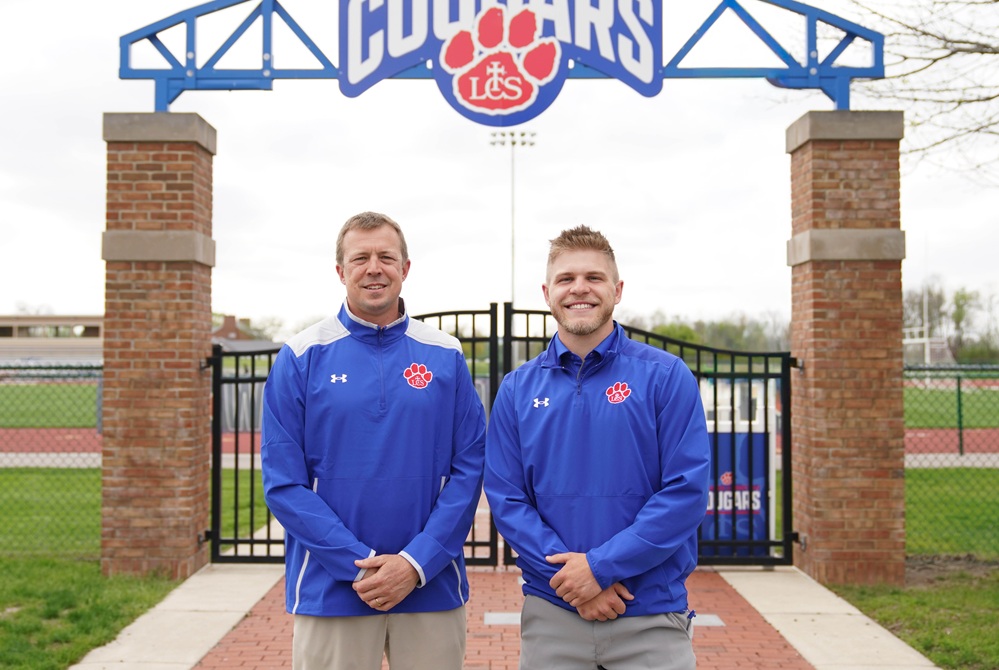
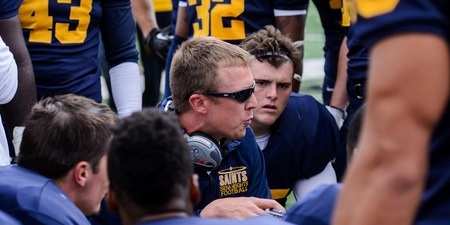
PHOTOS (Top) New Adrian Lenawee Christian athletic director Matt Kohn, left, and assistant Noah Beaudrie post for a photo in front of the school’s stadium gate. (Middle) Kohn huddles with his Siena Heights football team. (Top photo courtesy of Lenawee Christian Schools. Middle photo courtesy of the Siena Heights athletic program.)