

Inglis Finds Next Home at MHSAA
By
Geoff Kimmerly
MHSAA.com senior editor
December 4, 2013
The theme chosen by Portage Northern’s student section for its hockey Regional Final in 1989 was “Kings of the Ice,” and as such they wore Burger King crowns as a sign of the royalty their classmates soon would earn.
Just before team captain Cody Inglis accepted the championship trophy, he skated to his friends and was anointed as well as one placed a crown upon his head.
Golden cardboard and all, Inglis received his team’s prize and circled the ice.
Inglis returned home that night eager to discuss the highlights with his dad Bill, a former professional player and one-time coach of the NHL’s Buffalo Sabres. But there was only one thing Bill had to say – and it’s a principle that’s continued to guide Cody throughout his career in high school athletics.
“I was really looking for his input and congratulations, and he looked at me and said very succinctly, ‘There’s a right way and a wrong way to do things. And you chose the wrong way,’” Inglis remembered this week. “At the time, I couldn’t see it with the perspective of a 17-year-old kid. But now I look back on it as the most valuable life lesson I’ve ever gotten.
“I knew he was proud of me. But the lesson he was trying to impart on me was doing things the right way is much more important than winning.”
Inglis has been doing things the right way for two decades while serving first at Suttons Bay and then Traverse City Central High School. He’ll bring a winning list of achievements and wealth of knowledge when he joins the Michigan High School Athletic Association staff as an assistant director in January.
Inglis, 42, has served as athletic director and assistant principal at Traverse City Central since February 2008, taking over after 11 years as athletic director at Suttons Bay. He also has served as secretary for both the Big North and Northwest Conferences and for 13 years as the northern Lower Peninsula representative of 125 athletic directors for the Michigan Interscholastic Athletic Administrators Association.
Inglis will serve as the MHSAA’s director of ice hockey, girls and boys cross country, girls and boys golf, and girls and boys bowling. In addition, he will assist in the direction of girls and boys skiing and girls and boys track and field, and be in charge of the junior high and middle school committee. Inglis also will assist with the administration of the MHSAA’s Coaches Advancement Program and provide his expertise as an instructor.
“We had more than 100 candidates, including a half dozen of the finest ADs in America – not just Michigan. They couldn’t be any better,” MHSAA Executive Director John E. “Jack” Roberts said. “Cody’s selection was based in part on his being just a slightly better fit to the job description we had in mind.
“He’s had to do some tough things as an administrator. But he’s got a personality that causes people to rally around him.”
On the move
Inglis’ dad, Bill, spent 50 years in pro hockey, most of his final 20 as general manager of the Kalamazoo K-Wings, and Cody grew up in lockerrooms around future pros like Ron Hextall, Dirk Graham and Marty Turco. When the Toledo Goaldiggers won the IHL’s Turner Cup when Cody was in sixth grade, he got to carry the cup through downtown. The family moved 17 times, and prior to the stop in Kalamazoo, Cody had never lived anywhere longer than 2½ years.
Inglis graduated from Portage Northern High School in 1989 and went on to Hope College, where he earned a bachelor’s degree in physical education and his teaching certification. He also was the captain of Hope’s 1992 men’s cross country team and captain of the men’s track & field team in both 1992 and 1993, and earned academic All-America honors for cross country.
Given his ties to pro hockey, Inglis might have had an opportunity to follow his dad. But it wasn’t for him. After graduating from Hope, Inglis enrolled at Western Michigan University to study sports management. He went to class for one day and withdrew – his heart just wasn’t into it.
 Instead, Inglis hooked up with his Portage Northern cross country coach Bill Fries and found what he did want to do – coach, and in doing so, teach athletics.
The rest is northern Lower Peninsula history.
Inglis hooked on at Suttons Bay as a 23-year physical education teacher and head cross country and track & field coach, and two years later took over the athletic department.
“I was thrown into the fire right away, but I had a desire to be in sports somehow and coaching was a passion of mine,” Inglis said. “It was kinda sink or swim. I realized the craziness and hecticness of it, but it was something I embraced. I was lucky to have the opportunity to do it at Suttons Bay, to grow there and have people who were willing to let me make some mistakes, learn from my mistakes and become a better administrator.”
Inglis has supervised a group of more than 100 coaches while at Traverse City Central, plus a group of more than 20 teachers and staff as part of his assistant principal duties.
He’s managed more than 100 MHSAA Tournaments, including Ski Finals, Football Semifinals and Hockey Quarterfinals, and a variety of lower tournament levels for hockey, wrestling, track and field, cross country, basketball and golf.
His programs have achieved plentiful success under his leadership. Traverse City Central won the Big North Conference all-sport award every year from 2008-12 and earned six MHSAA Finals team championships during his tenure. The varsity programs have produced 34 academic all-state awards over the past three school years – including 14 in 2012-13 – and 62 percent of the student body was involved in athletics last school year.
While at Suttons Bay, Inglis led an athletic program that won the Northwest Conference sportsmanship trophy nine times and earned two MHSAA Finals championships. He also redeveloped athletic boosters programs, oversaw construction projects and was instrumental in the rewriting of athletic policies at both schools.
He was recognized in the spring with the MHSAA’s Allen W. Bush Award, which recognizes those who serve in high school athletics but do not always receive attention for their contributions.
Mentor to follow
Inglis was instrumental in the creation and later served as an assistant coach for the Traverse City Bay Reps ice hockey team, a co-operative headed by Traverse City St. Francis High School that’s now been in existence 15 seasons. He also was named Division 4 Girls Cross Country Coach of the Year in 2002 by the Michigan Interscholastic Track Coaches Association after leading his team to a runner-up finish at the MHSAA Finals.
Inglis coached a string of girls cross country teams that made the top 10 at MHSAA Finals five straight seasons, plus 25 all-state athletes in cross country and track and field including three individual MHSAA champions.
He has been a member of seven MHSAA sport committees, including for ice hockey. He’s been a frequent presenter at the MIAAA’s annual conferences, covering topics including fundraising, budgeting, organizing successful tournaments, balancing multiple roles and responsibilities, leadership and technology. He’s also taught MIAAA Leadership Training Courses.
Of little surprise, Inglis has been greatly impacted by growing up following his dad. While mother Jeris was the rock of the family, Bill was Cody’s idol and made a significant impact on the manager Inglis has become.
“My dad was so good at the way he treated people. I just saw how he treated them, whether it was the Zamboni drive or an assistant or secretary, he treated them with so much respect,” Inglis said. “That’s the part I’ve really taken from him, how he treated people and the relationships he made. How you treat people in athletics is so key; they’ll treat you the same way back, I’ve found most of the time.”
Inglis received minor degrees at Hope in business administration and communications, and has completed a number of courses toward a master’s in athletic administration from Ohio University.
He is married to Carrie (Ham) Inglis, an MHSAA Finals cross country individual champion for Big Rapids in 1987. They have three sons.
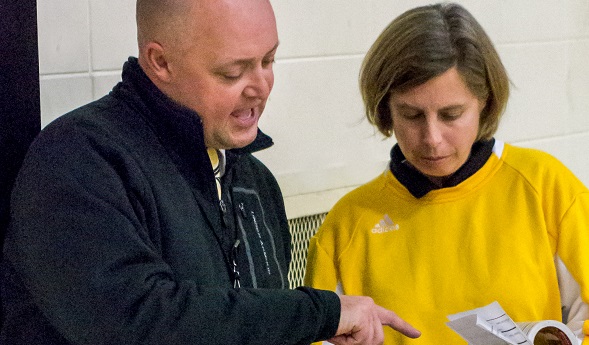
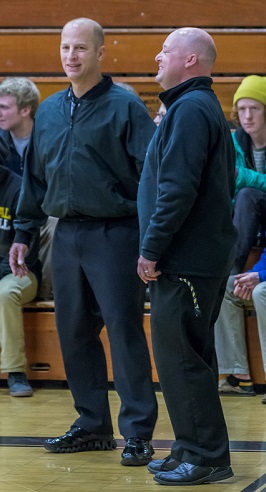
PHOTO: (Top) Traverse City Central athletic director Cody Inglis converses with a member of his staff Tuesday. (Middle) Inglis shares a laugh with an official before Tuesday's girls basketball games. (Photos courtesy of Rick Sack.)

Rep Council Wrap-Up: Spring 2016
May 13, 2016
By Geoff Kimmerly
Second Half editor
The Representative Council of the Michigan High School Athletic Association continued to create opportunities for participation in high school athletics during its annual Spring Meeting, May 1-2, in Glen Arbor, with a pair of actions designed to assist more schools in forming cooperative programs.
The Spring Meeting of the 19-member legislative body of the Association’s more than 1,400 member schools is generally the busiest of its three sessions each year. The Council considered 18 committee proposals and also dealt with a variety of eligibility rule, postseason tournament and operational issues.
Among proposals approved was a recommendation by the MHSAA Classification Committee designed to promote opportunities for schools demonstrating a long-standing lack of participation in baseball, bowling, competitive cheer, cross country, golf, soccer, softball, tennis and wrestling – provided those schools are part of the same public school district or fall under the same governing body. The new exception will allow, by Executive Committee approval, eligible schools to form cooperative programs regardless of enrollment limits placed on other schools and in other sports – currently, schools forming a co-op program in these sports must have an enrollment of fewer than 1,000 students.
The Council also voted to add opportunities for cooperative programs in all sports at the subvarsity level for schools showing a history of lack of participation. Again with Executive Committee approval, two or more member high schools may form a cooperative at the subvarsity level only regardless of student enrollment restrictions that would prevent the same cooperative at the varsity level. Students on these subvarsity cooperative teams would have varsity eligibility only with their school of actual enrollment should they be brought up to a varsity team.
The Council continued its work on health and safety that has been emphasized during the past seven years of an eight-year campaign focused on “4 H’s” – Health Histories, Heads, Heat and Hearts.
The Council approved enhancements to the MHSAA Physical Exam/Clearance/Consent Forms that in part include an annual requirement that students and parents acknowledge reading concussion education information. This enhancement is consistent with requirements of the Michigan Department of Health and Human Services.
A number of changes regarding rules meeting requirements for coaches beginning in 2017-18 also were authorized. Concussion education will be the focus of the meetings’ health and safety section every other year, with other health and safety topics (including overuse injuries, sudden cardiac arrest and heat illness) alternating in off years. High school assistant and subvarsity coaches will be required to complete the same rules/risk management meeting as high school varsity head coaches after previously having additional options by which to satisfy the requirement. At all levels, coaches will not be allowed to coach in the MHSAA tournament for that sport in that season if they do not comply with the rules meeting requirement.
For football, the Council approved a Football Committee recommendation stating that teams, after their first game, should partake in no more than 90 minutes of collision practice per week. Currently, teams are allowed two days of collision practice after their first game, but this new recommendation suggests a minute limit as well. During other days of practice, players still may wear helmets and other protective pads (although neither is mandatory) and practice blocking and tackling technique against pads, shields, sleds or dummies.
The Council also heard plans for the second year of the MHSAA’s sideline concussion testing pilot program and received a summary of the first meeting of the MHSAA Task Force on Multi-Sport Participation.
Here is a summary of other actions taken by the Representative Council at the Spring Meeting, which will take effect during the 2016-17 school year unless noted:
Handbook/Administrative Matters
• Out-of-season coaching rules were adjusted to allow teams of both genders playing the same sport to both host four-player skill group sessions with different coaches but at the same facility at the same time. Currently, only one four-player group in each sport, per school, can train at a facility at one time.
• Additional language regulating competition against out-of-state opponents prohibits MHSAA schools from participating in events involving teams from other states unless all of those teams at the event are bona fide school teams (not sports academy, club or community teams) and are members of their respective National Federation of State High School Associations (NFHS) member high school associations, if eligible.
Sport Matters
• In bowling, the number of athletes allowed on an MHSAA Regionals and Finals roster was reduced from eight to seven after past seasons showed the eighth bowler rarely was involved in competition. Teams may bowl up to five during competition and may still have up to two substitutes, but the roster reduction should reduce congestion in the competition area of bowling centers during events.
• In competitive cheer, the Council approved two committee recommendations intended to make uniforms more consistent for all teams: Beginning during the 2017-18 season, all hair bows must be one solid color and not include adornments; and beginning in 2019-20, all uniforms must be free from cutouts and adornments including sequins, rhinestones, studs, glitter, etc.
• For football, in addition to the collision practice recommendation, the Council voted to allow MHSAA staff to request permission from the National Federation to experiment with using a 40-second play clock for the 2016 season. If granted, individual schools, with agreement of opponents and/or their leagues, may request MHSAA permission to conduct a contest using this timing option. Teams automatically would have 40 seconds to snap the ball from the end of the previous play, rather than the current 25 seconds after the official sets the ball and signals for the play clock to begin. (If play has been stopped by a timeout or penalty, the offense still will have 25 seconds to snap from the time the referee sets the ball and starts the play clock.)
• In golf, the Council approved a committee recommendation to add a sixth Regional tournament for the Lower Peninsula for both girls and boys, allowing for three more teams and three more individual players to qualify for the Lower Peninsula Finals. In adding the sixth Regional, the Council also voted to eliminate Lower Peninsula Districts from the boys tournament, pursuant to the Golf Committee’s recommendation. However, while eliminating one round of play for the boys, the addition of another Regional for both boys and girls will bring the field to 108 players for each gender for the MHSAA championship rounds.
• In ice hockey, an additional option to MHSAA overtime procedures was approved that will allow teams playing a two-game total-goal series to proceed to an overtime shootout after the second game to determine a series winner if the total goals are tied at the end of the two games. Schools must receive MHSAA approval prior to the series start.
• In boys lacrosse, a tournament with eight Regionals advancing champions to four Quarterfinals was approved; the current bracket includes only four Regionals and advances those champions to Semifinals in each division.
• In volleyball, the Council approved an adjustment that standardizes where Class C and D Quarterfinals will be played when including one Upper Peninsula and one Lower Peninsula team. In even years, the Quarterfinal will be played in the Lower Peninsula for Class C and the Upper Peninsula for Class D. In odd years, Class C will be played in the Upper Peninsula and Class D in the Lower Peninsula.
The Council also reviewed reports on membership, with 755 senior high schools and 705 junior high/middle schools in 2015-16; eligibility advancement applications, which totaled five for the year; the use of Educational Transfer Forms, which again held steady this year; school violations, attendance at athletic director in-service workshops and Coaches Advancement Program sessions, officials’ registrations, rules meetings attendance and officials reports submitted for the past three sports seasons. The Association’s $10.7 million budget for the 2016-17 school year also was approved.
The Representative Council is the 19-member legislative body of the MHSAA. All but five are elected by member schools. Four members are appointed by the Council to facilitate representation of females and minorities, and the 19th position is occupied by the Superintendent of Public Instruction or designee.
The MHSAA is a private, not-for-profit corporation of voluntary membership by more than 1,400 public and private senior high schools and junior high/middle schools which exists to develop common rules for athletic eligibility and competition. No government funds or tax dollars support the MHSAA, which was the first such association nationally to not accept membership dues or tournament entry fees from schools. Member schools which enforce these rules are permitted to participate in MHSAA tournaments, which attract more than 1.4 million spectators each year.