

Inglis Finds Next Home at MHSAA
By
Geoff Kimmerly
MHSAA.com senior editor
December 4, 2013
The theme chosen by Portage Northern’s student section for its hockey Regional Final in 1989 was “Kings of the Ice,” and as such they wore Burger King crowns as a sign of the royalty their classmates soon would earn.
Just before team captain Cody Inglis accepted the championship trophy, he skated to his friends and was anointed as well as one placed a crown upon his head.
Golden cardboard and all, Inglis received his team’s prize and circled the ice.
Inglis returned home that night eager to discuss the highlights with his dad Bill, a former professional player and one-time coach of the NHL’s Buffalo Sabres. But there was only one thing Bill had to say – and it’s a principle that’s continued to guide Cody throughout his career in high school athletics.
“I was really looking for his input and congratulations, and he looked at me and said very succinctly, ‘There’s a right way and a wrong way to do things. And you chose the wrong way,’” Inglis remembered this week. “At the time, I couldn’t see it with the perspective of a 17-year-old kid. But now I look back on it as the most valuable life lesson I’ve ever gotten.
“I knew he was proud of me. But the lesson he was trying to impart on me was doing things the right way is much more important than winning.”
Inglis has been doing things the right way for two decades while serving first at Suttons Bay and then Traverse City Central High School. He’ll bring a winning list of achievements and wealth of knowledge when he joins the Michigan High School Athletic Association staff as an assistant director in January.
Inglis, 42, has served as athletic director and assistant principal at Traverse City Central since February 2008, taking over after 11 years as athletic director at Suttons Bay. He also has served as secretary for both the Big North and Northwest Conferences and for 13 years as the northern Lower Peninsula representative of 125 athletic directors for the Michigan Interscholastic Athletic Administrators Association.
Inglis will serve as the MHSAA’s director of ice hockey, girls and boys cross country, girls and boys golf, and girls and boys bowling. In addition, he will assist in the direction of girls and boys skiing and girls and boys track and field, and be in charge of the junior high and middle school committee. Inglis also will assist with the administration of the MHSAA’s Coaches Advancement Program and provide his expertise as an instructor.
“We had more than 100 candidates, including a half dozen of the finest ADs in America – not just Michigan. They couldn’t be any better,” MHSAA Executive Director John E. “Jack” Roberts said. “Cody’s selection was based in part on his being just a slightly better fit to the job description we had in mind.
“He’s had to do some tough things as an administrator. But he’s got a personality that causes people to rally around him.”
On the move
Inglis’ dad, Bill, spent 50 years in pro hockey, most of his final 20 as general manager of the Kalamazoo K-Wings, and Cody grew up in lockerrooms around future pros like Ron Hextall, Dirk Graham and Marty Turco. When the Toledo Goaldiggers won the IHL’s Turner Cup when Cody was in sixth grade, he got to carry the cup through downtown. The family moved 17 times, and prior to the stop in Kalamazoo, Cody had never lived anywhere longer than 2½ years.
Inglis graduated from Portage Northern High School in 1989 and went on to Hope College, where he earned a bachelor’s degree in physical education and his teaching certification. He also was the captain of Hope’s 1992 men’s cross country team and captain of the men’s track & field team in both 1992 and 1993, and earned academic All-America honors for cross country.
Given his ties to pro hockey, Inglis might have had an opportunity to follow his dad. But it wasn’t for him. After graduating from Hope, Inglis enrolled at Western Michigan University to study sports management. He went to class for one day and withdrew – his heart just wasn’t into it.
 Instead, Inglis hooked up with his Portage Northern cross country coach Bill Fries and found what he did want to do – coach, and in doing so, teach athletics.
The rest is northern Lower Peninsula history.
Inglis hooked on at Suttons Bay as a 23-year physical education teacher and head cross country and track & field coach, and two years later took over the athletic department.
“I was thrown into the fire right away, but I had a desire to be in sports somehow and coaching was a passion of mine,” Inglis said. “It was kinda sink or swim. I realized the craziness and hecticness of it, but it was something I embraced. I was lucky to have the opportunity to do it at Suttons Bay, to grow there and have people who were willing to let me make some mistakes, learn from my mistakes and become a better administrator.”
Inglis has supervised a group of more than 100 coaches while at Traverse City Central, plus a group of more than 20 teachers and staff as part of his assistant principal duties.
He’s managed more than 100 MHSAA Tournaments, including Ski Finals, Football Semifinals and Hockey Quarterfinals, and a variety of lower tournament levels for hockey, wrestling, track and field, cross country, basketball and golf.
His programs have achieved plentiful success under his leadership. Traverse City Central won the Big North Conference all-sport award every year from 2008-12 and earned six MHSAA Finals team championships during his tenure. The varsity programs have produced 34 academic all-state awards over the past three school years – including 14 in 2012-13 – and 62 percent of the student body was involved in athletics last school year.
While at Suttons Bay, Inglis led an athletic program that won the Northwest Conference sportsmanship trophy nine times and earned two MHSAA Finals championships. He also redeveloped athletic boosters programs, oversaw construction projects and was instrumental in the rewriting of athletic policies at both schools.
He was recognized in the spring with the MHSAA’s Allen W. Bush Award, which recognizes those who serve in high school athletics but do not always receive attention for their contributions.
Mentor to follow
Inglis was instrumental in the creation and later served as an assistant coach for the Traverse City Bay Reps ice hockey team, a co-operative headed by Traverse City St. Francis High School that’s now been in existence 15 seasons. He also was named Division 4 Girls Cross Country Coach of the Year in 2002 by the Michigan Interscholastic Track Coaches Association after leading his team to a runner-up finish at the MHSAA Finals.
Inglis coached a string of girls cross country teams that made the top 10 at MHSAA Finals five straight seasons, plus 25 all-state athletes in cross country and track and field including three individual MHSAA champions.
He has been a member of seven MHSAA sport committees, including for ice hockey. He’s been a frequent presenter at the MIAAA’s annual conferences, covering topics including fundraising, budgeting, organizing successful tournaments, balancing multiple roles and responsibilities, leadership and technology. He’s also taught MIAAA Leadership Training Courses.
Of little surprise, Inglis has been greatly impacted by growing up following his dad. While mother Jeris was the rock of the family, Bill was Cody’s idol and made a significant impact on the manager Inglis has become.
“My dad was so good at the way he treated people. I just saw how he treated them, whether it was the Zamboni drive or an assistant or secretary, he treated them with so much respect,” Inglis said. “That’s the part I’ve really taken from him, how he treated people and the relationships he made. How you treat people in athletics is so key; they’ll treat you the same way back, I’ve found most of the time.”
Inglis received minor degrees at Hope in business administration and communications, and has completed a number of courses toward a master’s in athletic administration from Ohio University.
He is married to Carrie (Ham) Inglis, an MHSAA Finals cross country individual champion for Big Rapids in 1987. They have three sons.
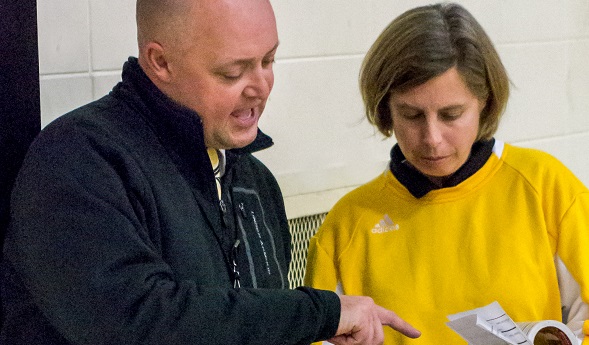
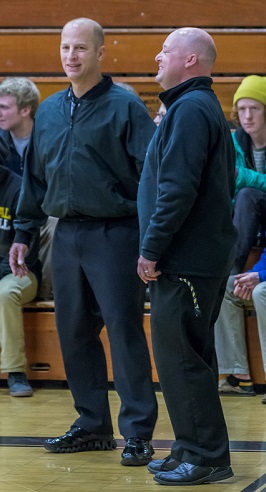
PHOTO: (Top) Traverse City Central athletic director Cody Inglis converses with a member of his staff Tuesday. (Middle) Inglis shares a laugh with an official before Tuesday's girls basketball games. (Photos courtesy of Rick Sack.)
Hice, Mazzolini Named Forsythe Winners
March 14, 2016
By Geoff Kimmerly
Second Half editor
Gary Hice's first job in education was as a study hall monitor. But he also got a chance to coach that year at Charlevoix, and that made all the difference.
"I don't know why I came to love it," Hice said of a career in high school athletics that didn't come to an end until nearly 40 years later. "That first job I had as study hall supervisor was not much fun. But I enjoyed working with kids ... and that spurred me to get into education. I think that's the most awesome animal on the face of the Earth, the high school student."
Gina Mazzolini, meanwhile, was a former high school and college star who came off the court as an athlete but returned almost immediately as a coach before rising to administrator with influence at the statewide and national levels – and a similar passion for giving back to the high school game.
“It’s one of those things where I’ve worked in this position because I loved doing it,” Mazzolini said. “I enjoyed working with the adult coaches and adult officials, and then the student-athletes."
Both have served Michigan high school student-athletes for more than 30 years in ways that will continue to impact schools and athletes for years to come.
In recognition of their efforts, they have been named the 2016 recipients of the Michigan High School Athletic Association’s Charles E. Forsythe Award.
The annual award is in its 39th year and named after former MHSAA Executive Director Charles E. Forsythe, the Association's first full-time and longest-serving chief executive. Forsythe Award recipients are selected each year by the MHSAA Representative Council, based on an individual's outstanding contribution to the interscholastic athletics community. Hice and Mazzolini will receive their honors during the break after the first quarter of the MHSAA Class A Boys Basketball Final on March 26 at the Breslin Student Events Center in East Lansing.
Hice retired in 2014 after 30 years as Petoskey’s athletic director overseeing one of the most successful programs in northern Michigan that regularly produced contenders for championships statewide. Under his leadership, Petoskey added five sports, revamped its facilities and became a founding member of the Big North Conference after Hice contributed to its creation.
Mazzolini has served the MHSAA since 1993 and is the administrator for girls volleyball, swimming and diving, alpine skiing and tennis. She also handles the sanctioning of out-of-state competitions and serves as the MHSAA’s point person on foreign exchange and international student issues. Mazzolini will receive a Citation from the National Federation of State High School Associations this summer and was the 2010 recipient of the MHSAA’s Women in Sports Leadership Award.
“Gary Hice and Gina Mazzolini have contributed to Michigan high school athletics on a variety of levels providing vision, leadership and dedication,” MHSAA Executive Director John E. “Jack” Roberts said. “Gary Hice served as a leader of leaders in northern Michigan and provided an example to be followed statewide, while Gina Mazzolini has shaped rules and policies that have impacted programs not only in our state, but nationally as well. We’re proud to honor Gary Hice and Gina Mazzolini with Forsythe Awards.”
 After his year at Charlevoix, Hice taught social studies and physical education and coached for one year at Petoskey before spending five years as director of parks and recreation and harbormaster for the City of Petoskey. He returned to the high school as athletic director in 1984.
During his tenure, Petoskey added girls golf, girls soccer, girls bowling, boys bowling and ice hockey programs. Petoskey teams won MHSAA Finals championships in boys skiing, girls skiing, wrestling, boys soccer and boys tennis, and the girls cross country and track and field teams were among those that earned runner-up finishes. The Petoskey girls ski team won four straight titles from 1991-94, and the boys ski team started a championship streak that last month reached six straight seasons. Hice also led the construction in 2000 of a $6-million gymnasium, weight room, wrestling practice area and indoor track at Petoskey High School, and initiated the school’s athletic Hall of Fame.
Hice is a member of both the Michigan Interscholastic Athletic Administrators Association and National Interscholastic Athletic Administrators Association. He was named state Athletic Director of the Year by the MIAAA in 2011 after receiving its George Lovich Award of Merit in 2008. He also was honored with the MHSAA’s Allen W. Bush Award in 2002 for his often-unseen contributions to high school athletics.
“When you’re in the heat of the battle, you don’t think on those terms,” Hice said of his many contributions and their lasting effects locally and beyond. “But toward the end of my career, I would relish the times when I could help young ADs, new ADs, people who didn’t have a lot of experience. In fact, I miss that today.”
Hice is a longtime member of Kiwanis Clubs, first of Petoskey and currently of Little Traverse Bay, and also has served with the Petoskey Education Foundation, Jeffrey P. Bodzick Memorial Scholarship Foundation and Beyond the Scoreboard initiative that promotes positive character and sportsmanship in northern Michigan’s youth and interscholastic athletics.
 After standout basketball and volleyball careers at St. Johns High School and Central Michigan University, Mazzolini taught and coached multiple sports during the 1979-80 school year at Ovid-Elsie High School. She then spent two years teaching and serving as an assistant volleyball coach at Michigan State University, where she also earned her master’s degree in physical education. Mazzolini then left to teach and serve as assistant volleyball coach and interim women’s Sports Information Director at the University of Texas.
In 1982, Mazzolini became an activities director with the University Interscholastic League, the service organization to high school activities in Texas. She became an assistant athletic director at the UIL in 1988, and five years later she returned to Michigan as a member of the MHSAA staff.
"To be recognized by my peers for this award … I’m appreciative and humbled," Mazzolini said. "You do those things because you enjoy them.”
In addition to her work at the MHSAA, Mazzolini has provided a long list of contributions at the national level. She has served as the NFHS representative on the board for the Council on Standards for International Educational Travel, which identifies, promotes and supports international youth exchange programs, and has sat on several CSIET committees. She’s currently serving on the NFHS Annual Meeting Planning Committee and also has served on NFHS rules committees for soccer, swimming and diving, and volleyball (chairing that sport’s rules committee from 2004-08), and on NFHS advisory committees for athletic directors and sports medicine.
She recently was inducted into the Michigan High School Ski Coaches Association Hall of Fame and has served as a voter for the Greater Lansing Sports Hall of Fame.
Mazzolini graduated from St. Johns High School in 1974 after an accomplished career that included leading the Redwings to a District title in the first MHSAA Girls Basketball Tournament in 1973. She went on to star in both basketball and volleyball at CMU; she graduated in 1978 as the leading scorer, rebounder and shot-blocker in CMU history and still ranks among the Chippewas’ leaders in multiple statistical categories. She was inducted into the CMU Athletic Hall of Fame in 1992.
Hice graduated from Ann Arbor Huron High School in 1970. He earned his bachelor’s degree at Eastern Michigan University in 1974 and his master’s at CMU in 1989, and received Certified Athletic Administrator certification from the NIAAA in 1994.
Past recipients
1978 - Brick Fowler, Port Huron; Paul Smarks, Warren
1979 - Earl Messner, Reed City; Howard Beatty, Saginaw
1980 - Max Carey, Freesoil
1981 - Steven Sluka, Grand Haven; Samuel Madden, Detroit
1982 - Ernest Buckholz, Mt. Clemens; T. Arthur Treloar, Petoskey
1983 - Leroy Dues, Detroit; Richard Maher, Sturgis
1984 - William Hart, Marquette; Donald Stamats, Caro
1985 - John Cotton, Farmington; Robert James, Warren
1986 - William Robinson, Detroit; Irving Soderland, Norway
1987 - Jack Streidl, Plainwell; Wayne Hellenga, Decatur
1988 - Jack Johnson, Dearborn; Alan Williams, North Adams
1989 - Walter Bazylewicz, Berkley; Dennis Kiley, Jackson
1990 - Webster Morrison, Pickford; Herbert Quade, Benton Harbor
1991 - Clifford Buckmaster, Petoskey; Donald Domke, Northville
1992 - William Maskill, Kalamazoo; Thomas G. McShannock, Muskegon
1993 - Roy A. Allen Jr., Detroit; John Duncan, Cedarville
1994 - Kermit Ambrose, Royal Oak
1995 - Bob Perry, Lowell
1996 - Charles H. Jones, Royal Oak
1997 - Michael A. Foster, Richland; Robert G. Grimes, Battle Creek
1998 - Lofton C. Greene, River Rouge; Joseph J. Todey, Essexville
1999 - Bernie Larson, Battle Creek
2000 - Blake Hagman, Kalamazoo; Jerry Cvengros, Escanaba
2001 - Norm Johnson, Bangor; George Lovich, Canton
2002 - John Fundukian, Novi
2003 - Ken Semelsberger, Port Huron
2004 - Marco Marcet, Frankenmuth
2005 - Jim Feldkamp, Troy
2006 - Dan McShannock, Midland; Dail Prucka, Monroe
2007 - Keith Eldred, Williamston; Tom Hickman, Spring Lake
2008 - Jamie Gent, Haslett; William Newkirk, Sanford-Meridian
2009 - Paul Ellinger, Cheboygan
2010 - Rudy Godefroidt, Hemlock; Mike Boyd, Waterford
2011 - Eric C. Federico, Trenton
2012 - Bill Mick, Midland
2013 - Jim Gilmore, Tecumseh; Dave Hutton, Grandville
2014 - Dan Flynn, Escanaba
2015 – Hugh Matson, Saginaw
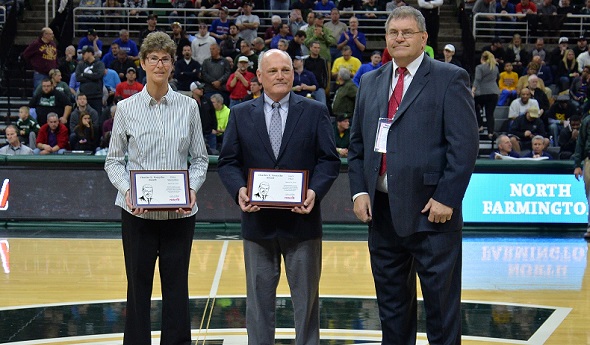
PHOTO: From left, Gina Mazzolini and Gary Hice receive Forsythe Awards on March 26 from Benton Harbor athletic director Fred Smith.