

March Magic Hoopfest Returns to MSU
March 17, 2014
By Geoff Kimmerly
Special to Second Half
March Magic Hoopfest will return to Jenison Field House for this weekend’s Michigan High School Athletic Association Boys Basketball Finals, marking the fifth championship weekend the event has run concurrent with the games being played at Michigan State University’s Breslin Center.
A number of favorite attractions will return including slam dunk (on lowered rims), 3-point shootout and full-court rainbow shot areas where fans can come at any time and participate. Also returning is the Walk of History, showcasing championship games, life-size photos and display boards from throughout the MHSAA Finals’ near century-long run. A large video screen will play a series of “Buzzer Beaters,” “Battle of the Fans” and other MHSAA-produced videos.
Two Hoopfest center courts will host a number of games throughout the event, including the “JumpBall Jamboree” made up of teams of boys and girls in grades 5-8, a wheelchair basketball tournament and a series between four Special Olympics Project UNIFY high school teams.
Admission to the March Magic Hoopfest is $2 per person, and fans attending the MHSAA Boys Basketball Semifinals and Finals will be admitted free with their game tickets. Hours on March 20 and 21 will be 2 p.m. to 7 p.m.; the event is open from 10 a.m. to 7 p.m. on March 22. Jenison Field House, site of Hoopfest, also was the site of the MHSAA Boys Basketball Finals for 31 years. To find out more general information about the event, visit the March Magic Hoopfest Website.
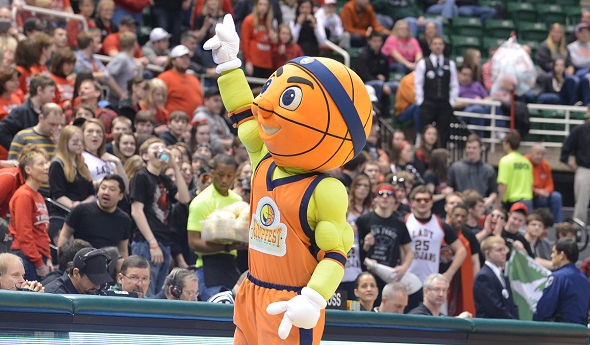
Hoopfest also will be home to Hoopie, the event’s mascot who made his first public appearances during the MHSAA Girls Basketball Finals. Click for video of Hoopfest’s newest volunteer as he helped prepare for this weekend’s event:
The March Magic Hoopfest is being conducted in a partnership between the Greater Lansing Sports Authority (GLSA), a division of the Greater Lansing Convention and Visitors Bureau; and the MHSAA, with vital support coming from the Department of Intercollegiate Athletics at Michigan State University.
“March Magic Hoopfest is a giant playground. There are opportunities for fun all over Jenison – and it’s a great way to spend an hour while waiting for the next round of games to start,” MHSAA Director of Brand Management Andy Frushour said. “All of us can remember reenacting games of our high school heroes. What better place to let kids do so now than across the street from Breslin Center in one of the most storied buildings in this state’s basketball history.”
The Greater Lansing Sports Authority’s mission is to be the leading voice of sports tourism in the Greater Lansing area and to promote economic growth by attracting a diverse range of sporting events to the region. The GLSA strives to enhance the quality of life for area residents through the development of local sports and fitness programs for all ages and supports the continued development and maintenance of safe, high-quality athletic facilities.
Hoopfest was not held at the 2013 Finals due to a Big Ten championship event being hosted by Jenison Field House.
"The GLSA is excited to partner with the MHSAA on the re-launch of March Magic Hoopfest," said Mike Price of the Greater Lansing Sports Authority. "While Hoopfest was absent in 2013, planning and improvement were ongoing. We are excited to showcase an improved Hoopfest that includes new games and activities, as well as the launch of our new mascot, Hoopie!”
PHOTO: Hoopie made his first public appearance during the weekend's MHSAA Girls Basketball Finals at the Breslin Center.
6 Schools Win First Titles in 2012-13
By
Geoff Kimmerly
MHSAA.com senior editor
June 24, 2013
A total of 101 schools won one or more of the 127 team Finals championships awarded by the Michigan High School Athletic Association during the 2012-13 school year – with six programs winning the first MHSAA team titles in any sport for their respective schools.
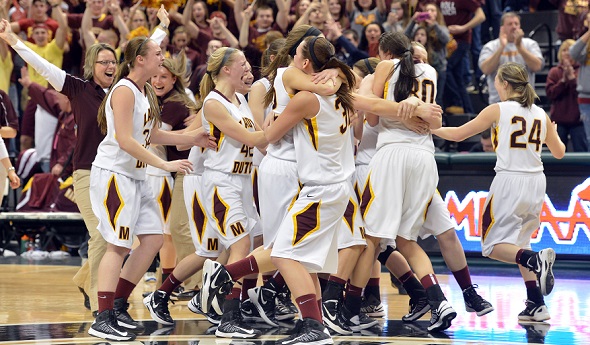
The Manchester girls basketball, Jackson Northwest girls bowling, Portland football, Harbor Beach football, Deckerville football and Hamtramck Frontier International boys soccer teams brought home the first MHSAA team championships in their schools’ histories.
A total of 33 teams won their first MHSAA titles. A total of 46 champions were repeat winners from 2011-12 – and 23 of those won for at least the third straight season. The Bloomfield Hills Brother Rice boys lacrosse team has the longest title streak of nine seasons, while the Battle Creek St. Philip volleyball team has won six straight titles for the second-longest streak overall and longest among girls programs.
Bloomfield Hills Cranbrook-Kingswood claimed the most championships, four, winning in Division 2 boys lacrosse, Lower Peninsula Division 3 girls swimming and diving, Lower Peninsula Division 3 girls tennis and Division 3 ice hockey. Four schools won three titles apiece: Grand Rapids Christian, Grand Rapids South Christian, Marquette and St. Ignace LaSalle.
Sixteen of the MHSAA's 28 championship tournaments are unified, involving teams from the Upper and Lower Peninsulas, while separate competition to determine titlists in both Peninsulas is conducted in remaining sports.
For a sport-by-sport listing of MHSAA champions for 2012-13 - Click Here (PDF)
The MHSAA is a private, not-for-profit corporation of voluntary membership by more than 1,500 public and private senior high schools and junior high/middle schools which exists to develop common rules for athletic eligibility and competition. No government funds or tax dollars support the MHSAA, which was the first such association nationally to not accept membership dues or tournament entry fees from schools. Member schools which enforce these rules are permitted to participate in MHSAA tournaments, which attract approximately 1.6 million spectators each year.
PHOTO: Manchester's girls basketball team celebrates the school's first MHSAA team championship in any sport this March at the Breslin Center. (Click to see more at HighSchoolsSportsScene.com.)