


MHSAA Provides Hot Weather Reminders
July 31, 2017
By Geoff Kimmerly
Second Half editor
As summer turns toward the beginning of fall sports practices next week, the MHSAA is providing a familiar but vital reminder that student-athletes need to prepare for activity in the hot weather that traditionally accompanies the beginning of August and the first training sessions of the school year.
Each year, the MHSAA provides information to its member schools to help them prepare for hot weather practice and game conditions during the late summer and early fall. Football practice can begin at MHSAA schools August 7, followed by first practices for all other fall sports August 9.
The topic of heat-related injuries receives a lot of attention at this time of year, especially when deaths at the professional, collegiate and interscholastic levels of sport occur, and especially since they are preventable in most cases with the proper precautions.
“We emphasize preparation for hot weather at the start of each fall, but this cannot be repeated enough: If we take precautions and plan as we should, heat illness is almost always preventable,” said John E. “Jack” Roberts, executive director of the MHSAA. “We encourage student-athletes to come to their first practice prepared for hot conditions. But coaches also are trained to assume not all student-athletes will be ready, and to be vigilant in making sure all participants are hydrating properly.”
A number of member schools continue to follow the MHSAA’s Model Policy for Managing Heat & Humidity, which while not mandated for member schools was adopted as a rule for MHSAA postseason competition in 2013. The plan directs schools to begin monitoring the heat index at the activity site once the air temperature reaches 80 degrees and provides recommendations when the heat index reaches certain points, including ceasing activities when it rises above 104 degrees.
The model heat & humidity policy is outlined in a number of places, including the publication Heat Ways, which is available for download from the MHSAA Website on the “Health & Safety” page.
To also assist in acclimatization, football practice rule changes adopted in 2014 allow for only helmets to be worn during the first two days, only shoulder pads to be added on the third and fourth days, and full pads to not be worn until the fifth day of team practice. The policy in detail can be found on the Football page of the MHSAA Website.
Heat, hydration and acclimatization continue to be focuses of the MHSAA’s required preseason rules meetings for coaches and officials. The online presentations discuss the need for good hydration in sports, regardless of the activity or time of year, and informs both how to recognize the early signs of heat illness and the immediate steps to take to respond to those symptoms. The MHSAA requires all head varsity, varsity assistant and subvarsity coaches at the high school level to complete the rules and risk minimization meeting requirement.
The first days of formal practices in hot weather should be more for heat acclimatization than the conditioning of athletes, Roberts reminded, and practices in such conditions need planning to become longer and more strenuous over a gradual progression of time. He noted that schools also must consider moving practices to different locations or different times of day, or change practice plans to include different activities depending on the conditions.
Roberts also noted that student-athletes should make sure to hydrate all day long – beginning before practice, continuing during and also after practice is done. Water and properly-formulated sports drinks are the best choices for hydration, while energy drinks, high-carbohydrate fruit juices (greater than eight percent carb content), carbonated and caffeinated beverages are among those that should be avoided.
The Health & Safety Resources page of the MHSAA Website has a number of links to various publications and information and a free online presentation on preventing heat illness from the National Federation of State High School Associations. Also accessible through the MHSAA Health & Safety page are resources from Sparrow Health System, a member of the Mayo Clinic Care Network, which lends expertise on-site at various MHSAA tournament events and provides an online “Ask the Experts” feature to connect MHSAA.com users with Sparrow sports medicine caregivers.
Visit MHSAA.com and click on "Health & Safety” in the top menu bar to find the information, or click the direct link provided above.
2023 Bush Award Honorees Groat, Albright, Show Dedication in Multiple Roles
By
Geoff Kimmerly
MHSAA.com senior editor
August 3, 2023
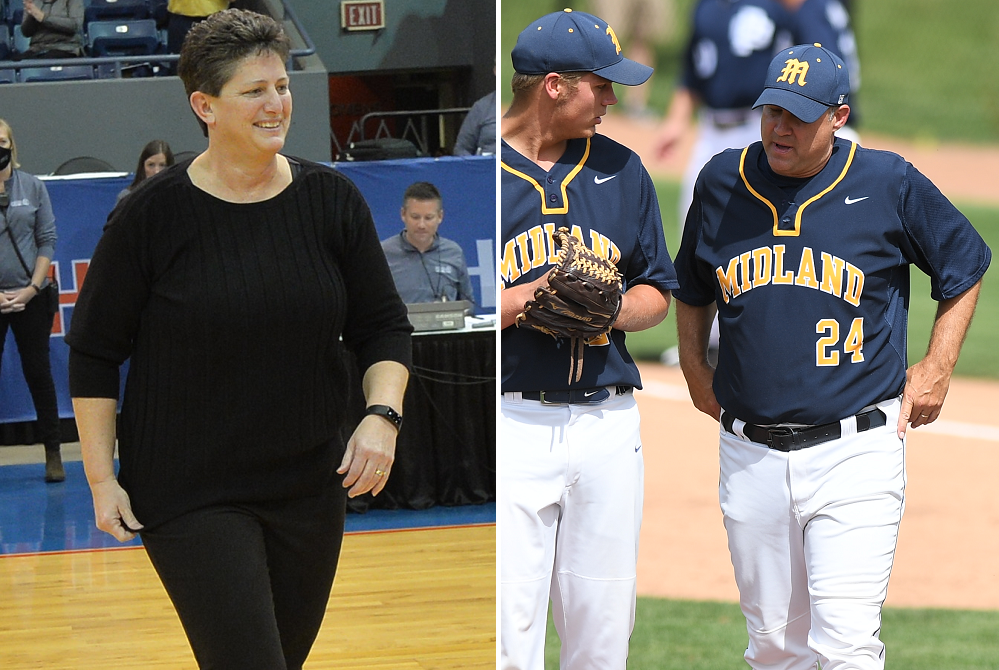
Battle Creek St. Philip’s Vicky Groat and Midland High’s Eric Albright both have devoted themselves to Michigan school sports for multiple decades – and both continue to lead as highly-successful coaches while also serving in multiple administrative roles within their schools and as important voices in statewide leadership as well.
To recognize their dedication and far-reaching contributions to educational athletics, Groat and Albright have been named recipients of the Michigan High School Athletic Association’s Allen W. Bush Award for 2023.
Al Bush served as executive director of the MHSAA for 10 years. The award honors individuals for past and continuing service to school athletics as a coach, administrator, official, trainer, doctor or member of the media. The award was developed to bring recognition to people who are giving and serving without a lot of attention. This is the 32nd year of the award.
Groat will enter this fall’s girls volleyball season with a career coaching record of 1,240-304-95, ranking seventh on the MHSAA coaching wins list for her sport. She took over for her mother, equally-legendary Sheila Guerra, for the 1997-98 winter season, stepped away briefly after her second year, and returned to lead the program again in 2000-01. Groat has guided the Tigers to 14 MHSAA Finals championships, including a record nine straight in Class D from Winter 2006-07 through Fall 2014 (volleyball moved to the fall with the 2007-08 school year), and most recently guided St. Philip to back-to-back Division 4 championships to cap the 2020 and 2021 seasons.
A 1985 graduate of the school, Groat is entering her 17th year as the athletic director and also took over as principal on an interim basis in December 2014 and then permanently to begin the 2016-17 school year. She previously had served as the school’s student services director and as an assistant principal. She also served on the MHSAA Representative Council from 2016-20 and is a longtime leader as part of the Michigan Interscholastic Volleyball Coaches Association (MIVCA).
Groat is a member of the Battle Creek St. Philip Athletic and MIVCA Halls of Fame. She was named Michigan High School Coaches Association volleyball Coach of the Year in 2009, and the national Coach of the Year for her sport by the National High School Athletic Coaches Association in 2021. She earned her bachelor's degree from Central Michigan University in 1989 and master’s from Fort Hays State University (Kan.) in 2019.
“Vicky Groat has established herself as one of the most accomplished volleyball coaches in the state and also wears multiple difficult hats so well as the athletic director and principal,” MHSAA Executive Director Mark Uyl said. “Her passion for St. Philip school and its students is evident at every turn, and her desire to help all students excel has been a great benefit to her school and throughout Michigan.”
Albright came to Michigan from Minnesota, graduating from Royalton High School in 1992 and then Hamline University with his bachelor’s degree in 1996. He began at Midland High as a teacher in 1997 and continued in the classroom through 2013-14, adding the varsity baseball coaching job in 2003 and building a 520-199 record over the last two decades while also leading the Chemics to seven league and four District titles and a Division 1 Semifinals appearance in 2018. He became the school’s athletic director in 2010 and serves as an assistant principal as well.
Midland has hosted various MHSAA postseason events under Albright’s direction, including Finals tennis, Semifinals in soccer and football and Quarterfinals for basketball, softball and volleyball. Albright has served on seven committees or task forces for the Association and as part of the Representative Council since 2019.
Albright also is beginning his tenure as president of the Michigan Interscholastic Athletic Administrators Association (MIAAA) and is a Leadership Training Course instructor for the National Interscholastic Athletic Administrators Association (NIAAA). He received a master’s degree from Central Michigan University in 2000 and earned a certified athletic administrator designation from the NIAAA in 2013. Albright also has been an MHSAA registered official in basketball and baseball over the last two decades, most recently in both sports since 2018-19. He worked as a professional baseball umpire in the Gulf Coast League during the 1997 season before beginning his tenure at Midland.
“Eric Albright is a leader in school-based athletics across Michigan with his work with the MIAAA and MHSAA, and he’s become a go-to person for other athletic directors statewide,” Uyl said. “He has worked tirelessly to provide a wealth of guidance and vision, continuously demonstrating his passion for educational athletics.”
PHOTOS Battle Creek St. Philip volleyball coach Vicky Groat steps on the court to receive her team's Division 4 championship trophy in 2021, and Midland's Eric Albright (far right) confers with his pitcher during the 2018 Division 1 Baseball Semifinals.