


MHSAA Provides Reopening Guidelines
May 29, 2020
By Geoff Kimmerly
Second Half editor
The Michigan High School Athletic Association today submitted to its member schools a series of updated timelines and recommendations to guide the return of sports, which have been suspended since mid-March to alleviate the potential spread of COVID-19.
The state’s current “Safer-at-Home” order runs through Friday, June 12. There can be no use of any school facilities (indoor and outdoor) and there can be no organized on-site athletic activity, including conditioning or competition, until the current stay-at-home order expires or is lifted by Governor Gretchen Whitmer. When the “Safer-at-Home” order expires or is lifted, the return-to-activity recommendations may be implemented locally by school district leadership, provided the district declares its facilities open to students and staff and the 2019-20 school year has ended for that district (based on its last originally-scheduled school day).
The “MHSAA/NFHS Guidance for Re-Opening School Sports” is based primarily on direction provided by the MHSAA and National Federation of State High School Associations’ (NFHS) Sports Medicine Advisory Committees, in addition to reopening plans provided by the Michigan and federal governments and recommendations from the Center for Disease Control and Prevention (CDC). Concepts from the United States Olympic & Paralympic Committee also were consulted.
The MHSAA/NFHS plan recommends a three-step process to returning to full athletic participation, and for each step outlines actions to be taken in five major areas: pre-workout/contest screening of athletes and coaches for sickness, limitations of the number of participants who may be involved in a gathering, proper cleaning for facilities, the use of equipment during activity and best practices for keeping participants safely hydrated. The plan also places sports into categories based on risk for transmitting the virus (low/moderate/high), with adjusted return-to-activity steps based on that level of risk.
The MHSAA serves more than 1,500 public and private schools, including 750 high schools.
“The MHSAA and its Representative Council believe restarting school sports is essential to the physical and mental well-being of students, and the guidelines outlined for schools today provide the ‘How’ for schools to return to athletics when they’ve received the go-ahead from state and county health officials,” MHSAA Executive Director Mark Uyl said. “We are thankful for our state government, state education and health departments, our medical partners and the NFHS for their guidance these last few months, and we will continue to follow and pass on their recommendations as we prepare our schools to bring back this part of student life that’s been sorely missed.”
At the present time, the only activity allowed continues to be individual, outdoor recreational activity including walking, hiking, running, etc. (as announced in Executive Order 2020-96). If this type of conditioning activity takes place with more than one person present, it must be in groups of fewer than 10 people with social distancing followed, and the activity cannot involve school coaches, be school sponsored or occur at any school facility (indoor or outdoor) until at least June 13.
Voluntary virtual (not in-person) communication and instruction from coaches to any number of students is permitted under MHSAA rules in all sports during the summer.
“The concept is that students can continue to individually condition themselves (by walking, hiking, running), but there should be no organized, group activity by any person until at least June 13. We must all continue do our part to flatten the curve in hopes of increased activity over the coming weeks,” Uyl said. “Again, it is important to note that this document addresses ‘How’ schools can return to activity; the decision on ‘When’ schools can return to activity will be done under the direction of state government and health department officials. As government actions impact this timeline, the MHSAA will continue to update all involved.”
The return-to-activity guidelines are aimed to provide direction for schools as they continue to limit potential exposure to respiratory droplets, the primary avenue for transferring COVID-19. Specifically, the MHSAA/NFHS plan addresses social distancing, use of cloth and other face coverings, event scheduling and transportation, and the possibility that schools may have to break from or completely discontinue activity including competition during the fall or winter because of recurrent outbreaks of the coronavirus.
School district administrators will determine at which step in the MHSAA/NFHS plan their schools are operating based on the number of people allowed to gather by state medical officials.
The document in full is available from the MHSAA Website. Further guidance will be provided over the weeks ahead as new information is available and the prevalence of COVID-19 changes. Updates to the MHSAA/NFHS guidelines will continue to be in accordance with those published by the Governor’s office.
The MHSAA has remained in regular contact with the Governor’s office, Michigan Department of Health & Human Services and Michigan Department of Education throughout the pandemic, in addition to leadership from the state’s superintendents, school principals, athletic administrators and school boards associations.
The MHSAA is a private, not-for-profit corporation of voluntary membership by more than 1,500 public and private senior high schools and junior high/middle schools which exists to develop common rules for athletic eligibility and competition. No government funds or tax dollars support the MHSAA, which was the first such association nationally to not accept membership dues or tournament entry fees from schools. Member schools which enforce these rules are permitted to participate in MHSAA tournaments, which attract more than 1.4 million spectators each year.
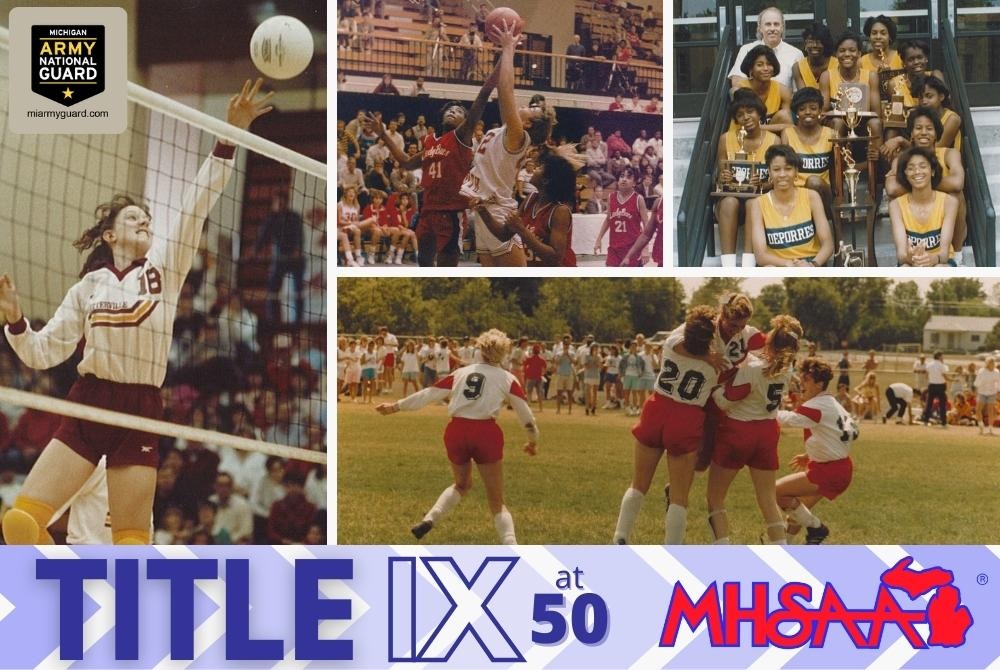
Title IX at 50: From Gymnastics to Wrestling, Girls Opportunities Continue to Grow
By
Geoff Kimmerly
MHSAA.com senior editor
June 7, 2022
Four teams will meet Saturday at Rockford high school to decide this season’s two MHSAA girls lacrosse champions, the 33rd and 34th titles winners since the sport gained MHSAA sponsorship beginning with the 2004-05 school year.
Lacrosse, for both girls and boys, is the most recently-added sponsored team sport among MHSAA offerings. The first girls sport to receive an MHSAA-sponsored postseason tournament was gymnastics, during the winter of the 1971-72 school year.
Below is a timeline detailing when every girls sport made its MHSAA postseason debut – including this winter’s Individual Wrestling Finals girls championship division. (Season played in parentheses.)
► 1971-72: Gymnastics (Winter)
► 1972-73: Golf (UP-Fall, LP-Spring), Swimming & Diving (Fall), Tennis (Fall), Track & Field (Spring)
► 1973-74: Basketball (Fall)
► 1974-75: Skiing (Winter), Softball (Spring)
► 1975-76: Volleyball (Winter)
► 1978-79: Cross Country (Fall)
► 1982-83: Soccer (Spring)
► 1993-94: Competitive Cheer (Winter)
► 2003-04: Bowling (Winter)
► 2004-05: Lacrosse (Spring)
► 2021-22: Wrestling Individual Finals (Winter)
Second Half's weekly Title IX Celebration posts are sponsored by Michigan Army National Guard.
Previous Title IX at 50 Spotlights
May 31: Mumford Sprinter's Magnificent 2006 Final Remains Unmatched - Read
May 24: Scane, Whiteside Alone on 400-Goal, 500-Point Girls Lacrosse Lists - Read
May 17: Over 8 Days in 1988, Pair of Champs Set No. 1 Singles Standard - Read
May 10: Portage Central's Tarpley Scores as State's Superstar, U.S. Soccer Hero - Read
May 3: Prychitko 'Legend In Her Own Time,' Legend for All Time - Read
April 26: Braddock vs. Verdun Still Striding Among All-Time Sprint Matchups - Read
April 19: Holmes' Strikeout Record Rarely Approached, May Be Unbreakable - Read
April 12: Anticipation High as 45,000 Girls Return to Spring Sports - Read
April 5: Regina's Laffey Retiring as Definition of Legendary - Read
March 29: Edison's Whitehorn named 2022 Miss Basketball - Read
March 22: Carney-Nadeau Sets Girls Hoops Standard with 78-Win Streak - Read
March 15: Binder Among Voices Telling Our Story on MHSAA Network - Read
March 8: 28 Years, Thousands of Cheers - Read
March 1: Kearsley Rolls On Among Girls Bowling's Early Successes - Read
Feb. 22: Marquette Ties Record for Swim & Dive Finals Success - Read
Feb. 15: Jaeger's 2004 Winter Run Created Lasting Connection - Read
Feb. 8: Marian's Cicerone to Finish Among All-Time Elite - Read
Feb. 1: WISL Award Honors Builders of State's Girls Sports Tradition - Read
Jan. 25: Decades Later, Edwards' Legend Continues to Grow - Read
Jan. 18: Iron Mountain Completes Championship Climb - Read
Jan. 11: Harrold's Achievement Heralds Growth of Girls Wrestling - Read
Dec. 20: Competitive Cheer Gives Michigan Plenty to Cheer About - Read
Dec. 14: Evelyn's Game Had Plenty of Magic - Read
Dec. 7: Council Term Ends, But Leinaar Leaves Lasting Impact - Read
Nov. 30: Basketball Season Ready to Add to Rich Tradition - Read
Nov. 23: Marysville Builds Winning Streak Yet to be Challenged - Read
Nov. 16: Wroubel Has Championed Girls School Sports from Their Start - Read
Nov. 9: Pioneer's Joyce Legendary in Michigan, National Swim History - Read
Nov. 2: Royal Oak's Finch Leading Way on Football Field - Read
Oct. 26: Coach Clegg Sets Championship Standard at Grand Blanc - Read
Oct. 19: Rockford Girls Set Pace, Hundreds After Have Continued to Chase - Read
Oct. 12: Bedford Volleyball Pioneer Continues Blazing Record-Setting Trail - Read
Oct. 5: Warner Paved Way to Legend Status with Record Rounds - Read
Sept. 28: Taylor Kennedy Gymnasts Earn Fame as 1st Champions - Read
Sept. 21: Portage Northern Star Byington Becomes Play-by-Play Pioneer - Read
Sept. 14: Guerra/Groat Legacy Continues to Serve St. Philip Well - Read
Sept. 7: Best-Ever Conversation Must Include Leland's Glass - Read
Aug. 31: We Will Celebrate Many Who Paved the Way - Read
PHOTOS (Clockwise from left) Potterville’s Kathy Gray reaches to make a play against Battle Creek St. Philip during the 1989 Lower Peninsula Class D Volleyball Final. Flint Beecher’s Carlotta Craven (41) and Frankenmuth’s Laura Butman (42) battle for a rebound during the 1987 Class B Final. The 1989 Detroit St. Martin dePorres track & field team shows its various trophies won during a run to the 1989 LP Class B title. Canton players celebrate their game-winning shootout goal against Livonia Churchill in the 1988 Class A Final. (MHSAA file photos.)