


MHSAA Survey Shows Lower Rate of ‘Pay-to-Play’ Fees Continued as Participation Rose in 2022-23
By
Geoff Kimmerly
MHSAA.com senior editor
July 27, 2023
Participation continued to bounce back at Michigan High School Athletic Association member schools during the 2022-23 school year, but the percentage of those schools charging fees to participate in sports was nearly unchanged for the third-straight year as it remained near its lowest rate of the last two decades.
Just 41 percent of MHSAA member schools charged participation fees during the 2022-23 school year, following 40 percent using them during 2021-22 and 41 percent in 2020-21.
The MHSAA participation fee survey has measured the prevalence of charging students to help fund interscholastic athletics annually since the 2003-04 school year. The percentage of member schools charging fees crossed 50 percent in 2010-11 and reached a high of 56.6 percent in 2013-14 before falling back to 50 percent or below. The survey showed 48 percent of member schools charged fees during 2019-20, the first school year affected by COVID-19, before the substantial reduction followed as programs continued to navigate the pandemic.
Of the 574 schools (77 percent of membership) which responded to the 2022-23 survey, 234 assessed a participation fee, while 340 did not during the past school year. For the purposes of the survey, a participation fee was anything $20 or more regardless of what the school called the charge (registration fee, insurance fee, etc.).
Class A schools, as in past years, made up the largest group charging fees, with 55 percent of respondents doing so. Class B and Class D schools followed, with 41 and 36 percent charging fees, respectively, and 30 percent of Class C schools also charged for participation.
Among schools assessing fees, a standardized fee for each team on which a student-athlete participates – regardless of the number of teams – has shown for a number of years to be the most popular method, with that rate unchanged in 2022-23 at 46 percent of schools with fees. Next again were 33 percent of assessing schools charging a one-time standardized fee per student-athlete, followed by 14 percent assessing fees based on tiers of the number of sports a student-athlete plays (for example, charging a larger fee for the first team and less for additional sports).
The amounts of participation fees have remained relatively consistent over the last decade. For 2022-23, the median annual maximum fee per student was again $150, although the median maximum fee per family increased slightly to $350 – up $50 from 2021-22. The median fee assessed by schools that charge student-athletes once per year was $120 for the second straight, and the median fee for schools that assess per team on which a student-athlete plays was $100, up from $75 in 2021-22.
The survey for 2022-23 and surveys from previous years can be found on the MHSAA Website.
As reported earlier this month, participation in MHSAA-sponsored sports continued to climb in 2022-23, up 2.7 more percent for a combined 9.9-percent increase over the last two school years. More on participation can be found here.
The MHSAA is a private, not-for-profit corporation of voluntary membership by more than 1,500 public and private senior high schools and junior high/middle schools which exists to develop common rules for athletic eligibility and competition. No government funds or tax dollars support the MHSAA, which was the first such association nationally to not accept membership dues or tournament entry fees from schools. Member schools which enforce these rules are permitted to participate in MHSAA tournaments, which attract more than 1.3 million spectators each year.
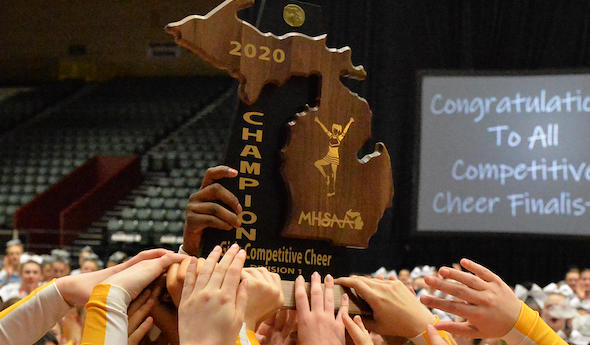
2019-20 Parade of Champions
By
Geoff Kimmerly
MHSAA.com senior editor
June 26, 2020
By Geoff Kimmerly
Second Half editor
A total of 58 schools won one or more of the 69 Michigan High School Athletic Association team championships awarded during the 2019-20 school year, with two teams winning three or more titles despite the cancellation of 62 MHSAA Finals due to COVID-19.
Marquette led with seven championships, winning its divisions in girls and boys skiing, girls and boys swimming & diving, girls and boys cross country and girls tennis. Grand Rapids Forest Hills Northern won the second-most titles, three, finishing first in its divisions in girls golf, boys tennis and boys soccer – the soccer championship its first in that sport.
Four more schools won two championships: Ann Arbor Pioneer, East Grand Rapids, Farmington Hills Mercy and Monroe St. Mary Catholic Central.
A total of 18 teams won first MHSAA titles in their respective sports, with Essexville Garber’s win in Division 3 girls bowling the school’s first Finals championship in any sport. A total of 23 champions were repeat winners from 2018-19 – and 11 of those won for at least the third straight season, while six extended title streaks to at least four consecutive years.
The Marquette boys skiing program owns the longest title streak at eight seasons, while Lowell wrestling joined Rockford girls lacrosse with a seventh consecutive championship. Rockford’s streak remains at seven after its season was canceled.
Sixteen of the MHSAA's 28 championship tournaments are unified, involving teams from the Upper and Lower Peninsulas, while separate competition to determine titlists in both Peninsulas is conducted in remaining sports. Because of COVID-19, the entire spring season was canceled as were Finals in girls and boys basketball, ice hockey, girls gymnastics and Lower Peninsula boys swimming & diving.
For a sport-by-sport listing of MHSAA champions for 2019-20, click here.
(NOTE: Included in the total of 58 schools above are both Zeeland East and West, which form the cooperative program that won the Division 1 girls bowling title. However, together they are counted as one of the 18 first-time championship teams.)