


Michigan Virtual University Teams with MHSAA
August 23, 2016
By Geoff Kimmerly
Second Half editor
Providing educational opportunities is central to the missions of both the Michigan High School Athletic Association and Michigan Virtual University. To promote its expansive opportunities for online education for Michigan high school students and educators, Michigan Virtual University will serve as the preferred provider of online education supporting MHSAA events and digital initiatives during the 2016-17 school year.
Michigan Virtual University is a nonprofit corporation established in 1998 to deliver online education and training opportunities to Michigan’s K-12 community and operates the Michigan Virtual School. Considered a national leader in providing online education, MVS has enrolled over 200,000 online courses in a broad range of core academic courses aligned with state standards, college-level equivalent courses; enrichment and world language courses, and other innovative online experiences. MVS is accredited by third-party AdvancED, meaning its instructors, tools, services and staff meet or exceed essential standards of educational quality.
MVS currently is working with 497 schools across Michigan to provide students more than 200 online courses, including 22 Advanced Placement courses and instruction in seven world languages. Like the MHSAA, MVS serves students grades 6-12.
“We focus on the whole child in educational athletics, and we see Michigan Virtual University as helping local schools broaden the academic offerings they can provide to students,” said John E. “Jack” Roberts, executive director of the MHSAA. “We help students compete in the local athletic arena; Michigan Virtual University helps students compete in the global classroom.”
Michigan Virtual School will have an on-site presence at MHSAA championship events throughout this school year and also digitally on MHSAA.com and in coordination with the MHSAA’s social media platforms. MVS also will receive air time as part of MHSAA video and radio programming.
MVS courses are designed to provide the same rigor as those students experience in a face-to-face classroom setting, while allowing students scheduling flexibility and the ability to work at their own pace. Core courses aligned with the Michigan Merit Curriculum (MMC) and the Common Core are available in English, math, science, social studies and world languages. Also, nearly 90 MVS courses are approved by the National Collegiate Athletic Association (NCAA), an additional value for student athletes seeking to secure eligibility at the college level.
"Increasingly, students involved with interscholastic athletics want and need school options that can be accessed outside the traditional school schedule,” Jamey Fitzpatrick, President & CEO of Michigan Virtual University, said. “We are excited about our new partnership with the MHSAA and look forward to helping more students and their parents learn about the value and potential of online learning options from MVU."
Michigan Virtual School is funded by the Michigan legislature and revenues from the courses it offers. Under current legislation students in grades 6-12 are allowed to take up to two courses per semester during the regular school year paid for by their schools, and students also may pay to take additional courses either during the school year or in the summer. Courses are developed by MVS or include content licensed from nationally-recognized providers.
Additionally, the MHSAA and MVU have agreed to explore possible areas of collaboration related to online and blended professional development for athletic directors, coaches, and other sports officials.
For additional information about Michigan Virtual University and Michigan Virtual School, go online to www.mivu.org.
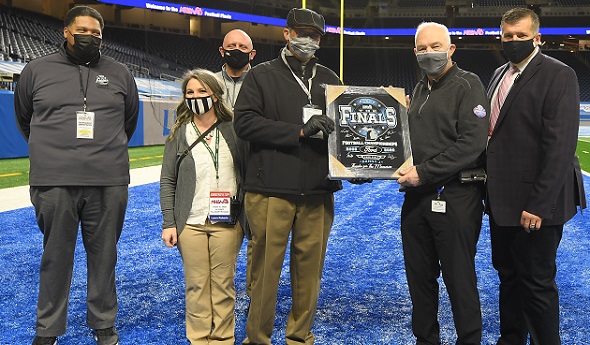
MHSAA Thanks Ford Field's 'Danny J'
January 28, 2021
By Geoff Kimmerly
Second Half editor
The MHSAA this past weekend celebrated and honored Dan Jaroshewich – known to many in the sports community as “Danny J” – who is retiring at senior director of sports events & business development after 48 years with the Detroit Lions organization, including many taking a significant role in MHSAA Finals played now at Ford Field.
Jaroshewich worked 30 years in the Detroit Lions equipment room before coordinating events at Ford Field over the last 18 years. He worked countless Lions home games going back to when they played at Tiger Stadium and then Pontiac Silverdome, and he also traveled with the team.
His passion and dedication for hosting events – including MHSAA events – will be missed, as he has been a staple at Ford Field since the stadium opened in 2002.
Jaroshewich was presented with a commemorative plaque during halftime of Friday’s Division 8 Final.
PHOTO: “Danny J” is recognized by the MHSAA this past weekend for his work hosting Football Finals at Ford Field. Second from right, Jaroshewich is pictured with, from left, MHSAA 11-Player Football Finals event staff Dante Favors, Laura Roberts and Mike Evoy, MHSAA assistant director Nate Hampton and MHSAA executive director Mark Uyl. (Photo by Hockey Weekly Action Photos.)