

Ottinger's 'Organ Game' a Slam Dunk
May 23, 2017
By Geoff Kimmerly
Second Half editor
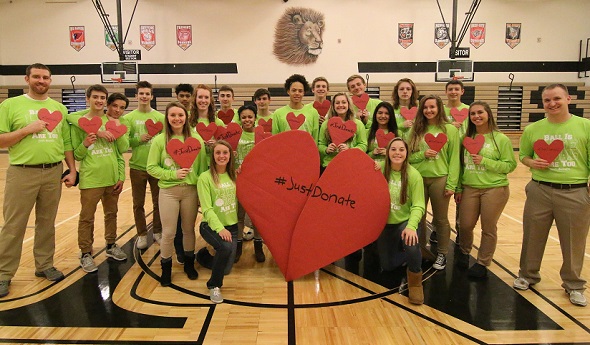
Every time Justice Ottinger sees one of the neon green T-shirts he designed on a student in the hallways at Newaygo High, he remembers fondly the “Ball Is Life, Organs Are Too” basketball game he planned this winter as an intern in the school’s athletic office.
 Much more frequently, the Lions’ senior gives thanks for the family friend who inspired the event by giving Ottinger a kidney last June.
Ottinger is a recipient of an MHSAA/Lake Trust Credit Union “Community Service Award” for his creation of the “Ball Is Life, Organs Are Too” event on Jan. 20 that raised more than $4,000 for Gift of Life Michigan and provided an opportunity for 13 people to register as organ donors.
As noted, the event started as an assignment from Newaygo athletic director Kristen Melvin to create and organize some sort of benefit game. It turned into an opportunity for Ottinger to not only spread the word about something that’s given him a better life, but also a chance to honor donor “Uncle” Tom Linsley for doing so.
“As soon as she said it, I said ‘organ game.’ There was nothing else. Organs mean so much,” Ottinger said. “There are a lot of people waiting for organs, and I don’t think people know the seriousness of this as much as they should. (I did it) just to get people to be aware of that, that organ transplants are a big deal, organ donation is a big deal, and I’m a believer everyone should be signed up to be organ donors.”
The Community Service Awards recognize contributions by Michigan’s high school student-athletes away from the field. Ottinger, a three-sport athlete, will user the $1,000 award as a scholarship toward his education at Cornerstone University, where he’ll begin studies toward his goal of becoming a doctor. Six honorees total are receiving awards this spring; Second Half is featuring one a day this week.
Just last weekend, Ottinger won Lower Peninsula Division 3 Regional championships in the 110 and 300-meter hurdles, advancing to next week’s MHSAA Track & Field Finals in both events. It was a performance that showed how much the kidney has affected him physically. His 15.43 time in the 110 race was a personal record and 1.4 seconds faster than his best all of last year. His 300 time of 41.38 was his second-fastest this spring and more than three seconds faster than his best in 2016. He’s undefeated in the 300 this season.
Compare that to a year ago, when Ottinger “was doing it, but not doing it very good. I was still putting forth my best effort, and stuff like that, but the closer I got to the transplant date, in basketball and track more I could tell. I’d fall asleep all the time,” he said.
“Once I had a transplant, it was the total opposite.”
Ottinger’s family knew he’s need a kidney transplant eventually since he was 2 years old. Although it was a slow process, his kidneys gradually lost their ability to function over the next 15 years; by last summer, they were down to functioning at only six perfect effectiveness.
 He was set to begin dialysis last summer when a donor was found – Linsley, who Justice affectionately calls “Uncle,” his dad’s best friend from when they attended Newaygo a generation ago.
Ottinger returned to play soccer in the fall and basketball in the winter, and set up his event for the Lions’ home game against Grant. Local businesses sponsored the event, and players and coaches wore the neon green shirts Ottinger designed. So did plenty of other people.
With Justice on the court, his mother Julie Long took over running the fundraiser during the game. But she had to get her son’s OK during warm-ups to order an additional 300 shirts – the first batch had sold out.
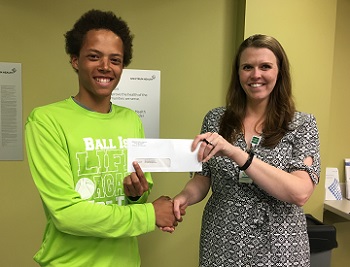
Gift of Life also sent a representative to sign up new donors on the spot, and Ottinger said the monetary donation will be used to help people who have had transplants pay hospital bills and for other costs that come with receiving a new organ.
He’s hopeful Newaygo will put on the event again next season, and Ottinger would like to do something similar at Cornerstone, where he’s set to join the track & field team.
His desire to become a doctor is boosted by what he’s experienced medically. But it’s rooted in something he’s already begun to fulfill.
“I’ve been in the hospital a lot, so I’d say that’s partially (the motivation),” Ottinger said. “But partially, I always have this urge to help people, make life better for people, and that’s driven me to do it too.”
The Community Service Awards are sponsored by the Michigan High School Athletic Association and Lake Trust Credit Union to recognize student-athletes' efforts to improve the lives of others in their communities. In addition to the $1,000 award, the Lake Trust Foundation is awarding an additional $500 to each honoree, to be donated to a non-profit, 501 (c)(3) organization of the awardee’s choice.
PHOTOS: (Top) Justice Ottinger (center of photo) and some of his many Newaygo supporters hold up #JustDonate hearts while wearing T-shirts he designed for his “Ball Is Life, Organs Are Too” event. (Middle) Ottinger presents a check to Gift of Life Michigan. (Photos courtesy of Justice Ottinger.)
2017 Community Service Awards
Sunday: Colon "Yard Squad" - Read
Monday: Bailey Brown, Brighton - Read

MHSAA Update Meeting Series Returns for 49th Year
By
Geoff Kimmerly
MHSAA.com senior editor
September 1, 2026
The Michigan High School Athletic Association will conduct its 49th annual Update Meeting series during September and October, and this year’s schedule will again offer in-service programming for athletic directors at six of the seven locations.
The Update series is annually attended by more than 800 school administrators. During the meetings, information about current MHSAA activities is disseminated, issues affecting interscholastic athletics are discussed and attendees are surveyed on various topics.
Six luncheon meetings are scheduled in the Lower Peninsula, and a morning meeting is scheduled for Marquette in the Upper Peninsula. MHSAA Executive Director Mark Uyl will address high school superintendents, principals, athletic directors and school board members on a variety of topics at these meetings. Update Meetings also provide school administrators an opportunity to ask questions and discuss any recent changes in the Association's rules and regulations.
This also will be the 24th year of Athletic Director In-Service programs conducted during morning-long sessions prior to most of the Update Meetings. These workshops are designed to help prepare those administrators for the rigors of their jobs, and with the Update Meetings offer those in attendance an opportunity to meet with administrators from neighboring school districts with whom they normally are not able to have day-to-day contact.
The meeting in Bath on Sept. 23 also will serve as the Annual Business Meeting for the MHSAA. The registration form for Athletic Director In-Service and Update Meetings is available on the Administrators page.
Here is a schedule of the 2026 Update Meetings:
• Sept. 8 – Radisson Plaza Hotel & Suites, Kalamazoo (Noon – Preceded by AD In-Service at 8:30 a.m.)
• Sept. 14 – Ukrainian Cultural Center, Warren (Noon – Preceded by AD In-Service at 8:30 a.m.)
• Sept. 21 – Prince Conference Center, Grand Rapids (Noon – Preceded by AD In-Service at 8:30 a.m.)
• Sept. 23 – Eagle Eye Banquet Center, Bath (Noon – Preceded by AD In-Service at 8:30 a.m.)
• Sept. 28 – Otsego Club & Resort, Gaylord (Noon – Preceded by AD In-Service at 8:30 a.m.)
• Sept. 30 – Zehnder's Restaurant, Frankenmuth (Noon – Preceded by AD In-Service at 8:30 a.m.)
• Oct. 16 – Northern Michigan University Superior Dome, Marquette (10 a.m.)
The MHSAA is a private, not-for-profit corporation of voluntary membership by more than 1,500 public and private senior high schools and junior high/middle schools which exists to develop common rules for athletic eligibility and competition. No government funds or tax dollars support the MHSAA, which was the first such association nationally to not accept membership dues or tournament entry fees from schools. Member schools which enforce these rules are permitted to participate in MHSAA tournaments, which attract more than 1.4 million spectators each year.