


Participation Again Bests Population Rank
August 11, 2016
By Geoff Kimmerly
Second Half editor
For the eighth straight year, Michigan ranked seventh nationally in high school sports participation, according to statistics for the 2015-16 school year released recently by the National Federation of State High School Associations. That level of participation continued to best Michigan’s national ranking for total number of residents of high school age, which remained ninth for the fourth consecutive year, and Michigan also again ranked ninth or higher in participation in 26 of 28 sports in which the Michigan High School Athletic Association conducts a postseason tournament.
Michigan’s participation ranking was based on a number of 295,436, with 126,160 girls and 169,276 boys taking part, and included sports in which the MHSAA does not conduct postseason tournaments. The totals count students once for each sport in which he or she participates, meaning students who are multiple-sport athletes are counted more than once.
The state’s girls participation remained seventh nationally for the fifth consecutive year, while the boys participation figure continued to rank sixth. According to the latest U.S. Census Bureau figures from 2015, Michigan ranks ninth in both females and males ages 14 through 17.
For the second straight year, 13 sports bested the state’s overall national participation ranking of seventh by placing sixth or higher on their respective lists. Six Michigan sports improved in national ranking during 2015-16, while three sports dropped one position.
Michigan girls bowling, girls tennis and girls and boys skiing all improved from fourth to third in national participation ranking, while wrestling improved to seventh and gymnastics one spot to 11th. Michigan also moved up to eighth, from 11th, for 8-player football participation – significant because the state’s 11-player football participation ranking didn’t fall with that increase, remaining at sixth nationally.
The three sports that fell in national rankings in 2015-16 still remained above population rank – competitive cheer from fifth to sixth nationally, girls track & field one spot to eighth and baseball also from seventh to eighth on its list.
The other Michigan sports that ranked sixth or higher all equaled their national rankings from 2014-15 and included boys basketball at sixth, boys bowling third, boys golf and girls golf both sixth, ice hockey fourth, boys tennis fifth and girls volleyball fourth. Other Michigan sports that equaled their 2014-15 national rankings were girls basketball at seventh, boys and girls cross country both also seventh, boys lacrosse eighth, girls lacrosse 13th, boys and girls soccer both ninth, softball seventh, boys swimming & diving ninth, girls swimming & diving 10th and boys track & field also seventh.
National participation in high school sports in 2015-16 set a record for the 27th consecutive year with 7,868,900 participants – an increase of 61,853 from the year before. After a decline the previous year, boys participation increased about 25,000 to an all-time high of 4,544,574, while girls participation increased for the 27th consecutive year with an additional 36,591 participants and set an all-time high of 3,324,326.
Track and field registered the largest increase in participants nationally for both boys and girls, with an additional 12,501 boys and 7,243 girls. Track and field ranked second to football in boys participants with 591,133, and remained the most popular sport for girls with 485,969 participants. In addition to track and field, six other top-10 girls sports registered increases nationally in 2015-16, including volleyball, soccer, softball, cross country, tennis and lacrosse. After track and field among the top 10 boys sports, soccer registered the largest gain with an additional 7,753 participants, followed by cross country (up 6,710), basketball (up 4,949) and baseball (up 2,248).
Football (1,083,308) remained the most-played high school sport overall and enjoyed an encouraging development. After a decline of nearly 10,000 participants in football the previous year, the number of boys playing 11-player football nationally in 2015 was almost identical to 2014 with a drop of just 309 from the 2014 total of 1,083,617.
Sailor Nation Works Together to Save Life
December 12, 2019
By Tom Kendra
Special for Second Half
Bob Mirkle calls it a miracle that he’s still alive.
 The 74-year-old Norton Shores resident had a brush with death Oct. 18 in front of 7,000 fans packed into Sailor Stadium for the blockbuster Muskegon at Mona Shores football game.
Just as the huge crowd stood for the national anthem, Mirkle was slumping back onto the bleachers from cardiac arrest, later identified as the failure of a heart stent which had been implanted 18 years ago.
“Something’s wrong with grandpa!” screamed his grandson, causing a ruckus in the Mona Shores reserved section, about 10 rows below the press box.
What transpired over the next 30 minutes was an incredible performance by the Mona Shores fans, coaches, media and entire community to save Mirkle’s life. It was a textbook reaction which was lauded by Norton Shores public safety officials – and the Mirkle family.
“We live in a great community,” said Cheryl Mirkle, Bob’s wife, who stayed home that night to babysit two of her grandchildren. “In a lot of other places, he wouldn’t have made it. We were told that 1 out of 9 people who have that situation happen don’t make it. So we believe it was nothing short of a miracle.”
The immediate family surrounding Mirkle – many of whom were at the game to support Shores starting junior linebacker Karsen Marihugh, Bob’s great-nephew, and two other family members who are cheerleaders – helped clear a small area in the packed stands and get Mirkle down flat on his back.
A woman sitting four rows back, who was well trained in cardio-pulmonary resuscitation, was able to clear Mirkle’s airway and immediately start chest compressions.
Mark Konecny, a Mona Shores assistant coach and part-time Norton Shores fireman, recognized what was going on and grabbed the automated external defibrillator (AED) on the sidelines and headed up into the stands. Konecny, who was an all-state quarterback for Shores in 1980 and went on to play two years in the NFL with Miami and Philadelphia, was able to connect the defibrillator and shock Mirkle’s heart back into action.
 Joe Kinnucan, who was in the press box about to go on the air with a Sailor Nation Sports Network broadcast of the game, threw down his headset and made a beeline for Mirkle, leaving his son Noah to make his unplanned broadcasting debut.
“There was no second thought,” explained Kinnucan, whose full-time job is Deputy Fire Chief for the Norton Shores Fire Department. “You ask any first responder who is truly vested in their work, and they will tell you that they are always on call. I was just happy to be able to help out.”
The huge crowd and both teams, who were wired for one of the state’s biggest regular-season prep football games of the year, briefly put aside the intense rivalry and went dead quiet out of respect. Shores public address announcer Dan Vandermyde even asked those in attendance to say a prayer as Mirkle was carried underneath the bleachers, where Konecny and Kinnucan and others continued working on him as the game began.
Cheryl Mirkle, meanwhile, who was at home and receiving cryptic, panicked phone calls and texts from friends and family, believed that her husband had died. That is until she got a call from her niece, screaming: “He’s breathing! He’s alive!”
Cheryl first saw her husband at Mercy Hospital in Muskegon where, like a true fan, the first words out of his mouth were: “What’s the score?”
The score of that night’s game was surprisingly one-sided: Muskegon 53, Mona Shores 0. Since that shocking night, both Mirkle and the Sailors have been on the recovery trail.
Mirkle underwent heart bypass surgery Oct. 23, five days after the game, and ended up spending 11 days in the hospital. He is back home and even mowed the lawn one day, and will start his therapy sessions this week.
“I’m doing great,” said Mirkle, a retired truck driver and devout fisherman. “I’m getting better and getting ready to start going to therapy. My story has a happy ending.”
As Mirkle was recovering, the Sailors and Big Reds were putting together long playoff runs, with both culminating Thanksgiving weekend in MHSAA Finals appearances at Ford Field in Detroit.
Muskegon’s run came to a disappointing end in a 30-7 loss to River Rouge in the Division 3 championship game.
Mona Shores, meanwhile, continued its magic run under diminutive junior quarterback Brady Rose, upsetting Detroit Martin Luther King, 35-26, in the Division 2 title game.
It capped an amazing rags-to-riches story for Mona Shores, which until recently had become synonymous with losing on the football field. Shores had only one winning season during a 14-year stretch from 1998 to 2012, but ended its playoff drought in 2013 and then made it all the way to the Division 2 championship game in both 2014 and 2018, before taking it all this time.
“We have waited all of these years for Shores to win some football games, and now it’s happening,” said Cheryl, who has been going to games with her husband since the late 1980s when their nephew, Sam Wakefield, was playing for the Sailors. “It really has been an amazing season in so many ways.”
At the community celebration at the school’s gym on Dec. 1, Mona Shores athletic director Todd Conrad praised the community for its support of the team and for rising up and raising funds to help defray the cost of travel en route to the championship.
It was actually the second time this season that the Mona Shores community responded quickly in a time of need.
“The saving of that man’s life was a textbook example of an entire community responding in the right way,” said Kinnucan. “People responded in a split-second with training which they had acquired somewhere along the line.
“Sure, we went on to win a state championship, which is incredible, but it still doesn’t top that moment and how everyone worked together to save his life.”
 Tom Kendra worked 23 years at The Muskegon Chronicle, including five as assistant sports editor and the final six as sports editor through 2011. E-mail him at [email protected] with story ideas for Muskegon, Oceana, Mason, Lake, Oceola, Mecosta and Newaygo counties.
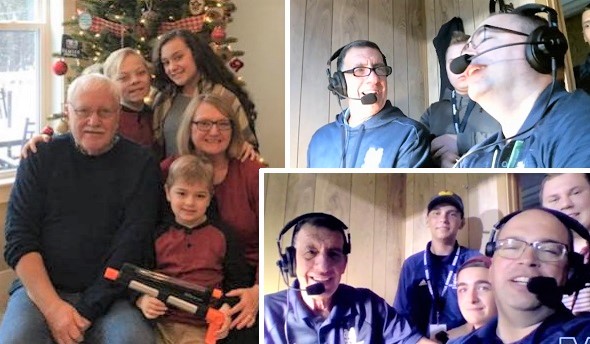
PHOTOS: (Top left) Bob and Cheryl Mirkle sit for a photo with their three grandchildren during Christmas 2017. (Top right) Joe Kinnucan, far right, returns to the press box Oct. 18 to share with play-by-play partner Nick Davros and their viewers that a man in the stands who was experiencing a cardiac event was “breathing and had a pulse.” (Top below) The Sailor Nation Sports Network crew, from left: Nick Davros, Noah Kinnucan, Connor Fritz, Joe Kinnucan and John Hall (with videographer Kimon Kotos on the roof). (Middle) Bob Mirkle. (Photos courtesy of Joe Kinnucan and Bob Mirkle, respectively.)