


Participation Again Bests Population Rank
August 11, 2016
By Geoff Kimmerly
Second Half editor
For the eighth straight year, Michigan ranked seventh nationally in high school sports participation, according to statistics for the 2015-16 school year released recently by the National Federation of State High School Associations. That level of participation continued to best Michigan’s national ranking for total number of residents of high school age, which remained ninth for the fourth consecutive year, and Michigan also again ranked ninth or higher in participation in 26 of 28 sports in which the Michigan High School Athletic Association conducts a postseason tournament.
Michigan’s participation ranking was based on a number of 295,436, with 126,160 girls and 169,276 boys taking part, and included sports in which the MHSAA does not conduct postseason tournaments. The totals count students once for each sport in which he or she participates, meaning students who are multiple-sport athletes are counted more than once.
The state’s girls participation remained seventh nationally for the fifth consecutive year, while the boys participation figure continued to rank sixth. According to the latest U.S. Census Bureau figures from 2015, Michigan ranks ninth in both females and males ages 14 through 17.
For the second straight year, 13 sports bested the state’s overall national participation ranking of seventh by placing sixth or higher on their respective lists. Six Michigan sports improved in national ranking during 2015-16, while three sports dropped one position.
Michigan girls bowling, girls tennis and girls and boys skiing all improved from fourth to third in national participation ranking, while wrestling improved to seventh and gymnastics one spot to 11th. Michigan also moved up to eighth, from 11th, for 8-player football participation – significant because the state’s 11-player football participation ranking didn’t fall with that increase, remaining at sixth nationally.
The three sports that fell in national rankings in 2015-16 still remained above population rank – competitive cheer from fifth to sixth nationally, girls track & field one spot to eighth and baseball also from seventh to eighth on its list.
The other Michigan sports that ranked sixth or higher all equaled their national rankings from 2014-15 and included boys basketball at sixth, boys bowling third, boys golf and girls golf both sixth, ice hockey fourth, boys tennis fifth and girls volleyball fourth. Other Michigan sports that equaled their 2014-15 national rankings were girls basketball at seventh, boys and girls cross country both also seventh, boys lacrosse eighth, girls lacrosse 13th, boys and girls soccer both ninth, softball seventh, boys swimming & diving ninth, girls swimming & diving 10th and boys track & field also seventh.
National participation in high school sports in 2015-16 set a record for the 27th consecutive year with 7,868,900 participants – an increase of 61,853 from the year before. After a decline the previous year, boys participation increased about 25,000 to an all-time high of 4,544,574, while girls participation increased for the 27th consecutive year with an additional 36,591 participants and set an all-time high of 3,324,326.
Track and field registered the largest increase in participants nationally for both boys and girls, with an additional 12,501 boys and 7,243 girls. Track and field ranked second to football in boys participants with 591,133, and remained the most popular sport for girls with 485,969 participants. In addition to track and field, six other top-10 girls sports registered increases nationally in 2015-16, including volleyball, soccer, softball, cross country, tennis and lacrosse. After track and field among the top 10 boys sports, soccer registered the largest gain with an additional 7,753 participants, followed by cross country (up 6,710), basketball (up 4,949) and baseball (up 2,248).
Football (1,083,308) remained the most-played high school sport overall and enjoyed an encouraging development. After a decline of nearly 10,000 participants in football the previous year, the number of boys playing 11-player football nationally in 2015 was almost identical to 2014 with a drop of just 309 from the 2014 total of 1,083,617.
Inman's 'Spirit' Recognized by NFHS
March 12, 2019
By John Gillis
Special from NFHS
Searra Inman, a student-athlete at Niles Brandywine High School, has been selected as the Section 4 recipient of the “National High School Spirit of Sport Award” by the National Federation of State High School Associations (NFHS).
The National High School Spirit of Sport Award was created by the NFHS to recognize those individuals who exemplify the ideals of the spirit of sport that represent the core mission of education-based athletics.
A soccer and wrestling participant during her athletic career at Brandywine High School, Inman’s life changed forever during the summer between her junior and senior years.
At that time, she was diligently preparing for her senior wrestling season. With 75 career victories to her credit, she had two goals – to achieve 100 victories and to earn a four-year varsity wrestling plaque.
On July 9, 2018, Inman was involved in a motorcycle crash that left her with a displaced vertebral fracture that severed her spinal cord and resulted in her being paralyzed from the waist down.
Inman underwent surgical procedures at Indiana University Health Methodist Hospital. Surgeons in Indianapolis used her as a case study due to the fact that almost no one with such severe spinal cord injuries had reached the operating table alive. Her initial prognosis was that she would remain hospitalized into January 2019.
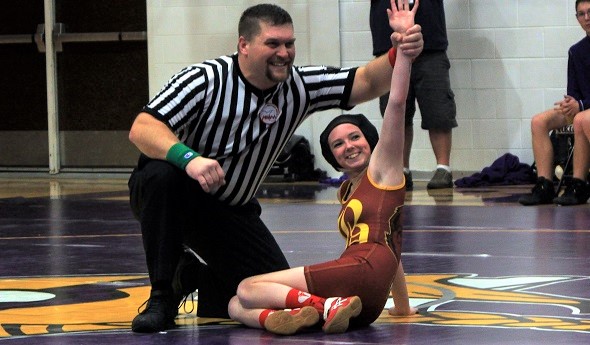
However, on Sept. 14, 2018, Inman led her school’s football team onto the field for its Week 4 game. Then, during Brandywine High School’s December 5th wrestling season opener with Bronson High School, Inman locked her wheelchair, crawled in uniform to the circle of the wrestling mat, and was awarded a forfeit win in the 103-pound weight class.
However, the best might have been saved for last when during a Feb. 12 Division 4 Regional match against Schoolcraft, Inman once again moved to the center of the mat, had her hand raised for another forfeit, and in the process, got victory No. 100 and accomplished her mission.
Click to read the Second Half report "In Her Fight, Inman Seeks to Provide Hope" published earlier this winter.
About the Award
The NFHS divides the nation into eight geographical sections. The states in Section 4 are Michigan, Wisconsin, Illinois, Indiana and Iowa.
Nominations for this award were generated through NFHS member state associations and reviewed by the NFHS Spirit of Sport Award Selection Committee composed of state association staff members.
While the national winner will be recognized June 29 at the NFHS Summer Meeting in Indianapolis, Indiana, the section winners will be recognized within their respective states and will receive awards before the end of the current school year.
PHOTO: Searra Inman has her arm raised in victory during a match this season. (Photo courtesy of the Niles Brandywine wrestling program.)