


Participation Again Bests Population Rank
August 11, 2016
By Geoff Kimmerly
Second Half editor
For the eighth straight year, Michigan ranked seventh nationally in high school sports participation, according to statistics for the 2015-16 school year released recently by the National Federation of State High School Associations. That level of participation continued to best Michigan’s national ranking for total number of residents of high school age, which remained ninth for the fourth consecutive year, and Michigan also again ranked ninth or higher in participation in 26 of 28 sports in which the Michigan High School Athletic Association conducts a postseason tournament.
Michigan’s participation ranking was based on a number of 295,436, with 126,160 girls and 169,276 boys taking part, and included sports in which the MHSAA does not conduct postseason tournaments. The totals count students once for each sport in which he or she participates, meaning students who are multiple-sport athletes are counted more than once.
The state’s girls participation remained seventh nationally for the fifth consecutive year, while the boys participation figure continued to rank sixth. According to the latest U.S. Census Bureau figures from 2015, Michigan ranks ninth in both females and males ages 14 through 17.
For the second straight year, 13 sports bested the state’s overall national participation ranking of seventh by placing sixth or higher on their respective lists. Six Michigan sports improved in national ranking during 2015-16, while three sports dropped one position.
Michigan girls bowling, girls tennis and girls and boys skiing all improved from fourth to third in national participation ranking, while wrestling improved to seventh and gymnastics one spot to 11th. Michigan also moved up to eighth, from 11th, for 8-player football participation – significant because the state’s 11-player football participation ranking didn’t fall with that increase, remaining at sixth nationally.
The three sports that fell in national rankings in 2015-16 still remained above population rank – competitive cheer from fifth to sixth nationally, girls track & field one spot to eighth and baseball also from seventh to eighth on its list.
The other Michigan sports that ranked sixth or higher all equaled their national rankings from 2014-15 and included boys basketball at sixth, boys bowling third, boys golf and girls golf both sixth, ice hockey fourth, boys tennis fifth and girls volleyball fourth. Other Michigan sports that equaled their 2014-15 national rankings were girls basketball at seventh, boys and girls cross country both also seventh, boys lacrosse eighth, girls lacrosse 13th, boys and girls soccer both ninth, softball seventh, boys swimming & diving ninth, girls swimming & diving 10th and boys track & field also seventh.
National participation in high school sports in 2015-16 set a record for the 27th consecutive year with 7,868,900 participants – an increase of 61,853 from the year before. After a decline the previous year, boys participation increased about 25,000 to an all-time high of 4,544,574, while girls participation increased for the 27th consecutive year with an additional 36,591 participants and set an all-time high of 3,324,326.
Track and field registered the largest increase in participants nationally for both boys and girls, with an additional 12,501 boys and 7,243 girls. Track and field ranked second to football in boys participants with 591,133, and remained the most popular sport for girls with 485,969 participants. In addition to track and field, six other top-10 girls sports registered increases nationally in 2015-16, including volleyball, soccer, softball, cross country, tennis and lacrosse. After track and field among the top 10 boys sports, soccer registered the largest gain with an additional 7,753 participants, followed by cross country (up 6,710), basketball (up 4,949) and baseball (up 2,248).
Football (1,083,308) remained the most-played high school sport overall and enjoyed an encouraging development. After a decline of nearly 10,000 participants in football the previous year, the number of boys playing 11-player football nationally in 2015 was almost identical to 2014 with a drop of just 309 from the 2014 total of 1,083,617.
'Yard Squad' Enjoys Unexpected Response
May 20, 2017
By Geoff Kimmerly
Second Half editor
The task itself was a simple one, and the reasons for doing it simple at first.
 An elderly woman called Colon High School – on the advice of her daughter, who teaches in the Upper Peninsula – looking for a student group that might be interested in assisting with some yard work.
Sophomore Andrew Smolarz, meanwhile, always is looking for community service hours to go toward membership in his school’s Varsity Club and National Honor Society chapter.
So he and four track & field teammates volunteered and spent a few hours picking up sticks, raking around her house and cleaning up brush. But they never anticipated the response.
“After the first time we did it, the reaction we got from people – it was more than just doing work for them,” Smolarz said. “When she saw us, the first lady said we’d restored her faith in the youth in the community. She got pretty teary-eyed, so it meant a lot to us, and she wanted a hug from all of us too.”
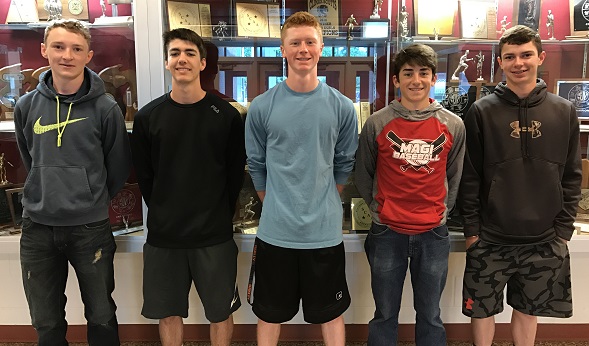
Since, Smolarz and his “Yard Squad” – sophomores Isaiah Fellers and Andy Stoll and freshmen Philip Alva and Austin Stoll – have taken their cleaning talents to two more homes, with three more and a restaurant also on the schedule.
Colon’s Yard Squad is a recipient of an inaugural MHSAA/Lake Trust Credit Union “Community Service Award” recognizing contributions by Michigan’s high school student-athletes away from the field. The Yard Squad will receive $1,000, which will go toward Colon’s athletic department and equipment for the track & field and baseball teams. Six honorees total are receiving awards this spring; Second Half will feature one a day this week.
While there are a multitude of ways to serve one’s community – over the next few days we will feature some incredibly impressive campaigns to raise money, awareness and donate goods to those in need – Colon’s Yard Squad found a way to help that students at any school can replicate, and to the same unexpected benefits.
That first call ended up on the ear of Colon athletic director Paige Smolarz – also Andrew’s mother and the school’s boys track & field coach – and when she offered the opportunity, these five underclassmen stepped up. It’s not that they don’t have other things going on; all five are dual sport athletes also playing baseball or golf, so clean-ups so far have come on Sundays adding up to about 15 hours total by each student with many more yet to be worked this spring.
Among others they’ve helped were a second elderly woman and her disabled husband, and a young couple where the wife is fighting cancer and the husband is working long shifts to support the family.
The village of Colon, tucked south of Kalamazoo and north of Sturgis, has roughly 1,200 residents, and word quickly gets around. The first woman helped by the Yard Squad told her friends, and there was some Facebook buzz as well. Smolarz said he and the “squad” are just a bunch of friends (and the Stolls are cousins) having fun working together to do something good.
“People think so much more of the little things you do for them than I actually thought (they would),” Andrew Smolarz said. “I just thought we’d go clean up, say thanks, and leave. But they thought so much more over it.
“It’s gotten a lot more fun in my opinion. The reaction is really cool to see on people’s faces. People just can’t believe we’d come out and do that for them.”
The Community Service Awards are sponsored by the Michigan High School Athletic Association and Lake Trust Credit Union to recognize student-athletes' efforts to improve the lives of others in their communities. In addition to the $1,000 award, the Lake Trust Foundation is awarding an additional $500 to each honoree, to be donated to a non-profit, 501 (c)(3) organization of the awardee’s choice.
PHOTO: Colon High School's "Yard Squad" from left: Isaiah Fellers, Andy Stoll, Andrew Smolarz, Phillip Alva and Austin Stoll. (Photo courtesy of the Colon athletic department.)