


Participation Remains Steady in 2018-19
July 18, 2019
By Geoff Kimmerly
Second Half editor
Michigan High School Athletic Association member schools continued to experience a decade-long decline in enrollment in 2018-19, and participation across 28 sports for which the MHSAA sponsors postseason tournaments also decreased slightly. However, while the drop in enrollment was 1.28 percent from the previous school year, participation fell only 1.03 percent as four sports repeated in setting records.
A total of 281,992 participants competed in MHSAA-sponsored sports this past school year. The overall MHSAA participation totals count students once for each sport in which they participate, meaning students who are multiple-sport athletes are counted more than once.
Boys participation fell 1.2 percent to 161,614, and for the first time in four years girls participation also decreased, by eight tenths of a percent to 120,378. However, both reductions were smaller than losses in enrollment of 1.36 percent for boys and 1.19 for girls. Since the 2008-09 school year, overall enrollment in MHSAA member high schools is down 12.8 percent. But during that time, overall participation in MHSAA-sponsored sports is down only 7.3 percent.
Girls lacrosse continued its run of setting a participation record every season since becoming a sponsored tournament sport in 2005, this spring with 3,180 participants – a 9.7-percent increase from a year ago. Boys lacrosse set a record for the third consecutive year, up 5.2 percent with 5,438 participants. Both boys and girls bowling also repeated in breaking participation records – boys bowling participation increased 4.7 percent over 2017-18 with 4,329 participants, while girls bowling was up 1.1 percent with 3,093 athletes. Boys cross country, with 9,588 athletes, just missed last year’s record-setting total but still saw its second-largest group of participants since totals first were tracked year-to-year in 1991-92.
Seven more sports saw increases in participation in 2018-19, boys skiing leading the way with 11.2-percent growth – its 6,284 athletes were the sport’s most since 2014-15 thanks with an increase of three tenths of a percent over a year ago. Girls and boys tennis both saw increases; girls 1.8 percent to 9,286 athletes, its most since 2011-12, and boys up 1.6 percent to 6,261 athletes, its most since 2014-15.
Girls swimming & diving was up 1.1 percent to 5,794 athletes, its most since 2013-14. Girls track & field had its highest number of participants since 2009-10 with 17,406, with an increase of seven tenths of a percent from last year. Wrestling increased a percent from 2017-18, to 9,494 athletes, ending two years of declines. Boys Golf was up three tenths of a percent to 6,284 athletes, ending three straight years of decreases.
While 17 sports saw decreases in participation, eight saw decreases by smaller percentages than the loss of enrollment: boys basketball (-1.2 percent), girls competitive cheer (-0.6), boys cross country (-0.7), girls gymnastics (-1.1), girls skiing (-0.5), boys soccer (-0.9), girls soccer (-0.1) and boys track & field (-0.1). Football, despite a decrease in participation of 4.3 percent, remains the most played sport by far with 35,412 participants. Boys track & field is second with 23,548, followed by boys basketball with 21,125. Girls volleyball, despite a 1.8-percent decline from a year ago, remains the most popular girls sport with 19,072 athletes.
The participation figures are gathered annually from MHSAA member schools to submit to the National Federation of State High School Associations for compiling of its national participation survey. Results of Michigan surveys from the 2000-01 school year to present may be viewed on the MHSAA Website.
The following chart shows participation figures for the 2018-19 school year from MHSAA member schools for sports in which the Association sponsors a postseason tournament:
|
BOYS |
GIRLS |
|||
|
Sport |
Schools (A) |
Participants |
Schools (A) |
Participants (B) |
|
Baseball |
639/9 |
17,211 |
- |
0/23 |
|
Basketball |
731/2 |
21,119 |
693 |
15,376/6 |
|
Bowling |
398/13 |
4,302 |
370 |
3,093/27 |
|
Competitive Cheer |
- |
- |
347 |
6,672 |
|
Cross Country |
634/0 |
9,588 |
619 |
8,144 |
|
Football - 11 player |
572/82 |
33,868 |
- |
0/94 |
|
8-player |
79/10 |
1,432 |
- |
0/18 |
|
Golf |
504/74 |
6,136 |
337 |
3,587/148 |
|
Gymnastics |
- |
- |
86 |
694 |
|
Ice Hockey |
242/10 |
3,282 |
- |
-/12 |
|
Lacrosse |
163/8 |
5,423 |
120 |
3,180/15 |
|
Skiing |
102/0 |
924 |
95 |
763 |
|
Soccer |
492/16 |
14,425 |
476 |
13,209/67 |
|
Softball |
- |
- |
628 |
13,290 |
|
Swimming & Diving |
248/18 |
4,968 |
262 |
5,794/35 |
|
Tennis |
290/17 |
6,221 |
330 |
9,286/40 |
|
Track & Field |
679/0 |
23,548 |
673 |
17,406 |
|
Volleyball |
- |
- |
713 |
19,072 |
|
Wrestling |
466/186 |
9,167 |
- |
-/327 |
(A) The first number is the number of schools reporting sponsorship on the Sports Participation Survey, including primary and secondary schools in cooperative programs as of May 15, 2019. The second number indicates the number of schools that had girls playing on teams consisting primarily of boys.
(B) The second number indicates the number of additional girls playing on teams consisting primarily of boys and entered in boys competition.
The MHSAA is a private, not-for-profit corporation of voluntary membership by more than 1,500 public and private senior high schools and junior high/middle schools which exists to develop common rules for athletic eligibility and competition. No government funds or tax dollars support the MHSAA, which was the first such association nationally to not accept membership dues or tournament entry fees from schools. Member schools which enforce these rules are permitted to participate in MHSAA tournaments, which attract more than 1.4 million spectators each year.
Brighton's Brown Brings Holiday Joy
May 22, 2017
By Geoff Kimmerly
Second Half editor
Bailey Brown will begin at Oakland University this fall with plenty to drive her through what at times will be grueling studies as she prepares for a career in pediatric medicine.
 As the oldest of six siblings, she’s always been around kids – and she loves it that way and looks forward to caring for them as their doctor. But sadly, though just a senior at Brighton, she’s already experienced her share of hospital life – although those tough times also provide motivation and inspired another mission as well.
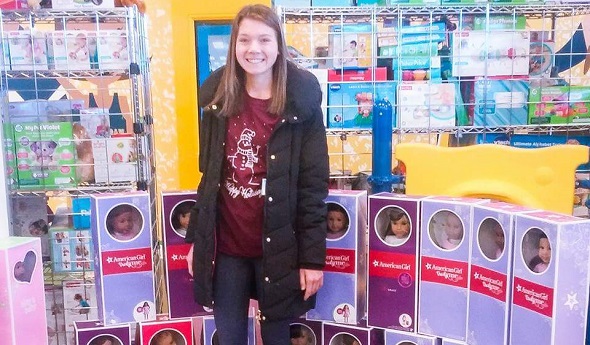
Brown ran across an advertisement this past winter in an American Girl catalog for dolls without hair – an amazing idea, she thought, because it allows children who have lost their hair during cancer treatment to have a doll that looks just like them.
She decided to raise enough money -- $230 – to buy two dolls for little girls spending Christmas in the hospital. Brown – a recipient of an inaugural MHSAA/Lake Trust Credit Union “Community Service Award” – ended up with more than $5,000 and an opportunity to play Santa Claus to many more thankful families.
“I couldn’t believe how fast things grew. It was hard to keep track of all the donations, but people were just messaging me on Facebook – I couldn’t believe people wanted to do that,” Brown said. “I never thought I’d be able to make such a big difference.”
The Community Service Awards recognize contributions by Michigan’s high school student-athletes away from the field. Brown, a cross country and track runner for the Bulldogs, will use her $1,000 award as a scholarship toward her education at Oakland, where she’ll be part of the Honors College. Six honorees total are receiving awards this spring; Second Half is featuring one a day this week.
 Since seventh grade, Brown has battled what was diagnosed her freshman year as amplified musculoskeletal pain syndrome – an abnormally overactive pain reflex that for Brown caused head-to-toe pain especially in her neck and back, making it difficult to sit and do school work. She also had to stop playing soccer completely and running for a time because of pain in her hips. As a junior, she was diagnosed with bone spurs and torn labrums in both hips, requiring multiple surgeries. As she worked to recover that winter, she had to enter treatment for anorexia after losing 25 percent of her body weight.
Despite those challenges, she managed to build a 3.88 grade-point average to rank among the top 15 percent in her graduating class. She also came back to continue running cross country and returned to the track this spring for the first time since eighth grade, while also participating in National Honor Society and her school’s Interact club.
As a doctor, Brown hopes to help children and teenagers who might be going through the same. Her service over the winter was aimed especially at children who would have to remain in the hospital over the holidays.
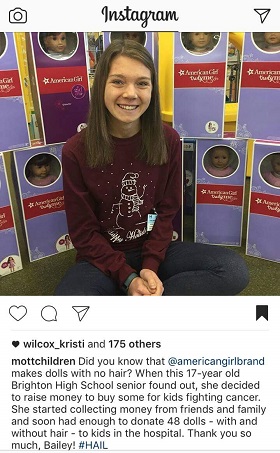
The outpouring of donations allowed her to affect many more families than she would’ve at first imagined – she was able to purchase 48 dolls plus hundreds of toys for little boys also undergoing cancer treatment. She delivered the dolls and toys to University of Michigan’s C.S. Mott Children’s Hospital, where she volunteered in the annual Mott Toy Shop that allows parents to pick up gifts for their children free of charge – saving money and time shopping “to make Christmas much easier and children a lot happier.”
Brown surely will be busy jumping into her first year of college, and she still fights pain although running and deep tissue massage alleviate some of it. But she said she’d like to start another campaign for hospitalized kids like the one that came off so successfully this past winter, maybe something even larger in scope.
“I am proud of everything I have accomplished despite my setbacks,” Brown wrote in her award application, “and look forward to touching even more lives this year.
“I have learned never give up, no matter how many obstacles are thrown my way.”
The Community Service Awards are sponsored by the Michigan High School Athletic Association and Lake Trust Credit Union to recognize student-athletes' efforts to improve the lives of others in their communities. In addition to the $1,000 award, the Lake Trust Foundation is awarding an additional $500 to each honoree, to be donated to a non-profit, 501 (c)(3) organization of the awardee’s choice.
PHOTO: (Top) Brighton’s Bailey Brown stands with some of her donation of toys to the C.S. Mott Children’s Hospital this past winter. (Middle) Brown is recognized by Mott on its Instagram feed. (Photos courtesy of Bailey Brown.)
2017 Community Service Awards
Sunday: Colon "Yard Squad" - Read