


Rep Council Wrap-Up: Fall 2014
December 11, 2014
By Geoff Kimmerly
Second Half editor
The promotion of junior high and middle school athletics and possibility of allowing younger students opportunities to compete in certain sports highlighted topics discussed by the Representative Council of the Michigan High School Athletic Association during its annual Fall Meeting on Dec. 5 in East Lansing.
Although no action was taken, the Council heard findings of the Junior High/Middle School task force created at the 2013 Fall Meeting to consider how the MHSAA should continue to encourage multi-sport experiences at that level and review the possibility of serving sixth-grade students in addition to those in the seventh and eighth grades.
The task force met four times during the 2014 calendar year. It provided support for longer quarters in basketball and football that were recommended by the MHSAA’s Junior High/Middle School Committee and approved by the Representative Council in March. The Junior High/Middle School Committee will consider another task force recommendation in January that would allow sixth graders to participate against seventh and eighth graders in all sports except football and ice hockey without seeking annual waivers from the MHSAA in order to do so. The Council could then review that recommendation when it reconvenes in March. Currently, the MHSAA serves 725 member schools at the 7th and 8th-grade level.
The Council also continued to examine the impact of increasing numbers of international students and additional rules approved in March to equalize the treatment of J-1 and F-1 visa students and standardize their opportunities at both public and non-public high schools.
A package of proposals adopted at the Council’s March 2014 meeting in part allowed for the MHSAA to approve school-operated international student placement programs if they were not listed by the Council on Standards for International Educational Travel (CSIET). The MHSAA for 2014-15 approved five such programs, with the notion that all programs would require CSIET approval moving forward. However, the Council will determine in March if the MHSAA will retain the ability to approve non-CSIET school-operated programs again in 2015-16.
An update also was provided on work to determine if rules regulating out-of-season coaching by school staff should be changed to allow those coaches more involvement with student-athletes out of season. MHSAA staff discussed possible changes with member school administrators at league meetings and then athletic director in-service and update meetings this fall and surveyed athletic directors on the desirability of potential changes in late October. The Council reviewed results of the survey and input from meetings and a schedule of upcoming discussions with coaches associations and league and conference leaders. Further Council discussion is slated for March with possible action during its final meeting of the school year in May.
The Council voted on two matters concerning MHSAA tournaments. E-cigarettes and other smoking devices were added to the list of substances prohibited at MHSAA tournament events. The Council also approved the opportunity for presentation of awards by a sport’s coaches association at MHSAA Finals for that sport so long as awards are to recognize students.
The Fall Meeting also saw the addition of Pat Watson, principal at West Bloomfield High School, to the 19-person Council. He was appointed to a two-year term and previously served as his school’s athletic director and coached baseball and girls and boys basketball. He fills the position formerly held by Carmen Kennedy, principal at St. Clair Shores South Lake High School, whose term ended. Also, Orlando Medina, athletic director at Harrison Township L’Anse Creuse High School, was reappointed for a second two-year term. Don Gustafson, superintendent of St. Ignace Area Schools, was appointed to the Upper Peninsula Athletic Committee for 2015.
The Council elected Scott Grimes, assistant superintendent of human services for Grand Haven Area Public Schools, as its president; Buchanan athletic director Fred Smith was elected vice president and Vic Michaels, director of physical education and athletics for the Archdiocese of Detroit, was elected secretary-treasurer. Grimes was elected to fill the position of recently-retired Negaunee Superintendent Jim Derocher, who had served as Council president since 2008. Grimes had served as vice president since 2009.
The Representative Council is the legislative body of the MHSAA. All but five members are elected by member schools. Four members are appointed by the Council to facilitate representation of females and minorities, and the 19th position is occupied by the Superintendent of Public Instruction or designee.
The MHSAA is a private, not-for-profit corporation of voluntary membership by more than 1,400 public and private senior high schools and junior high/middle schools which exists to develop common rules for athletic eligibility and competition. No government funds or tax dollars support the MHSAA, which was the first such association nationally to not accept membership dues or tournament entry fees from schools. Member schools which enforce these rules are permitted to participate in MHSAA tournaments, which attract more than 1.4 million spectators each year.
Parade of Champions 2015-16
By
Geoff Kimmerly
MHSAA.com senior editor
June 23, 2016
By Geoff Kimmerly
Second Half editor
Seven schools hoisted Michigan High School Athletic Association team championship trophies for the first time this school year, as 99 schools total won one or more of the 130 Finals championships awarded during 2015-16.
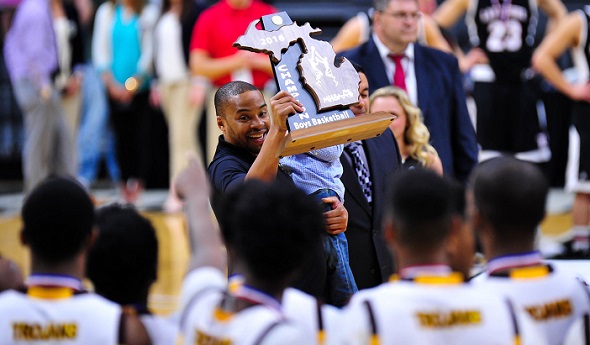
Teams earning the first MHSAA championship in any sport for their schools were Sterling Heights Parkway Christian in baseball, Detroit Henry Ford in boys basketball, Ypsilanti Arbor Prep in girls basketball, Tawas and Clarkston Everest Collegiate in boys golf, Burton Genesee Christian in boys soccer and Bloomfield Hills in boys tennis.
A total of 37 teams won their first MHSAA titles in their respective sports. A total of 50 champions were repeat winners from 2014-15 – and 25 of those won for at least the third straight season, up from 16 that accomplished the same feat a year ago. Still, championships were more spread out this school year; the 99 schools winning at least one title were nine more than in 2014-15.
The Birmingham Brother Rice boys lacrosse team has the longest title streak of 12 seasons, while the Ann Arbor Greenhills boys tennis team has won eight straight titles for the second-longest streak overall. The Gibraltar Carlson competitive cheer and Marquette girls track & field teams share the longest girls winning streaks with six straight championships apiece.
Marquette again claimed the most MHSAA team titles, six, winning in Division 1 boys skiing and Division 1 girls skiing, Upper Peninsula Division 1 girls cross country, Upper Peninsula boys swimming & diving, and Upper Peninsula Division 1 boys track & field and girls track & field. Ishpeming won five titles, and four more schools won at least three titles – Grand Rapids Forest Hills Central, Ithaca, Negaunee and Rockford (including the championship won by the combined Rockford/Sparta girls gymnastics team.)
Sixteen of the MHSAA's 28 championship tournaments are unified, involving teams from the Upper and Lower Peninsulas, while separate competition to determine titlists in both Peninsulas is conducted in remaining sports.
For a sport-by-sport listing of MHSAA champions for 2015-16 - Click Here (PDF)
PHOTO: Detroit Henry Ford boys basketball coach Kenneth Flowers hoists his team's Class B championship trophy this winter.